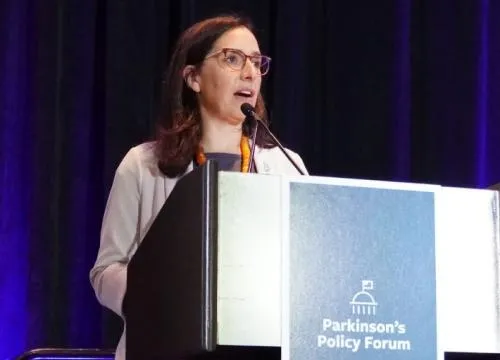
As a movement disorders specialist, one issue that people with Parkinson’s disease (PD) often bring up to Sneha Mantri, MD, during office visits is stigma. Stigma stems from stereotypes and lack of understanding that can lead to judgment, delayed diagnosis, isolation and feelings of shame for people with Parkinson’s and chronic diseases.
In our latest Neuro Talk, Dr. Mantri, Chief Medical Officer of the Parkinson’s Foundation, highlights the stigma that can accompany living with Parkinson’s and how it is being researched. Dr. Mantri and the Parkinson’s Foundation believe that combatting stigma through education, storytelling and awareness efforts can help the greater PD community. Dr. Mantri highlights what stigma looks like for people with PD, research findings surrounding stigma and ways to combat it.
What is stigma?
Stigma is when a person or group is judged or treated unfairly because of a negative belief or stereotype about them. Stigma is associated with stereotypes, prejudice, discrimination and exclusion. Experiencing stigma can significantly impact the lives of people living with Parkinson’s and care partners.
What does stigma look like for people with Parkinson’s?
Stigma around Parkinson’s often begins with misunderstanding. Stereotypes ignore the reality that people of all backgrounds — men and women — live with PD. Visible symptoms like tremors, freezing of gait or speech issues can be misread as intoxication or aging, rather than signs of a complex neurological condition. These reactions can be hurtful and isolating.
Many people with Parkinson’s internalize stigma, leading to delaying treatment, hiding symptoms or their diagnosis out of embarrassment or shame. In the workplace, stigma can fuel fear of being seen as less capable (learn more about employment with Parkinson’s). It can also show up as fear of becoming a burden to loved ones. Acknowledging these experiences is a critical step toward breaking down stigma.
Research Findings Surrounding PD and stigma
Stigma worsens quality of life for people with Parkinson’s. Researching stigma is critical, as bringing academic attention to the topic is critical to addressing it. Research has found that stigma:
Shapes the PD experience.
Contributes to social anxiety, isolation, hesitation to seek medical care, loneliness and emotional distress.
Misconceptions and bias lead to people with Parkinson’s being stereotyped, devalued or even avoided. This, and worsening symptoms over time, can lead to self-stigma, impacting self-esteem and depression.
Many people with Parkinson’s have experienced a form of stigma.
Stigma can take many forms. Felt stigma is when someone believes others see them negatively.
Care partners may experience affiliated stigma, facing bias because they are connected to a person with Parkinson’s.
For doctors and healthcare professionals, understanding stigma’s impact can help them respond with greater empathy and more proactive care strategies. This is crucial people with Parkinson’s and care partners, who often experience their own forms of stress and social isolation.
Ways to Combat Stigma
One of the most powerful ways to reduce stigma is through education and staying connected. The Parkinson’s Foundation works to share information about Parkinson’s to help spread awareness and knowledge, breaking down the misconceptions that fuel stigma. Explore Parkinson’s Foundation resources now.
“As a movement disorders specialist, I talk to patients about stigma. Research shows that practicing narrative medicine — using a patient’s story to guide care — helps their care team address the issues that matter most to them. This approach can strengthen independence and reduce stigma.” – Dr. Mantri
Personal stories (including My PD Stories), humanize Parkinson’s and highlight resilience. While community engagement — through events like Moving Day, support groups or exercise classes — helps people feel less alone and build connection.
Everyone can play a role in reducing stigma by knowing the signs of Parkinson’s, volunteering or sharing information to raise awareness.
Join the University of Southern California (USC), together with the Parkinson’s Foundation, for “Living Well with Parkinson’s Disease,” a free educational symposium for people with Parkinson's and care partners.
Hear from USC speakers about therapeutics, surgical updates, non-motor symptoms, and lifestyle in Parkinson's. There will be Q&A discussions after each panel conversation. Please submit your questions with your registration.
Attendance is free, but registration is required and seating is limited.
In partnership with Keck School of Medicine of University of Southern California Parkinson’s Disease and Movement Disorder Center, a Parkinson's Foundation Center of Excellence.
After living with Parkinson’s disease (PD) for 14 years, I find the most hope in connecting with people who are newly diagnosed. Which leads me to my own story with Parkinson’s.
Early on after being diagnosed, a series of kidney stones landed me in the hospital. Some of the nursing staff had no clue as to the importance of PD medication and wanted to take my medication away. I used the Parkinson’s Foundation Hospital Safety Guide to get medication management under control and have been connected to the Parkinson’s Foundation ever since.
Look for Bob and Deb in our new PSA aiming to help people find real answers to their Parkinson’s questions.
When I was diagnosed with Parkinson’s, my movement disorders specialist (MDS) told me that PD is not like falling off a cliff. ‘You don’t go from no symptoms to a plethora of symptoms overnight,’ he said. After that appointment, I realized that the way doctors deliver news can quickly impact my depression and mood from one day to the next. So began my committed efforts to better my own mental health with mindfulness.
Learning to cope with Parkinson’s is an active endeavor for me and Deb, my amazing wife and care partner. Since day one we have been committed to finding ways to get involved with the PD community. We quickly found Moving Day Chicago, where our team, Martini Shakers, blended humor with PD and allowed us to build a support network I never anticipated.
I was hesitant to share my diagnosis with everyone, but my friends and business associates supported me through Moving Day. We ended up hosting fun martini parties and raising $60,000 through our team, but what was most amazing was how people showed up and continued to spur my fight, after Moving Day.
The Power of Mindset
My mindset, mindfulness and support team, have shaped our experience with Parkinson’s.
I love to talk to people when they are first diagnosed because it’s so important to talk about mindset. Their mindset is going to change how they deal with Parkinson’s. The first opportunity to start healing from PD is at diagnosis. Being involved socially, being in support groups, all of it works hand in hand. I don’t think one works without the other.
When it comes to Parkinson’s, it seems like a lot people with Parkinson’s isolate themselves and that’s something they don’t need to do, especially when the Parkinson’s Foundation is there to support them.
The Parkinson’s Foundation Helpline (1-800-4PD-INFO) has always been there for me. It can be a support system and helps you find local resources such as exercise classes, support groups and events. They can also help you find a movement disorders specialist, which is essential to everyone with Parkinson’s.
Actively Managing Parkinson’s
My care team is an instrumental part of my support network. I go to Northwestern University Movement Disorders Center, a Parkinson’s Foundation Center of Excellence, where I feel I have some of the best care available.
I think everyone with PD should see a doctor who knows Parkinson’s. When I talk to people who are new to Parkinson’s, my first question is if they are seeing a neurologist or movement disorders specialist. That can make the difference, as these doctors know the medicine, therapies and what’s happening in PD research.
Over the years, my care team has guided me from medication adjustments to deep brain stimulation (DBS), which I recently underwent. DBS changed my life. The procedure is hard to promote to people, as being conscious for the procedure is tough, but I would do it again.
To keep a positive mindset and keep anxiety at bay, I also exercise and attend PD events. Parkinson’s means you have time to adjust your life as your disease progresses. If I gave in to all the stress that comes along with it, I feel I would progress quicker. I’m able to look at things through mindfulness.
Answering PD Questions & Advice
My questions about living with Parkinson’s have changed over the last 14 years. Those first few years I had a ton of questions, mostly for my neurologist: do I really need these medications? Are there other treatments? Can I work?
But over time, my questions morphed to What exercises help my symptoms? How can I find more people with PD? How can I get involved with the Parkinson’s Foundation?
Today, I barely ask questions about Parkinson’s and focus on staying positive. Deb and I have really worked to adapt to Parkinson’s, together. But that didn’t come without surprises. After years, Deb told me she didn’t know how to talk to me about her fears because it might take away from my positivity. With this disease, people with PD can tend to neglect their caregivers and children, but for me, all my support comes from the people around me so it’s important to have these conversations.
Parkinson’s has made me more adaptable. I used to say that Parkinson’s will not define me, but the joke’s on me. I’ve written a book, given a Ted Talk, volunteered, speak about Parkinson’s and even appear in the Parkinson’s Foundation PSA. I talk about Parkinson’s all the time — it has become my identify, and I’m thankful for that.
Deb’s PD Story
Since the moment of Bob’s diagnosis, we have chosen to remain optimistic and positive. Parkinson's disease is progressive and affects each individual differently. We accepted the diagnosis; we couldn't change that but have always reacted with hope. It is our attitude that we can control.
I am a middle school instructional assistant, and I work with special education students. Every day, these students face challenges and we always try new ways to encourage and support them. This outlook has guided my experience in how I can support my husband, Bob.
Together we brainstorm different strategies to stay successful in everyday life. It's these successes and positive beliefs that give me courage and keep me happy and hopeful.
From the onset of Bob’s Parkinson’s, we got involved. We participated in many Moving Day walks as a team (Martini Shakers) and as volunteers. We hosted our own fundraisers, we attended the World Parkinson Congress, where Bob spoke with Dr. Okun, the Parkinson’s Foundation National Medical Advisor, and we continue to talk with others facing challenges with Parkinson's.
All of this inspires me and keeps me going. I truly believe making the choice to be positive and optimistic has been the key to my husband's success, and mine as a care partner in this journey.
Gather with others in the Parkinson’s community for a gentle yet effective movement class you can do from a chair. Together we’ll work on mobility, posture, circulation, and breath while keeping safety and accessibility at the forefront. Expect clear guidance, uplifting energy, and movements that help you feel more at home in your body.
Instructor
Crista Ellis, E-RYT, B.Sc,
Yoga & Meditation Teacher, Life Coach, Founder of Rising Rose Yoga
Senior Community Engagement Manager, Parkinson's Foundation
There is no charge to attend, but registration is required. This program is open to people with Parkinson's, their family, friends, and the community.
Check-in, lunch and resource fair begin at 11 a.m.
Living with Parkinson's can be challenging, but there are many things you can do to maintain and improve your quality of life. Join us to learn about important lifestyle factors to help you live your best life, including exercise, nutrition and sleep, as well as a live Q&A session with Parkinson's experts.
Expert Speakers
Tran Le, MD
UT Southwestern Medical Center
Valerie Johnson, PT, DPT
Balance Therapy LLC
Michael Salvatore, PhD
UNT Health Science Center
Vicki A. Nejtek-Salvatore, PhD
Parkinson Discovery Institute
Ali Mahmood, MD
UT Southwestern Medical Center
Sarah Diesing, MS, CCC-SLP
Parkinson Voice Project
This is an in-person program. Check-in, lunch, and resource fair begin at 11 a.m.
Parking: Parking is complimentary for program attendees. For driving directions, please click here.
There is no charge to attend, but registration is required as lunch is provided. This program is open to people with Parkinson's, their families and friends, medical providers/practitioners, and the community.
Tengo aproximadamente 8 años trabajando en la comunidad de Chicago y suburbios ofreciendo clases y recursos de salud en la comunidad de la 3ra edad latina.
Mi experiencia laboral me ha llevado a educar, ayudar y convivir con personas de la tercera edad y a romper las barreras del idioma, entre otros determinantes sociales en la salud.
Trabajé en una agencia que ayudaba en la lucha contra el Alzheimer y así es como conocí la Parkinson’s Foundation ya que, al ser tipos de demencia, están relacionadas con las funciones del cerebro que afectan a personas de la tercera edad.
Actualmente, estoy tomando entrenamientos sobre el Parkinson y llevando los recursos a las comunidades latinas y de bajos recursos para romper estigmas de la enfermedad y dando a conocer los avances de la lucha contra el Parkinson.
He podido conocer y convivir con personas que actualmente tienen Parkinson, así como con sus cuidadores y familiares. Me alegra poder ayudarlos con los recursos que ofrece la Fundación. Es importante que sepan que no están solos; que sepan que en la Parkinson’s Foundation hay muchas personas trabajando para lograr tener una cura en un futuro.
Recientemente, pude participar en la elaboración de un anuncio de servicio a la comunidad para la Fundación que se hizo en español e inglés. Para mí, fue emocionante saber que estaba en español porque la información llegará a la comunidad hispanohablante en nuestro idioma.
¡La importancia de este comercial es para que sepan que no están solos y que pueden acercarse a la Fundación y encontrar muchos recursos en español!
¡Espero que puedan compartir con las personas para que sepa que la Parkinson Foundation es una comunidad que los puede ayudar y guiar!
Yo seguiré educándome y llevando los recursos en eventos de salud, presentaciones y participando en la carrera de la Parkinson’s Foundation donde espero conocerlos y platicar.
4 High-Impact Solutions to Transform Parkinson’s Care in the U.S.
Parkinson’s disease (PD) care in the U.S. is at a critical crossroads. As the population ages, more people are being diagnosed with PD. The growing number of people living with PD is outpacing the number of neurologists, creating gaps in access to PD care and impacting quality of life for people with PD and their loved ones. The Parkinson’s Foundation is taking action, identifying ways to improve Parkinson’s care on a national scale.
On September 4, 2025, the Parkinson’s Foundation led The National Roundtable on Parkinson’s Care and Innovation in Washington, D.C., with support provided by Manatt Health. The Foundation organized this first-of-its-kind convening with the goal of identifying solutions to address the most pressing national challenges in Parkinson’s care. Participants included people living with PD, care partners, physicians, health care providers, health system leaders, policy experts and innovators across disciplines and industries — inside and outside of the PD space.
Roundtable participants discussed what is and is not working in PD care and what must change to improve outcomes, reduce costs and ease care partner strain. Their discussion resulted in a new multiyear roadmap to transform PD care called Parkinson’s Care and Innovation: A Patient-Centered Agenda for Change.
“The four priorities in care that came out of the roundtable are not one-size-fits-all solutions, they reflect the nuances of living with this disease. These priorities identify practical, actionable steps to strengthen Parkinson’s care, improve coordination and ensure that people with Parkinson’s receive the support they need to live well,” said Chief Medical Officer of the Parkinson’s Foundation, Sneha Mantri, MD, MS.
Below are the four high-impact, actionable solutions to transform PD care in the U.S.:
1. Create networks to support general neurologists and primary care who provide Parkinson's care.
With only 660 movement disorder specialists practicing in the U.S., most people with Parkinson’s receive their PD care from a general neurologist or primary care provider. These community clinicians often have less experience and expertise in PD.
To ensure that all people with PD have access to high-quality, evidence-based care regardless of where they live or receive treatment, it is critical that we extend PD expertise to community clinicians.
Education and consultation networks that connect community clinicians with movement disorders specialists can provide the support community clinicians need to navigate the complexities of PD diagnosis and treatment. Equipping community clinicians with these resources and tools can help people with PD access high-quality Parkinson’s care closer to home.
Resources available now to help make this a reality:
People with Parkinson’s and care partners can explore ways to play an active role in optimizing their care.
2. Develop a care model that makes it easier for people with PD to access services they need to live well.
Quality Parkinson’s care uses a team-based approach that focuses on what matters most to the person with PD. PD care should be tailored to each person and connect them to rehabilitative therapies, mental health and complementary medicine.
However, across the U.S., the availability of providers varies, making it difficult for people with PD and care partners to navigate and access services. For example, compared to those in urban areas, people with PD living in rural areas typically have less access to movement disorders specialists and can find it difficult to build a care team trained in PD.
The PD community needs an evidence-based care model that can be adapted to communities across the U.S. Among many positive outcomes, goals of creating this care model include accelerating time to diagnosis, helping people get the services they need, and addressing the impact of care coordination often felt by care partners.
Resources available now to help make this a reality:
3. Make it easier for health professionals to share information across care settings.
Parkinson’s requires care from a variety of health professionals across many care settings. Ideally, when a person with PD moves between doctors and specialists, these providers would be able to share information with one another. However, limitations in current systems and technology make it challenging for clinicians to communicate, even when treating the same person.
To address this challenge, the PD community needs a standardized clinical data set. This universal data set would serve as a common language across all care settings, ensuring that every time a person with PD sees a clinician, that provider can access essential information, such as past and current treatment plans.
A standardized PD data set would allow health care providers to see the full picture of their patient, and better tailor treatment for them. In the long-term, this data set could also help improve our understanding of Parkinson’s and lay the groundwork for future innovations in care.
Resources available now to help make this a reality:
4. Encourage technological developments grounded in real PD experiences.
Every year there are new ways people with PD can use technology to help manage symptoms. A variety of tech-driven tools are now available to support people with PD, care partners and clinicians. However, these tools have not been widely adopted.
Technology has the potential to transform Parkinson’s care — but only if it reflects real-world needs. Tech-driven tools and innovations must be grounded in the lived experiences of people with Parkinson’s and care partners and must generate data that is easily used by clinicians to inform treatment.
The PD community needs a framework that guides innovation and investment in Parkinson’s technology. This framework would identify the most important problems to address, those who would realistically use this technology and the collaboration and investments needed to bring the technology to life. The framework will ensure innovation is centered on people with Parkinson’s and care partners.
What’s Next: How to Implement These Changes
Bringing attention to these four high-impact solutions to transform PD care in the U.S. are only the beginning.
“This specific, achievable, and robust agenda gives our community a much-needed action plan to address the challenges that so many of us face. Following these steps will make life better for people with Parkinson’s now and in the future. Time is precious and we have no time to waste!"
-Kathy Blake, Chair of the People with Parkinson’s Advisory Council, retired cardiologist and Roundtable participant
Improving Parkinson’s care on a national scale requires bold ideas, working across PD organizations and the continued commitment to make life better for people with Parkinson’s. As a national leader in Parkinson’s care, the Foundation is has built these four priorities into its strategic plan. Through working with policymakers, clinicians, researchers, industry partners and people living with Parkinson’s, the Foundation works to drive change when it comes to care.
Today, the Foundation is working to drive change through policy. Once the National Parkinson’s Project Advisory Council is seated, council members can use these four ways to improve Parkinson’s care in the U.S. as a roadmap to improve health outcomes for people with PD.
The Parkinson’s Foundation is committed to playing a role in advancing these solutions, ensuring the voices of people with Parkinson’s are heard.
4 soluciones de gran impacto para transformar los cuidados para el Parkinson en los EE.UU.
La atención para la enfermedad de Parkinson (EP) en los EE.UU. se encuentra en una encrucijada crítica. A medida que envejece la población, hay más diagnósticos de la EP. El creciente número de personas que viven con la EP está superando al número de neurólogos, creando lagunas en el acceso a la atención de la EP e impactando en la calidad de vida de las personas con la EP y de sus seres queridos. La Parkinson's Foundation está actuando, identificando formas de mejorar los cuidados para el Parkinson a escala nacional.
El 4 de septiembre de 2025, la Parkinson's Foundation dirigió la National Roundtable on Parkinson’s Care and Innovation, (Mesa Redonda Nacional sobre Cuidados e Innovación para el Parkinson) en Washington, D.C., con el apoyo de Manatt Health. La Fundación organizó esta primera reunión de su tipo con el objetivo de identificar soluciones para abordar los desafíos nacionales más apremiantes en los cuidados para el Parkinson. Entre los participantes se encontraban personas que viven con la EP, aliados en el cuidado, médicos, proveedores de atención para la salud, líderes de sistemas de salud, expertos en políticas e innovadores de distintas disciplinas e industrias, dentro y fuera del ámbito de la EP.
Los participantes en la mesa redonda debatieron acerca de lo que funciona y lo que no en la atención para la EP y de lo que debe cambiar para mejorar los resultados, reducir costos y aliviar la tensión de los cuidadores. Su debate dio lugar a una nueva hoja de ruta plurianual para transformar la atención de la EP denominada Parkinson's Care and Innovation: A Patient-Centered Agenda for Change, (Cuidado e innovación para el Parkinson: una agenda para el cambio centrada en el paciente).
"Las cuatro prioridades de atención que surgieron de la mesa redonda no son soluciones “unitalla”, sino que reflejan los matices de vivir con esta enfermedad. Esas prioridades identifican pasos prácticos y factibles para fortalecer los cuidados para el Parkinson, mejorar la coordinación y asegurar que las personas con Parkinson reciban el apoyo que necesitan para vivir bien", dijo la Dra. Sneha Mantri, MD, MS, FAAN, directora médica en jefe de la Parkinson's Foundation.
Las siguientes son las cuatro soluciones de alto impacto y factibles para transformar los cuidados para la EP en los EE.UU.:
1. Crear redes de apoyo para los neurólogos generales y de atención primaria que atienden el Parkinson.
Con sólo 660 especialistas en trastornos del movimiento ejerciendo en los EE.UU., la mayoría de las personas con Parkinson reciben su atención para la EP de un neurólogo general o de un proveedor de atención primaria. Estos médicos comunitarios suelen tener menos experiencia y conocimientos en la EP.
Para garantizar que todas las personas con la EP tengan acceso a una atención de alta calidad basada en evidencia sin importar dónde vivan o reciban tratamiento, es fundamental que ampliemos los conocimientos en la EP a los médicos comunitarios.
Las redes de educación y consulta que conectan a los médicos de la comunidad con los especialistas en trastornos del movimiento pueden proporcionar el apoyo que los médicos de la comunidad necesitan para navegar por las complejidades del diagnóstico y el tratamiento de la EP. Equipar a los médicos comunitarios con estos recursos y herramientas puede ayudar a las personas con la EP a acceder a una atención de alta calidad para el Parkinson más cerca de casa.
Recursos disponibles ahora para ayudar a hacerlo realidad:
Las personas con Parkinson y sus aliados en el cuidado pueden explorar formas de jugar un papel activo en optimizar sus cuidados.
Los neurólogos generales y los proveedores de atención primaria pueden explorar recursos de la Parkinson’s Foundation y materiales educativos para pacientes.
2. Desarrollar un modelo de atención que facilite a las personas con la EP el acceso a los servicios que necesitan para vivir bien.
La atención de calidad para el Parkinson utiliza un enfoque basado en el trabajo en equipo que se centra en lo más importante para la persona con la EP. Los cuidados para la EP deberían adaptarse a cada persona y conectarla con terapias de rehabilitación, salud mental y medicina complementaria.
Sin embargo, la disponibilidad de proveedores varía en los EE.UU., lo que dificulta a las personas con la EP y a sus cuidadores navegar y acceder a los servicios. Por ejemplo, en comparación con las que viven en zonas urbanas, las personas con la EP en zonas rurales suelen tener menos acceso a especialistas en trastornos del movimiento y les puede resultar difícil formar un equipo de atención con formación en la EP.
La comunidad de la EP necesita un modelo de atención basado en evidencia que pueda adaptarse a las comunidades alrededor de los EE.UU. Entre los muchos resultados positivos, los objetivos de crear este modelo de atención incluyen acelerar el tiempo hasta el diagnóstico, ayudar a las personas a obtener los servicios que necesitan y abordar el impacto de coordinar los cuidados, que a menudo experimentan los aliados en el cuidado.
Recursos disponibles ahora para ayudar a hacerlo realidad:
3. Facilitar a los profesionales de la salud intercambiar información entre centros de atención.
El Parkinson requiere cuidados de diversos profesionales de la salud en muchos entornos de atención. Lo ideal sería que, cuando una persona con la EP alterna entre médicos y especialistas, éstos pudieran compartir información entre sí. Sin embargo, las limitaciones de los sistemas y la tecnología actuales dificultan la comunicación entre los profesionales, incluso cuando tratan a la misma persona.
Para abordar este desafío, la comunidad de la EP necesita un conjunto de datos clínicos estandarizados. Este conjunto de datos universales serviría como lenguaje común en todos los entornos de atención, garantizando que cada vez que una persona con la EP vea a un médico, éste pueda acceder a información esencial, como los planes de tratamiento pasados y actuales.
Un conjunto de datos estandarizados acerca de la EP permitiría a los profesionales de la salud tener un panorama completo del paciente y adaptar mejor el tratamiento a sus necesidades. A largo plazo, este conjunto de datos también podría ayudar a mejorar nuestra comprensión del Parkinson y sentar las bases para futuras innovaciones en la atención.
Recursos disponibles ahora para ayudar a hacerlo realidad:
La Red Global de Atención de la Parkinson’s Foundation conecta a las personas diagnosticadas de la EP con expertos de atención clínica que les ayudan a controlar los síntomas y a mejorar su calidad de vida.
4. Fomentar desarrollos tecnológicos basados en experiencias reales de la EP.
Cada año aparecen nuevas formas en las que las personas con la EP pueden utilizar la tecnología para ayudar a manejar los síntomas. Actualmente existen varias herramientas tecnológicas para ayudar a las personas con la EP, a sus cuidadores y a los médicos. Sin embargo, estas herramientas no se han adoptado de forma generalizada.
La tecnología tiene el potencial de transformar los cuidados para el Parkinson, pero sólo si refleja las necesidades del mundo real. Las herramientas e innovaciones tecnológicas deben basarse en las experiencias vividas por las personas con Parkinson y sus aliados en el cuidado y deben generar datos que los médicos puedan utilizar fácilmente para informar acerca del tratamiento.
La comunidad de la EP necesita un marco que guíe la innovación y la inversión en tecnología para el Parkinson. Este marco identificaría los problemas más importantes que hay que resolver, quiénes utilizarían esta tecnología de forma realista y la colaboración e inversiones necesarias para hacerla realidad. El marco garantizará que la innovación se centre en las personas con Parkinson y en los aliados en el cuidado.
Recursos disponibles ahora para ayudar a hacerlo realidad:
Explore las herramientas tecnológicas para la vida diaria con Parkinson
Qué sigue: cómo aplicar estos cambios
Enfocar la atención en estas cuatro soluciones de gran impacto para transformar los cuidados para la EP en los EE.UU. es sólo el principio.
"Esta agenda específica, alcanzable y sólida ofrece a nuestra comunidad un plan de acción muy necesario para abordar los desafíos a los que tantos nos enfrentamos. Seguir estos pasos mejorará la vida de las personas con Parkinson ahora y en el futuro. ¡El tiempo es oro y no tenemos tiempo que perder!"
-Kathy Blake, presidenta del Consejo Asesor para Personas con Parkinson de la Parkinson’s Foundation (Parkinson’s Foundation People with Parkinson’s Advisory Council), cardióloga jubilada y participante en la mesa redonda.
Mejorar los cuidados para el Parkinson a escala nacional requiere ideas audaces, trabajar a través de las organizaciones de la EP y el compromiso continuo de mejorar la vida de las personas con Parkinson. Como líder nacional en la atención para el Parkinson, la Fundación ha incorporado estas cuatro prioridades en su plan estratégico. A través de la colaboración con legisladores, médicos, investigadores, socios de la industria y personas que viven con Parkinson, la Fundación trabaja para impulsar el cambio en lo que respecta a la atención.
Hoy en día, la Fundación trabaja para impulsar el cambio a través de políticas. Una vez que se constituya el Consejo Asesor del Proyecto Nacional sobre el Parkinson (National Parkinson’s Project Advisory Council), los miembros del consejo podrán utilizar estas cuatro formas de mejorar la atención para el Parkinson en los EE.UU. como hoja de ruta para mejorar los resultados de salud de las personas con la EP.
La Parkinson's Foundation se compromete a desempeñar un papel en el avance de estas soluciones, asegurando que las voces de las personas con Parkinson sean escuchadas.
Join us for a live fitness class, offered once a month. Each Friday, we share a PD-tailored video that features a different focus every week, from balance to coordination and more.
Instructor
Dr. Meredith Roberts Lo, DPT
Founder, Parkinson's Pointe
There is no charge to attend, but registration is required. This program is open to people with Parkinson's, their family, friends, and the community.
Grow your knowledge of support, classes, and services for your journey with Parkinson’s. Visit with local resources at exhibit tables to learn about their offerings. Complimentary refreshments.
Speakers:
Panel discussion with speakers from M Health Fairview
There is no charge to attend, but registration is required. This program is open to people with Parkinson's, their family, friends and the community.
1:00-2:00 pm: Resource table visits in the gym
2:00-3:00 pm: Panel discussion with expert from M Health Fairview
3:00-3:30 pm: Last chance for attendees to pick up materials from vendor tables following the presentation