The Parkinson's Foundation Midwest Chapter and Northwestern Medicine Parkinson's Disease and Movement Disorders Center present: Parkinson's Disease Patient and Family Symposium.
This program provides an overview of the current understanding of Parkinson's disease risk factors, exploring how genetics, lifestyle, and environmental influences may contribute to disease development. Attendees will learn about genetic risk factors and the latest genetic clinical trials, examine environmental and lifestyle factors associated with Parkinson's disease, and receive updates on emerging research and ongoing clinical trials shaping the future of prevention and treatment.
Speakers
Tanya Simuni, MD, FAAN Northwestern Medicine Parkinson's Disease & Movement Disorders Center A Parkinson's Foundation Center of Excellence
Danny Bega,MD, MSCI Northwestern Medicine Parkinson's Disease & Movement Disorders Center A Parkinson's Foundation Center of Excellence
Lucy Morse,MD Northwestern Medicine Parkinson's Disease & Movement Disorders Center A Parkinson's Foundation Center of Excellence
Ignacio Keller-Sarmiento,MD Northwestern Medicine Parkinson's Disease & Movement Disorders Center A Parkinson's Foundation Center of Excellence
Paulina Gonazalez-Latapi,MD, MsC Northwestern Medicine Parkinson's Disease & Movement Disorders Center A Parkinson's Foundation Center of Excellence
There is no charge to attend, but registration is required. This program is open to people with Parkinson's, their family, friends and the community.
The Parkinson's Foundation Midwest Chapter in partnership with Northwestern Medicine Parkinson's Disease and Movement Disorders Center presents: The Parkinson's Disease Patient and Family Symposium.
Experts will share practical strategies and safety precautions to improve safety and minimize fall risk to support balance and mobility in everyday life.
Georgia Chapter Ambassador Retreat | July 31–August 1, Atlanta, GA. Join fellow Parkinson’s Foundation ambassadors for a weekend of connection, learning, collaboration, and planning as we celebrate our impact and prepare for the year ahead.
We’ll explore how to notice habitual thinking patterns—especially those tied to worry, self-criticism, or uncertainty about Parkinson’s—and learn to release what no longer serves us.
Check-in & Resource Fair* begins at 10:00 a.m. and the program starts at 10:30 a.m.
Exercise is a powerful tool for managing Parkinson’s disease symptoms at every stage. This program explains how staying active supports movement, mood and thinking and may even slow disease progression. Participants will learn practical ways to build exercise into daily life for better mobility and overall well-being.
Lunch will be served. Parking is available on site.
There is no charge to attend, but registration is required. This program is open to people with Parkinson's, their family, friends and the community.
Experts will share practical strategies and safety precautions to improve safety and minimize fall risk to support balance and mobility in everyday life.
Georgia Chapter Ambassador Retreat | July 31–August 1, Atlanta, GA. Join fellow Parkinson’s Foundation ambassadors for a weekend of connection, learning, collaboration, and planning as we celebrate our impact and prepare for the year ahead.
We’ll explore how to notice habitual thinking patterns—especially those tied to worry, self-criticism, or uncertainty about Parkinson’s—and learn to release what no longer serves us.
Check-in & Resource Fair* begins at 10:00 a.m. and the program starts at 10:45 a.m.
Even after years of good symptom control, Parkinson's disease can take unexpected turns. This program explores the "mid-stride" changes that happen and offers strategies to manage them. Learn about treatment options, when to adjust your care team, how to stay independent and supported as your needs change.
Speakers
Guy Schwartz, MD Movement Disorders Neurologist Co-Director, Stony Brook Parkinson's and Movement Disorders Center Stony Brook Medicine
Carine Maurer, MD, PhD, FAAN Movement Disorders Neurologist Stony Brook Parkinson’s and Movement Disorders Center Stony Brook Medicine
Lunch will be served. Parking available on site.
There is no charge to attend, but registration is required. This program is open to people with Parkinson's, their family, friends and the community.
Experts will share practical strategies and safety precautions to improve safety and minimize fall risk to support balance and mobility in everyday life.
Georgia Chapter Ambassador Retreat | July 31–August 1, Atlanta, GA. Join fellow Parkinson’s Foundation ambassadors for a weekend of connection, learning, collaboration, and planning as we celebrate our impact and prepare for the year ahead.
We’ll explore how to notice habitual thinking patterns—especially those tied to worry, self-criticism, or uncertainty about Parkinson’s—and learn to release what no longer serves us.
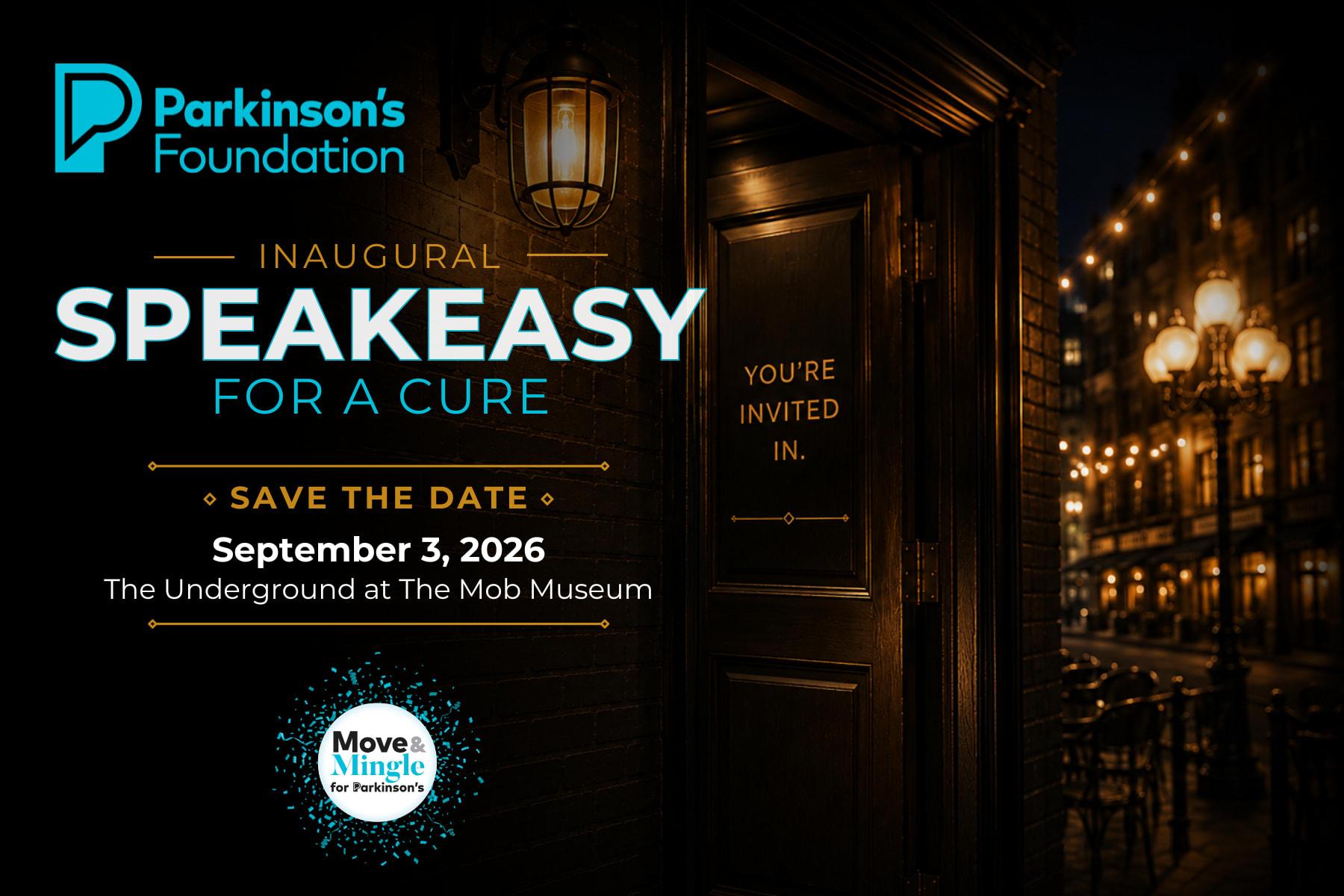
Join the Parkinson’s Foundation on Thursday, September 3, 2026 for the inaugural Move & Mingle Las Vegas Speakeasy for a Cure event at the Underground at the Mob Museum! Prepare for an evening of cocktails, period-inspired appetizers, conversation and connection as we continue the fight against Parkinson's disease. Hosted by two-time Emmy Award-winning journalist and meteorologist Chloe Koast of News 3 Las Vegas.
Honoree and inaugural Voice of Hope Award recipient: Nina Ten of Spotlight President & COO, Spotlight Senior Services Las Vegas
Special Guest: Erin O'Quinn, Associate Vice President of Public Policy, Parkinson's Foundation
Experts will share practical strategies and safety precautions to improve safety and minimize fall risk to support balance and mobility in everyday life.
Georgia Chapter Ambassador Retreat | July 31–August 1, Atlanta, GA. Join fellow Parkinson’s Foundation ambassadors for a weekend of connection, learning, collaboration, and planning as we celebrate our impact and prepare for the year ahead.
We’ll explore how to notice habitual thinking patterns—especially those tied to worry, self-criticism, or uncertainty about Parkinson’s—and learn to release what no longer serves us.
Check-in & Resource Fair* begins at 10:00 a.m. and the program starts at 10:30 a.m.
Exercise is a powerful tool for managing Parkinson’s disease symptoms at every stage. This program explains how staying active supports movement, mood and thinking and may even slow disease progression. Participants will learn practical ways to build exercise into daily life for better mobility and overall well-being.
Lunch will be served. Parking is available on site.
There is no charge to attend, but registration is required. This program is open to people with Parkinson's, their family, friends and the community.
Experts will share practical strategies and safety precautions to improve safety and minimize fall risk to support balance and mobility in everyday life.
Georgia Chapter Ambassador Retreat | July 31–August 1, Atlanta, GA. Join fellow Parkinson’s Foundation ambassadors for a weekend of connection, learning, collaboration, and planning as we celebrate our impact and prepare for the year ahead.
We’ll explore how to notice habitual thinking patterns—especially those tied to worry, self-criticism, or uncertainty about Parkinson’s—and learn to release what no longer serves us.
Celebrating Our 2026 National Volunteer Award Recipients
🧠 What will you learn in this article?
This article celebrates 2026 Parkinson’s Foundation National Volunteer Award recipients, recognizing the dedicated volunteers whose leadership, service, fundraising and community-building efforts help advance our mission. It highlights:
How each honoree supports and impacts the PD community.
Their PD story.
How volunteers help us strengthen connections and move research forward.
Volunteers are at the heart of the Parkinson's Foundation mission. Across the country, they raise awareness, build community, support programs, advocate for change and help connect people living with Parkinson's disease (PD) and their families to the resources they need.
Each year, the Parkinson's Foundation recognizes exceptional volunteers through our national volunteer awards. These awards celebrate key people whose service, leadership and dedication have made a lasting impact on the Parkinson's community.
We are proud to introduce our 2026 National Volunteer Award recipients. Meet John, Dale, Jordan, Jen, Rocky and Cindy below — and let their stories inspire you as they have us.
Paul Oreffice Volunteer of the Year: John Poma
John embodies the spirit of service. His leadership spans community, state and national levels — from chairing Moving Day Richmond and the Volunteer Leadership Summit to representing Virginia at the Parkinson’s Policy Forum. Through the People with Parkinson's Advisory Council, he has advised on PD GENEration: Powered by the Parkinson’s Foundation, reviewed community grants and encouraged young investigators at the research grantee summit, demonstrating his commitment to advancing science and care.
Beyond his formal roles, John consistently uses his voice to raise awareness of REM sleep behavior disorder and the lived experience of Parkinson's through local and national media. He partners with healthcare providers at Virginia Commonwealth University, a Parkinson’s Foundation Center of Excellence and beyond — including researchers at Mass General and Harvard — to advance the Foundation's mission. John believes in empowering others through education and has spoken at major events, including the Planning for Prevention of Parkinson's conference.
“One of the guiding principles of my longtime professional career in and around healthcare is that helping one person may not change the world, but it may change the world for that one person.”- John Poma
Dale’s impact has been extraordinary in a short amount of time. His authenticity, leadership and willingness to openly share his diagnosis have helped break down barriers and create meaningful awareness around PD within the first responder and firefighter communities. By leveraging his lifelong connections, he not only raised significant funds for the Parkinson’s Foundation but also expanded our reach into a passionate and service-oriented network of supporters.
What makes Dale especially deserving of the Rising Star Volunteer Award is the way he channels his own experience into action for others. Rather than stepping back after his diagnosis, he stepped forward — becoming a fighter, advocate, fundraiser and source of inspiration. His dedication perfectly reflects the spirit of courage, community and perseverance that this award represents.
“I am honored and privileged to walk amongst many heroes that are fighters, that won't quit and are fighting back.” – Dale Picciano
Top Fundraiser Award: Jordan Levin, Jen & Rocky Pontikes
Jen and Rocky Pontikes, along with Jordan Levin, transformed one idea into an inspiring movement that united hundreds of people during Parkinson's Awareness Month. Through the Million Meter Challenge, participants rowed, walked, biked and ran together to demonstrate the power of movement while raising critical funds to advance Parkinson's research and improve care.
What began with Jen's passion for rowing as a way to manage her Parkinson's symptoms grew into a multi-state community effort that inspired more than 300 participants to move more than 24 million meters and raise more than $185,000 for the Parkinson's Foundation. Their creativity, leadership and ability to bring people together exemplify the spirit of this award.
“The Parkinson's Foundation introduced me to an extraordinary community of people living with Parkinson's, care partners, advocates, researchers and healthcare professionals. Through those connections, I found my voice. What began as one of the most difficult moments of my life became my purpose.” - Jen Pontikes
“My hope is simple: to support the research and education that may one day cure or ease these brutal diseases, and to ensure that caregivers are never left without the information, resources and support they need on their own journey.”- Jordan Levin
Cindy leads by example through extraordinary service to the Parkinson's community. As President of the Parkinson’s Foundation New York Chapter Board, facilitator of the Women with Parkinson's Community Network, Research Advocate and dedicated Moving Day volunteer, she consistently gives her time, leadership and compassion to support others living with Parkinson's.
When Cindy logged her volunteer hours for the year, she wasn't seeking recognition — she simply wanted to ensure the impact of her chapter was reflected. Only then did she realize she had contributed an incredible 339 volunteer hours, a testament to the countless ways she strengthens her local Parkinson's community.
“Being involved in the Parkinson’s Foundation makes me feel like I’m doing something that’s helping. Everything I do is somehow related to the Foundation. I attend a PD support group of 60 women, some of whom have become my closest friends — and I found this group through the Foundation. I call the Helpline for referrals. I go on Parkinson.org every time I feel a new symptom coming."- Cindy Finestone
Congratulations to our 2026 award recipients! As we celebrate these six outstanding people, we are grateful for every volunteer who gives their time, talents and passion to help us make life better for people living with Parkinson's.
Check-in starts at 11:30 am and the program starts at 12:30 pm. A complimentary boxed lunch will be provided.
Please join the Parkinson's Foundation Midwest Chapter in partnership with the Froedtert & the Medical College of Wisconsin Movement Disorders Team, a Parkinson’s Foundation Center of Excellence, for our Parkinson's Disease Symposium: Building Your Parkinson’s Toolbox.
This educational program will offer practical information and strategies to support everyday health and well-being, for those affected by Parkinson’s. Attendees will hear from experts on topics including sleep and fatigue, preparing for medical appointments, fall prevention/home safety, nutrition, and self-care for care partners. Throughout the day, participants can also connect with local vendors and community resources that provide valuable information. Whether you are navigating Parkinson's yourself or caring for a loved one, this program offers tools, education, and encouragement.
Speakers:
Karen Blindauer, MD Froedtert & MCW health network
Sheila Rane Eichenseer, MD, MS Froedtert & MCW health network
Molly Sievers, DPT, NCS Froedtert & MCW health network
This program is a partnership with the Parkinson's Foundation Midwest Chapter and the Froedtert & the Medical College of Wisconsin Movement Disorders Team- a Parkinson's Foundation Center of Excellence.
Experts will share practical strategies and safety precautions to improve safety and minimize fall risk to support balance and mobility in everyday life.
Georgia Chapter Ambassador Retreat | July 31–August 1, Atlanta, GA. Join fellow Parkinson’s Foundation ambassadors for a weekend of connection, learning, collaboration, and planning as we celebrate our impact and prepare for the year ahead.
We’ll explore how to notice habitual thinking patterns—especially those tied to worry, self-criticism, or uncertainty about Parkinson’s—and learn to release what no longer serves us.
Check-in & Resource Fair begin at 12 pm and program begins at 1pm.
Managing Parkinson’s disease (PD) symptoms goes beyond traditional medications, with integrative health and holistic approaches offering additional support. This program introduces participants to non-drug options—such as massage, acupuncture, red light therapy, and CBD—that can help relieve symptoms and enhance daily well-being. By exploring integrative health's focus on root causes and whole-body wellness, participants will gain a deeper understanding of how these therapies can address symptoms and improve overall quality of life, providing a more balanced and individualized approach to PD management.
Speaker: Kayla Daniel, MA OSU Wexner & the Movement Disorders Clinic at OSU Wexner
There is no charge to attend, but registration is required. This program is open to people with Parkinson's, their family, friends and the community.
12:00 pm- Check in & Resource Fair 1:00 pm- Program Starts 1:40 pm- Movement Break 2:00 pm- Program Part 2 3:00 pm- Program ends
Experts will share practical strategies and safety precautions to improve safety and minimize fall risk to support balance and mobility in everyday life.
Georgia Chapter Ambassador Retreat | July 31–August 1, Atlanta, GA. Join fellow Parkinson’s Foundation ambassadors for a weekend of connection, learning, collaboration, and planning as we celebrate our impact and prepare for the year ahead.
We’ll explore how to notice habitual thinking patterns—especially those tied to worry, self-criticism, or uncertainty about Parkinson’s—and learn to release what no longer serves us.
Two New Studies Show Adaptive Deep Brain Stimulation May Improve Walking in Parkinson’s
🧠 What will you learn in this article?
This article highlights two studies, published in Nature Medicine, that show promise for using new adaptive deep brain stimulation (DBS) methods to treat walking difficulties in Parkinson’s disease (PD). Highlights include:
Unlike traditional DBS, adaptive DBS adjusts stimulation in real time based on movement or brain signals.
Both studies identified personalized brain signals (neural biomarkers) to tailor stimulation for specific movement. Both approaches improved walking while preserving traditional DBS benefits for symptoms such as tremors and stiffness.
Researchers at Lausanne University Hospital in Switzerland used brain signals to identify and tailor stimulation for different activities.
Researchers the University of California, San Francisco (UCSF) used different brain signals to time and adjust stimulation to participant’s walking rhythm.
Deep brain stimulation (DBS) is the most common surgical treatment for Parkinson’s disease (PD). It uses continuous electrical pulses to help control movement symptoms like tremor, stiffness and slowness. For many, DBS can be life changing. Its big shortfall is that it delivers the same stimulation all the time, which does not help with walking difficulties — including unsteady gait, freezing of gait (a sudden inability to move when walking) and falls. These are among the most disabling and dangerous PD symptoms with limited treatment options.
Recently, major advancements have been made in adaptive DBS (aDBS), which is when a DBS device adjusts its stimulation in real time based on a person’s symptoms or behavior. Studies show that aDBS is more helpful for controlling typical “on/off” symptoms (such as tremor and rigidity) compared to traditional DBS treatment. Now, two new studies published in Nature Medicine suggest that aDBS may also hold promise for treating gait impairment in people with Parkinson’s.
One study, conducted by a team at Lausanne University Hospital in Switzerland, developed a system that uses brain signals to detect which locomotor (the ability to move) activity a person is performing — such as sitting, standing, walking or turning — and selects stimulation settings optimized for that specific activity.
The other study, led by a team at the University of California, San Francisco (UCSF), took a different approach: timing stimulation to specific phases of the walking cycle, footstep by footstep, guided by brain signals unique to each individual participant.
Both studies were small and early-stage but highlight that adaptive DBS could improve walking in ways that traditional DBS cannot.
Study Results
The primary focus of both studies was whether adaptive DBS settings that target gait are feasible and safe, and whether they could improve walking compared to traditional continuous stimulation. Encouragingly, neither study reported negative events.
Adaptive DBS was well tolerated in all participants, and both studies found that it still helped manage the movement symptoms — like tremors and stiffness — that traditional DBS provides. Beyond safety, both teams also tracked changes in participants’ walking patterns, including step consistency, symmetry and falls.
The Swiss study enrolled six people with Parkinson’s who had DBS implants in the subthalamic nucleus. The team used recordings from the implanted DBS device, combined with detailed motion tracking, to develop algorithms that could detect which activity a person was performing — walking on flat ground, avoiding obstacles, turning, etc. — and automatically adjust stimulation settings to match.
This approach improved movement across multiple daily activities while preserving the benefits of traditional DBS for other movement symptoms.
This system successfully decoded and adjusted to locomotor activities in real time, even as participants’ symptoms changed or took levodopa medication throughout the day — a key challenge for adaptive approaches.
The UCSF study enrolled five people with Parkinson’s who received DBS implants in the globus pallidus region, along with additional recording devices in other brain regions. Using those recordings, they found that the brain produces distinct electrical patterns during specific phases of walking — for example, when the leg swings forward.
These patterns were unique to each participant, appearing at different frequencies and brain locations. By identifying each person’s individual ‘gait signature,’ the researchers were able to program the neurostimulator to deliver brief boosts of stimulation timed to match each step.
During in-clinic testing, this adaptive DBS strategy improved step variability and step symmetry compared to traditional DBS stimulation.
Three participants completed a multi-day trial in their own homes, where neither the participants nor the researchers knew which type of stimulation was being used. In this real-world setting, adaptive DBS maintained general movement symptom control and reduced falls.
The UCSF study in this article was supported by the National Institute of Neurological Disorders and Stroke (NINDS), part of the National Institutes of Health. The Parkinson’s Foundation advocates for increased federal funding to advance PD research, improve treatments and move us closer to a cure.
While these are early results need to be confirmed in larger studies, they offer a promising glimpse into a fundamentally new way to address one of the most challenging aspects of Parkinson’s: walking difficulties.
Highlights
Two studies, both published in Nature Medicine, tested adaptive DBS systems designed to target movement symptoms that automatically adjust to what a person is doing in real time.
Both studies used personalized brain signals, unique to each participant, that specifically indicated different types of movement or activity.
The Swiss study used activity states— for example, recognizing whether a person was sitting, walking, or turning — to switch between optimized stimulation settings.
The UCSF study used step-level precision — synchronizing stimulation pulses to the exact rhythm of each individual step – to make adjustments.
Both approaches improved walking measures while maintaining the benefits of traditional DBS for other movement symptoms like tremor and stiffness.
Neither study reported negative events and showed that these aDBS techniques were well tolerated.
Both studies were small (six and five participants). Larger trials are needed to confirm these findings.
What Does This Mean?
Falls are a leading cause of injury and hospitalization for people with Parkinson’s. Since walking is a highly complex activity that requires precise coordination, traditional DBS with consistent stimulation often does not address balance and walking issues. Instead of delivering the same stimulation all the time, adaptive DBS devices adjust in real-time based on the brain’s activity. These studies leveraged this concept to specifically target gait impairment, indicating an important shift in how DBS could help walking symptoms.
If larger studies confirm these findings, adaptive DBS could offer a meaningful improvement in daily life for people living with Parkinson’s — especially those experiencing gait and balance challenges.
These studies worked by identifying unique, personalized brain signals that were specific to each participant. The algorithms for adaptive DBS were then optimized based on this brain activity — a form of individualized, precision medicine. In addition, the physical location of the participants’ DBS implant varied between studies; the success of both platforms indicates that these treatments can be effective regardless of the DBS implant location, offering hope for more people with Parkinson’s.
What Does This Mean for People with Parkinson’s?
These studies are in the early stages and have only been tested on a very small number of people. Neither paradigm is ready for widespread clinical use. However, hope lies in the fact that these studies have already moved beyond the lab and are being tested in people living with Parkinson’s. Additionally, the Swiss study used a commercially available DBS neurostimulation device, removing an important barrier to access and suggesting that widespread implementation in the near future may be feasible.
Next, larger trials will need to confirm the findings to improve features for long-term use and to better understand who would benefit most. People experiencing walking difficulties and falls related to Parkinson’s should talk to their doctor about current treatments and keep an eye out for future adaptive DBS clinical trials.
Learn More
The Parkinson’s Foundation Helpline (1-800-4PD-INFO) provides answers to questions about PD symptoms and management. Learn more about this topic with the below resources:
Check-in & Resource Fair* begins at 11:00 a.m. and the program starts at 11:30 a.m.
Speech and swallowing challenges are common in Parkinson’s, but they can be managed. Participants will learn about voice changes and swallowing difficulties, along with strategies to improve communication and address swallowing challenges. We’ll also discuss the effect of speech and swallowing therapy on quality of life.
*The Resource Fair will feature local Community Partners that provide services and support for the Parkinson’s Community.
Speakers
Suja Sadasivan, MD Blue Rock Therapeutics
Anne Quirk, MA, MS, CCC-SLP True Self Speech Therapy
Sandra Aguiar, MS, CCC-SLP Brown University Health
Movement demonstration by Angelina DiNardo, MS, CCC-SLP Speech-Language Pathologist Rhode Island Hospital Outpatient Rehabilitation
Large parking lot in front of the JCC will be available.
There is no charge to attend, but registration is required. This program is open to people with Parkinson's, their families, friends, and the community.
Experts will share practical strategies and safety precautions to improve safety and minimize fall risk to support balance and mobility in everyday life.
Georgia Chapter Ambassador Retreat | July 31–August 1, Atlanta, GA. Join fellow Parkinson’s Foundation ambassadors for a weekend of connection, learning, collaboration, and planning as we celebrate our impact and prepare for the year ahead.
We’ll explore how to notice habitual thinking patterns—especially those tied to worry, self-criticism, or uncertainty about Parkinson’s—and learn to release what no longer serves us.