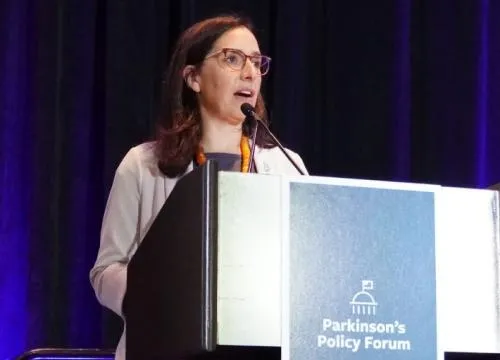
Crista Ellis 00:00:01
Hello and welcome to the Parkinson's Foundation's webinar series for veterans living with Parkinson's. I'm Crista Ellis, your host for today's webinar. Helping me behind the scenes are my colleagues Danielle and Laura. More than 110,000 veterans with Parkinson's disease receive care through the U.S. Department of Veterans Affairs.
Many U.S. military veterans with Parkinson's have access to specialized medical care and financial assistance through the VA. During this webinar, we'll dive into an exploration of cognitive changes and thinking changes in Parkinson's and provide you with some support, tangible and strategic practices to help support your cognitive health.
Today's webinar and the entire Veterans Webinar Series is presented with support from the Don and Lorraine Freeberg Foundation. We want to take this moment to thank the Freeberg Foundation for helping to make these programs possible.
The mission of the Foundation is to make lives better for people with Parkinson's. Whether you are living with Parkinson's, caring for someone with Parkinson's, or working to end the disease, we are here to support you. To achieve our mission, we pursue three goals: improve care for everyone with Parkinson's, advance research toward a cure, and empower and educate our global community. Today's program is a great example of one of the things we are doing to help us meet these goals.
The Parkinson's Foundation hosts weekly education and wellness programs through our PD Health @ Home virtual programming. Join us for Mindfulness Mondays, Wellness Wednesdays, and Fitness Fridays. Most of the PD Health @ Home programs are recorded and posted on the Parkinson's Foundation's YouTube channel. With your smart device, you can scan that QR code on the screen and register to attend our live PD Health @ Home programs at Parkinson.org/PDHealth.
Crista Ellis 00:02:00
Part of the Foundation's commitment is to reach every person living with PD. A critical way we do that is through our partnerships. With more than 110,000 veterans living with Parkinson's disease, the Foundation is proud to have established a formal partnership with the Veterans Administration. This partnership has the overarching goal to improve the quality of life for veterans living with Parkinson's disease and their care partners through greater access to education, resources, and support.
I'd like to invite you to visit our webpage and explore the resources offered by the Parkinson's Foundation that can support your navigation of living with Parkinson's as a veteran. That website is Parkinson.org/Veterans.
Before we dive into the formal part of the webinar, I'd like to outline today's agenda. We'll start with a presentation from Dr. Anita Sim, who will help us understand the cognitive changes in Parkinson's. Then we'll move to a second presentation provided by Dr. Konner Kielman, offering us practical strategies to support cognitive health and maintain independence, safety, and quality of life. We'll close presentations with Christy Becker, who will explore cognitive communication changes in Parkinson's, and we'll conclude our webinar with a brief question-and-answer session.
Again, we are recording today's presentation, and you will receive a follow-up email from us with a link to today's recording and the slides in the coming days.
And now I'd like to introduce our first presenter for today's program, Dr. Anita Sim.
Dr. Anita Sim is a board-certified clinical neuropsychologist and professor of rehabilitation medicine at the University of Minnesota Medical School. She has served at the Minneapolis VA since 2008 with clinical and research expertise in movement disorders, traumatic brain injury, dementia, and other conditions that affect cognition, including PTSD and anxiety. Dr. Sim is also a leader in her field, currently serving as president-elect of the American Board of Clinical Neuropsychology.
Dr. Sim, thank you for all that you are and all that you're doing for our community, and thank you for sharing your time with us today.
Dr. Anita Sim 00:04:17
Thank you, Crista, and to the Parkinson's Foundation for the very kind invitation. I'm honored to be here with all of you today. Let me start my little timer here so I don't go over.
As Crista mentioned, I'd like to be sure to describe the primary cognitive changes we see in PD, briefly discuss why they occur, and then how we go about evaluating cognitive changes.
Not everyone is familiar with clinical neuropsychologists, so we are psychologists by training. However, not all psychologists are neuropsychologists, so we tend to focus on cognition and the brain and behavior and how they work together.
Many of you are probably familiar with this graphic that demonstrates the difference between motor symptoms, which is what most people can observe, as well as the host of non-motor symptoms that most people don't often see. Cognitive changes really fall squarely in the non-motor symptoms that not everyone can notice, especially early on in the course of PD, but are, of course, quite significant and debilitating to patients.
I think it's important to discuss the difference between subjective symptoms and objective symptoms, particularly as it relates to cognitive changes and neuropsychological assessment. Many of us can walk into a room and wonder why we went in. Or I often hear my veterans say, "I'm losing all my stuff because I'll set it down and I can't find it," or, "My wife will tell me things, and I can't remember what she said." Inevitably, the question is, are these things normal or are they not normal?
Subjective symptoms are the symptoms that you experience internally and that you can report to your providers. But only you experience them. You can have pain or dizziness or fatigue that's really bad or maybe not so bad, but only you can tell whether it's a 10 out of 10 pain or a zero out of 10 pain. Other people can't tell how bad your pain is, for example.
Objective symptoms, on the other hand, which we typically refer to as signs, can be observed or measured by someone else. Some examples are fever. We could take your temperature and see how bad your fever is. Or same thing if you have an abnormal heart rate. That can be measured, so we call those objective symptoms. As neuropsychologists, our role is to objectively evaluate your cognitive functions.
When veterans come into my office and they say, "Doctor, my short-term memory stinks," that's the subjective report. Then my job is to objectively look at, well, let's take a look to see how bad or how good your memory is, as well as your other cognitive functions.
In a comprehensive neuropsychological assessment, basically all of the main domains or thinking abilities are objectively assessed. We'll get a sense of your baseline intellectual abilities, look at attention, processing speed, your language abilities, of course learning and memory, a group of skills that we refer to as your executive functions, your visual-spatial or visual-perceptual abilities, how you are seeing things in space, motor, and personality and emotional functioning.
Dr. Anita Sim 00:08:27
This is one of the reasons why, if you've ever had a neuropsych assessment, you'll see it's quite a lengthy appointment. It could be two, three, four hours in duration, and it's because of the thoroughness in which we look at all of your thinking skills.
I often get asked, why not just have a brain scan? Why do I have to go through three hours of neuropsych testing? Wonderful question. I often liken it to opening up the hood of a car. Let's say you're trying to buy a used vehicle. If you open up the hood and take a look at the engine bay, that gives you a sense as to, are all the engine components in the right place? Does the engine look okay? But it doesn't tell you, does the car actually run? Because somebody can do a nice job and clean up an engine and make it look nice and sparkling, but the car may not run.
Neuropsych testing goes hand in hand with any imaging that you get, like an MRI, to see: Does the structure of the brain, kind of what you see in a CT or MRI, map onto how the engine actually runs? How does your brain actually function from a cognitive standpoint?
What happens with PD? There are two main mechanisms that are going on. The first is a loss of dopamine neurons in the substantia nigra, which is in our midbrain, part of our brainstem.
Dopamine is a neurotransmitter, which is a kind of chemical messenger. I often say, if you think of your brain, picture your brain as a major city. We're in Minneapolis, and you have all of these buildings in your brain, but the buildings are separated, right? They don't touch each other. If the buildings need to talk to each other, you need a messenger to go in between the buildings. That's what neurotransmitters or chemical messengers like dopamine do in our brain. They talk in between the buildings. This first picture is a healthy individual.
This is one end of a neurotransmitter, so one building, if you will, and then another building. The dopamine goes in between the buildings as a messenger. In Parkinson's disease, you get a loss of those dopamine neurons. You see in the right picture, there are fewer of these messengers. We have a lot of different neurotransmitters in our brain, but dopamine is kind of like the neurotransmitter that says, "Yeah, let's do that again."
It gives us our energy and our desire to repeat something, which is why, in addiction disorders, for example, dopamine is where addictive disorders kind of play on. In PD, it's also the reason why oftentimes you can get a sense of apathy or a loss of motivation in Parkinson's because you don't have as much of that "yeah, let's do it again" neurotransmitter in your body.
The other thing that happens in PD is you get these Lewy body aggregates. You see in this graphic, alpha-synuclein is a protein that we all have. But in PD, they end up misfolding and then aggregating together to create these Lewy bodies that gum up our neurons and eventually cause the neurons to malfunction and end up dying. Again, if you don't have all those neurons, which are almost like telephone cords in our brain, then we see some of the cognitive changes.
Dr. Anita Sim 00:12:41
This is a graphic that describes how the progression of cognitive changes typically occurs. This is a side profile of our brain. Imagine here, in the front, are our eyeballs, and then this is the back of our brain, and this is the brainstem. You can have the loss of the dopamine neurons in our brainstem, in our midbrain, and then it progresses up. This cortex, this top part of our brain, is more of our traditional cognitive abilities like learning, memory, and executive function.
Over time and with disease progression, you'll get more of the cognitive symptoms beyond just the motor symptoms.
The common cognitive changes that we typically see in Parkinson's disease are trouble with more complex attention, or what we call working memory; a slowing in general, but of our processing speed, how quickly we think through things and process information; difficulties with executive functions; difficulties with our visual-spatial abilities; and then trouble with learning, which in turn affects our memory. I'll go into these in a bit more detail here.
Attention is a broad ability that encompasses a lot of different abilities within the domain of attention, but simple attention would be like if I asked you to repeat these numbers. Let's say I say to you, three, six, two, nine, seven, and ask you to just repeat those numbers. That's simple attention. It's kind of just an in and out. Simple attention tends to stick around okay in Parkinson's disease.
In contrast, Parkinson's tends to have a more negative effect on what we call complex attention or working memory, which is our mental sketchpad. Let's say I repeat those numbers again, but instead of asking you to simply repeat them forward, I ask you to repeat them to me backward, in backward order. You can imagine, in order to do that, you have to first pay attention to the sequence and then mentally rearrange them in your brain and then spit them back out. That's something that tends to cause some difficulty in PD.
Visual-spatial or perceptual difficulties are also a common cognitive change. This first graphic looks at how well you are spatially judging distances or angles. In this task, the veteran is given these two lines and asked which lines they match on the array below. In this case, the one vertical line is the number six and then the one at an angle is maybe a three. But having that spatial judgment can be impacted.
Sometimes we'll ask veterans to copy a figure, again looking at how they are visually and spatially seeing things. This is an individual who had more of a dementia where they were asked to draw a clock face. You see a lot of the numbers are missing, and they're all pushed to one side.
Learning and memory, I'd like to go into this in just a little bit more detail, in part because it's typically the primary subjective symptom or complaint I hear in my office.
Dr. Anita Sim 00:16:50
It's important to talk about the process of how we learn and then remember something, and it's usually a four-step process. I often say, let's pretend that we're trying to learn how to speak French. The first step would be that we have to first learn or encode all of the new French vocabulary words. Learning is in and of itself its own ability. Some people learn better than others. Some people have a learning difficulty. Some people learn better visually or by doing something. Other people learn better by hearing something. But you first have to learn the vocabulary and the grammar before you can speak French, right? That's step one.
Step two is, once you studied and learned all the French vocabulary words, you have to have it congeal and set in your brain. That is what we call consolidation.
Step three is, once it's in your brain, you have to hang on to it and not forget it. Then the last step of memory is the ability to reach in and retrieve what it is you want to remember. This is an area where a lot of us, as we age in particular, have trouble. All of us are familiar with sitting there being like, "Oh, what's the name of that street?" or, "What's the name of that actress?" We know it.
In other words, it's in our brain, but maybe we just have some stickiness in terms of how quickly we retrieve that information. As we'll hear, that's another difficulty that comes up in Parkinson's disease where we have the memory stored in our brain, but it's just hard sometimes to pull it out or retrieve it right when we want to get that information.
This is just one example of a test that you might be given if you were to do a neuropsych assessment. This is a list-learning test, and this first part is looking at learning. In this example, I would read this list of words to the veteran.
Each time, I would ask them, "Tell me all the words that you remember." This is looking at what we might call short-term memory, but it's impossible, I think, for most of us to memorize something fully just by hearing it once. Any sort of learning test will repeat it a few times to help with learning. I would repeat it again, ask again, "Tell me how many words you remember," and then repeat it again. This is three trials. This list has 10 words.
This is just a depiction of what might be an average or normal performance and how that's affected by age. For a 25-year-old, this might be how someone does: six words after trial one, eight words after trial two, and nine words after trial three, for a total of 23 words. That, again, is a normal or average level performance. But for a 75-year-old, a normal performance is actually only 18 words.
There's a normal level of learning difficulty that takes place just from aging alone. Sometimes when I see veterans who come in and say, "I can't remember or learn things anymore," part of that is true. That subjective sense of trouble with short-term memory is probably right on target, but that could be considered a normal level of reduced learning ability with normal aging.
Similarly, if we were to look at a delayed memory, in my office I will ask maybe 20 to 30 minutes later, "Tell me all the words from that list." Again, for a young 25-year-old, eight words out of 10 would be considered normal, but for a 75-year-old it could just be six words. I often say that we all appreciate that we may get wrinkles on our face, but a similar process can happen in our brains where, just from an aging process alone, we get more forgetful or have more difficulty with learning new information. Part of our assessment is to figure out, again, are your difficulties related to a normal aging process, or is it beyond that?
Dr. Anita Sim 00:22:04
This is the same picture as before, and I just wanted to point out that attention trouble, trouble paying attention, or that slowed processing that we can see in Parkinson's, really can impact how well we learn new information, as well as how quickly or easily we retrieve memories. Again, sometimes when folks say, "I have a memory difficulty," it could be that it was not learned properly, or it could be it's in there, but it just needs a little bit of help or cueing to draw that memory out.
Two key things I often remind folks are that just because you understand something, that doesn't necessarily equal that you've adequately learned it and that it goes into your memory storage.
A good example is, if your wife tells you, "Hey, we're having lunch with the Smiths on Saturday," you may very well, in fact, understand what your wife is saying and nod, but that doesn't necessarily mean that it's embedded itself in your memory storage, which is why on Friday you might be like, "What are we doing on Saturday again?" Because it didn't quite make it into your memory.
I also often say we cannot learn and remember information that we never adequately paid attention to or adequately processed. If information goes in one ear and straight out the other, then we never learned it and we're never going to remember it.
Back to this graphic. We talked a little bit about cognition, but there are obviously also a lot of non-motor symptoms that impact how we're doing emotionally, but also things like our sleep. The reason I want to point those out is that a lot of conditions can affect our cognition beyond the Parkinson's disease process that directly affects our brain regions that support cognition.
Sleep issues are very common in Parkinson's. Or in veterans, it could be non-Parkinson's-related sleep issues like sleep apnea, or a lot of veterans can have PTSD that affects their sleep by way of nightmares. Bottom line, if you're having sleep issues, you're likely also going to have issues with cognition because, for anybody who doesn't sleep well, it's going to affect how clearly and sharply you think.
Similarly with your mood, if you don't feel good emotionally, whether it's anxiety, depression, or trauma symptoms, that too is going to affect your cognition. Sometimes there's another brain condition that is playing side by side with Parkinson's that could also be contributing to cognitive difficulties. Medication effects, especially as we get older and more medications potentially get added to control high blood pressure or pain, can have side effects that affect our cognition.
And then stress as well. When you've got a lot on your mind, it doesn't provide a lot of bandwidth to then have to think our best and to remember our best.
Dr. Anita Sim 00:26:02
I talked a lot about what might be affected with Parkinson's, but there are also things that tend to stick around okay and are not affected until really late into the disease process. Generally speaking, people's intellectual abilities tend to stick around well. I mentioned simple attention usually is okay. Language, particularly naming, if I show you a picture of a turtle, for example, and I ask you, "What's the name of this thing?" typically, that tends to stick around as well. And that recognition memory, too.
Again, you may have those moments where you're fishing for something like the name of a movie or the name of an actress. You know it, but it is just not coming up right away. But if someone were to give you a list of actresses' names and ask you, "Well, which one is correct?" you would quickly be able to say, "Oh, yes, it is Julia Roberts I was looking for." That is what we call recognition memory where, again, the memory is intact. It's in your head, but there's just that lag or difficulty in pulling it out in a particular moment.
When does neuropsych testing make sense? Not everyone needs a comprehensive neuropsych evaluation. These are just a few times where it could be helpful. Sometimes with big life changes or decisions, a neuropsych evaluation can be helpful. Sometimes I'll have a couple who is residing in their single-family home and they're wondering, gosh, is it time to make a change to an assisted living or memory care?
Neuropsych testing can be helpful. Or sometimes folks may want to change their will or advance directive and want to make sure that thinking abilities are okay before making such a big change. Sometimes I'll be asked about driving, when is it time to hang up your keys, and neuropsych testing can be helpful with that, along with OT.
Clarifying diagnosis or clarifying why somebody might be having some cognitive difficulties. We can help determine: Is somebody being forgetful because they're having trouble paying attention, or is it due to depression that's not treated very well, or are they actually, in fact, having some legitimate memory problems that we need to take a different look at? With all this information, of course, the testing can be helpful to update any recommendations or help with treatment planning.
The last thing I want to leave off with is just a reminder that the health of our brain is directly tied to our heart health or our physical health. Oftentimes I'll have veterans and family members ask me, "Doctor, should I be doing crossword puzzles or Sudoku puzzles?" I think that's fine, but I often say if somebody has two options, option one is sit on the couch and do a crossword puzzle, and option two is go to the YMCA and walk in the pool to get some exercise, option two will always be better for your brain than option one.
Physical exercise, getting your heart pumping, is the number one best thing that one can do for their brain health, as well as their heart health. Of course, eating a heart-healthy diet, or if you have diabetes, a diabetic-consistent diet.
Wearing your hearing aids is a big one, I know, for a lot of veterans. Not wearing your hearing aids can be peaceful because it could be quiet. But our brain is very much like any other part of our body. It's kind of a use-it-or-lose-it. Hearing, or sound, is one of the five senses, right? You can imagine that if you are then blocking off sound input to your brain and your brain is not getting that stimulation of sound, then it can contribute to increased risk of cognitive decline and dementia because you're removing an important source of brain stimulation by not wearing your hearing aids.
That's one of the big recommendations I make. Of course, taking your medications as prescribed, staying socially active and socially stimulated. If you are experiencing depression or anxiety or high stress, which again can be common with trying to cope with PD, make sure that you seek out treatment and support, and then get as best restorative sleep as possible and support good habits of sleep. I look forward to any questions at the end, but thank you so much.
Crista Ellis 00:31:58
Thank you, Dr. Sim, for sharing a little overview of cognitive changes in Parkinson's disease and what to look for. And now we're going to shift gears to invite our second speaker, Dr. Kielman, to share a little bit about occupational therapy and how we can use this form of therapy to support our cognitive and our brain health.
Dr. Kielman is an occupational therapist at the Minneapolis VA Health Care System, where he specializes in Parkinson's disease and movement disorders. He's been with the VA for five years and joined the Parkinson's team in 2023. Dr. Kielman is LSVT BIG certified and brings expertise in neurorehabilitation, assistive technology, cognitive and amplitude-based training, and supporting individuals in aging in place. He's passionate about continuing his work with the Parkinson's community for years to come. Dr. Kielman, thanks for joining us today.
Konner Kielman 00:32:54
Thanks for having me. After the first presentation, I figured I would have scared them away, but here we are, right? I can't see anybody, but I'm sure that joke killed. So, thank you guys for listening. I'm jotting that one down in my notebook here.
I like to start off by explaining today we're going to be talking about cognition, especially in how it relates to occupational therapy, from somewhat of a bird's-eye view. As many of you who might be in this presentation that work with me know, I can talk all day about pretty much anything, but cognition in particular. So I'm trying to keep it a little bit shorter to make sure everybody gets time today.
I thought it'd be good to go over the importance of an interdisciplinary team when you're treating cognition. Going back to Dr. Sim being our neuropsychologist here at the Minneapolis VA, she obviously is assisting with things like diagnosis, management, and education about what those diagnoses can mean, how that's impacting you, how you did on your testing, and providing a little bit of guidance to our team as well on where you're at cognitively.
The next group here is OT and speech, so that's going to be who you're hearing from today, at least from the Minneapolis VA, with Christy and myself. We help a lot with compensatory strategies, adaptive equipment, assessments, and then just overall functional maintenance. We're trying to keep you active, trying to keep you independent, trying to keep you doing your best throughout the disease progression.
The next group here I would say that's a big helping hand in the cognitive realm is neurology and neurorehab. For those of you who have a neurorehab physician at your facility, they are available to help with medication options, care coordination, and things that we can do to manage the cognition throughout the disease progression. I think there are many more valued team members. I think those are just the big ones that come to mind for me on the topic of cognition.
The other thing I think is important to keep in mind throughout this presentation is I want us to reframe cognition a little bit. Sometimes when we learn about cognition or when we think about therapies in general, so that's PT, OT, speech, we come at it from a rehabilitative mindset or trying to fix the problem, trying to get some of that function back.
I like to think of it more as a maintenance or compensatory mindset. In other words, thinking from an aspect of we can't change how your brain operates, but we can change how we react to it. The things that we can do to help you out, to make sure that even though the brain might not be doing what it used to, we can have some tools, some strategies, and some education to get you to the level you were at, or at least close.
The next aspect here I wanted to talk about is that the cognition and the journey of cognitive decline, whether that's through dementia or through any kind of cognitive disorder, is going to be subjective, not necessarily the symptoms. The symptoms are a little bit more common throughout the progression. However, a lot of aspects of the journey will be unique. What you did for work, your familial support, who's around you, your current environment, your level of activity: all these things are going to be things that can pivot or change what your cognitive journey looks like. Those are just a couple of things that I wanted to keep in mind as we go through the presentation here.
Konner Kielman 00:36:11
This is a common question I get in my clinic: why are we assessing cognition, especially after we have that conversation about pivoting from the rehabilitative mindset to compensatory? I'll often get an answer, you know, if we can't do anything about it, what's the point of learning? Well, as I said before, there's a lot that we can do about it. So we like to assess cognition so that we can see how it's impacting you, because this is an area of life that can impact everything you do. It can impact your ability to get dressed because sequencing is thrown off. So we're not sure if the underwear goes on first versus the pants. It can impact driving. So I get lost, or I'm not sure how to operate my vehicle, or I feel like I have a tough time focusing on the road.
So it impacts everything. That's a big reason why we want to know how you're doing with it. So we know what areas we should work on, what areas we should avoid, what you should be doing, what you shouldn't be doing, and that leads us to how it guides our clinical decision-making. So, based on cognition, there are certain things that we would encourage you to do, but if your cognition is limiting your ability to do them, then we wouldn't want you to push just to necessarily maintain independence at the risk of your safety or your bodily well-being.
The next thing here is, and it's one of the biggest aspects of my job in cognition, is assisting with caregiver education. So throughout the spectrum, as Dr. Sim had mentioned earlier, I often hear, "My husband doesn't remember anything I say, and it's because he's just not listening."
Part of that could be true, but a lot of it is going back on what Dr. Sim said: maybe that information was understood but not retained. So kind of having that conversation with caregivers so they understand it's not your spouse or your loved one making a deliberate decision not to pay attention or to ignore what you're saying, but rather that maybe their skills are not conducive to remembering this information. And then lastly, identifying areas of need. Going back to those areas of daily living, if we're struggling with X, Y, and Z, what can we do to address those? Because now we know that's an area where we need a little bit of help.
So that's why we assess cognition in OT. How is a little bit different. So the first step is cognitive screening. That's a little bit more basic. For those of you who are familiar with this, I put the SLUMS up there. That's the test I typically complete. It stands for the Saint Louis University Mental Status Exam.
It's fairly quick, right? So they can be done in about five to 10 minutes. They're not super in-depth. They don't have a ton of information in terms of specific diagnoses or specific skills that you may be lacking. But rather, I compare it to a blood pressure test, where it's looking at your overall status right now. So what's your status at this moment? Is it doing well? Is it doing normal? Is it doing poor? And how can we assess that quickly?
I like this because it gives us an opportunity to not have you go through a ton of testing, especially if that's something that maybe gives you anxiety or some frustration, but still allows us to have somewhat of a picture of how you're doing. And if you're familiar with this test, you're very familiar with Jill the stockbroker and her devastatingly handsome husband Jack. So, the next one here is functional cognitive testing. This is going to be the CPT, or the Cognitive Performance Test. There's also the Cognistat or the EFPT, which is your Executive Functioning Performance Test. This is assessing how your cognition might be impacting function.
Konner Kielman 00:39:43
So, what I mean by that is how it might be impacting your activities of daily living, such as getting dressed, taking a shower, getting in and out of bed, your ability to manage your medications, how you're doing with your financial management, how you're doing with maintaining your home. So it assesses how cognition may be impacting those skills, and even more so, it can be used to help guide our recommendations for maybe a level of supervision or assistance you may need. So, for example, if on this test we identify that, okay, medication management is a little hard for John, we want to see if maybe we can get somebody to help him set up his pills for the week and make sure that he has his refills and that he has everything that he might need so that we're not going without. So, that's how we assess cognition.
To start us off here, I wanted to go over mild cognitive decline. So, this is those initial stages where people might feel that there's a little bit of memory deficit. This could be age-related, this could be related to Parkinson's progression. There are a lot of areas that it can pop up.
But the main three things we want to focus on here are compensatory strategies, establishing a routine, and active participation. So the first one, compensatory strategies, can be some basic things: setting up a calendar so that you're remembering when your appointments are; using alarms so that you can remind yourself, oh, it's four o'clock, it's time to take my medication; using a reminders app if you're trying to remind yourself, oh, I need to remember that I need to submit that paperwork to the VA for my advance directive.
Additionally, things like notes, taking notes on conversations, what was discussed at your doctor's appointment, things that we can quickly look at and determine, okay, I know when I saw Konner on March 19th that we talked about this. Okay, so then next time I see him, I need to have that ready. The other thing we can talk about is how to get the caregiver involved. So this is just some initial involvement: basic assistance for reminders, helping with setting up equipment or technology if needed. And that leads me into my second point here, which is establishing that routine. So routine is extremely important. I call it establishing your muscle memory.
So if you have a daily routine that's pretty strict, like I get up at 8 a.m., I go to bed at 10 o'clock, and in between I'm doing my exercises before we have breakfast, and my wife and I go for a walk after dinner, having that established routine makes it so that there's just less that your brain has to think about, which is why when we throw off the routine, people can really get out of whack. So, establishing a routine is another critical element here in occupational therapy and how we would deal with mild cognitive decline. Then lastly, at this point, we would want to see active participation as much as you can in a safe manner. But I do want to clarify that this is things you have to do actively.
So sometimes people will say, "Oh, well, I go to a brunch meeting with a couple of my buddies every month or something like that." One, that's not super often. Once a month leaves you 30 days for other opportunities for you to do things. The other thing, too, is if you're kind of a wallflower when you're at that event, you're not actively participating. So we're not using our cognitive skills to keep ourselves going. So finding activities that you can actively engage in so that you have the opportunity to continue to use that cognition, like Dr. Sim had said with the use-it-or-lose-it mentality.
Konner Kielman 00:43:06
So, some common equipment, like I had discussed on the previous slide there: alarming pill boxes. So this is a really common one that I'll get for people. Initially, we don't need to do a ton with it outside of setting up for the times because we're forgetting medications. So we set it up for four times a day at every four hours. And then this machine would essentially dispense your med and have an alarm that goes off to let you know, hey, it's time to take your pills. This is something that, if we get it for more of a mild cognitive decline, is something we can hang on to in case we're concerned that major cognitive decline is coming down the pike, because this can then be locked.
So if people are struggling with things like tampering with medications, accidentally taking two doses because they forgot they took the first one, this is an opportunity where we can use a device like this to make sure that we have the opportunity to keep the person with Parkinson's safe. The next one, and this is a pretty basic option, is a vibrating or alarming watch. That's going to be the picture at the bottom left there, that WobL watch. So that's something that you could wear. It discreetly vibrates to let you know, 8 a.m.'s rolled around, it's time to take your carbidopa levodopa. It's something that's pretty easy, I think, to set up. It's a little bit lower-tech, right? So not a lot of programming or technology needed to operate this.
And then the next one kind of leads me into the tech-heavy options, which would be like smartphone apps. So things like the Reminders application on your phone, the Alarms, the Calendar, they all can provide you an active alert that it's time to take your meds, it's time to go to your five o'clock appointment, it's time to do your exercises. Really anything and everything you can think of, you can put on there and have an opportunity to get alerted about it.
And then the last one, again back to low-tech. Having a home calendar or a whiteboard, I usually will have people put them in a central location in the house, so something like the kitchen, the foyer, that just indicates today is Thursday, March 19th. We have the Parkinson's Foundation presentation from 1:30 to 3:00 if you're Central Time. And we have the opportunity to then be alerted by that and feel like I can go back and remind myself. I don't have to poke around at the people around me to say, "Hey, what's that thing we're doing again today?" So it just gives us an opportunity to take a little bit of that independence back. I did want to give just a little case example for mild cognitive decline.
So our friend John Doe here, he's a fictional gentleman with a great bow tie. He's a 74-year-old male with Parkinson's disease. His testing has indicated mild cognitive decline. He's experiencing difficulty with medication management, remembering appointments, completing exercises, and managing his home. So, going back on what we've learned about mild cognitive decline, the things he can expect from his occupational therapist would be doing things like setting alarms on his phone or his watch, if he has one, for a medication reminder. If he does not, getting him set up with one. The next step would be assisting in setting up that daily calendar. So teaching him how he can use that daily routine to reinforce medication compliance, activity engagement, and routine.
So, walking through, okay, we're going to set up your day each day so that eight o'clock you're waking up, nine o'clock you're doing this, and so forth.
Konner Kielman 00:46:12
The next thing we would want to do is set up monthly reminders for home maintenance. So maybe this is an alarm on his phone, maybe this is a calendar, but just alerting him that, first of every month, I want you to put in that softener salt and change your air filter so that you remember to do that each month. Same thing with cleaning or chores or things he needs to do, just so that he has these reminders and can refer back to that calendar. The next step would be providing some adaptive equipment to assist in managing these goals. So, as I talked about before, having that alarming watch if he does not have a phone. Providing a daily calendar system, whether that's electronic or paper. A medication box, which could be standard, just your typical Sunday-through-Saturday, seven-day pillbox.
Or lastly, that whiteboard, that thing that he can set up in the room and refer back to at any point. The other thing I would strongly encourage at this point of cognition, especially if John's still going to appointments alone, would be requesting written handouts describing all information discussed at the visits. A lot of times people will walk out, and when you have Parkinson's appointments, I'm sure everybody's aware, they can be a little bit information-intensive. Because of that, it feels like we took a drink out of a fire hose. So having a written reminder to allow us to know what we talked about can really help people.
That brings us to the next step. And there's a lot of area in between these two, but just thinking about beginning stages and later stages. So this is for major cognitive decline. At this point, we're seeing a pretty large uptick or increase in caregiver support. So helping out more with those activities of daily living, helping out more with those reminders, potentially running the calendar or the schedule for the patient.
At this point also, we're seeing a higher level of supervision. So maybe we're not home alone anymore, we're not driving. We're having people keep an eye on you just to make sure that we're not getting ourselves into any sort of concerning situations. At this point, additionally, we'll have an increased use of protective strategy and equipment. So that could be anything from your walker, your wheelchair, to home alarms to make sure that you're not jailbreaking here. And then the next one I would say is maximizing and encouraging appropriate participation. So often I'll hear in clinic that somebody does not want to limit their spouse or their loved one's ability to remain independent.
And I fully support that decision and am on board with it in most cases. However, at times cognition progresses so far that it's no longer safe for that person to do those things, even if physically they may be capable. The biggest one I would say in this realm is driving. A lot of times people are encouraged to continue doing what they can, even if it's not appropriate, and that's where driving can really become a hazardous activity. And then lastly, depending on how far we've progressed into that major cognitive decline domain, we would maybe consider a higher level of care, like Dr. Sim had mentioned with the assisted living, the long-term care.
Konner Kielman 00:49:06
So, common equipment at this stage would be things like a door or wander alarm. So this is something that you could set up to the doors of the bedroom, the doors of the bathroom, the doors of the house, really anything, just a door alarm that allows you to be alerted if that door is opened and you're unaware of it. This can happen when folks are maybe having a little bit more difficulty with things like wandering, leaving the house without alerting family, and running the risk of putting themselves in harm's way. That also puts us with home security systems. So sometimes I'll have people use these, particularly if they're trying to allow their loved one to be at home alone a little bit more often.
Things like this, you can get those indoor cameras that you can refer back to. It's also an opportunity for your loved one to communicate with you if you get the ones that have the buttons. So then they can push a button and alert you and say, hey, I need some help. So that's going to be another good option.
The next one is those locked medication boxes we talked about earlier. So having a locked medication box allows us to prevent tampering, prevent overtaking medications or losing medications. It also allows the caregiver to be a little bit more structured with how they're monitoring meds because they know nobody's messing with it. The next one is fidgets or busy boards. So I like these for when your loved one happens to pick at their hands or fidget around while they're sitting because they're distracted, or that's just what they do to kind of stimulate the brain.
Sometimes this can lead to things like scratching at your skin or causing little scabs here and there. Having something like a fidget allows them to keep their hands busy and stay safe without really allowing any kind of injury to their skin. And then the next one is a medical ID bracelet. So this would be, or necklace, something that would indicate, hi, my name is John Doe. I have Parkinson's disease dementia. My emergency contact is my wife, Joan. Here's her phone number. That gives us the opportunity that if you happen to wander and get lost, we have the ability to find you and have somebody assist you if, at that point, cognition has gotten bad enough that we're disoriented or lost.
Additionally, at this point, we always like to consider wheeled mobility. So having the ability to utilize a wheelchair to get around if we're making some unsafe choices with our walking. So back to our friend John Doe. He still has that great bow tie, but we're about eight years later. At this point, we're now experiencing difficulty with wandering from the house, tampering with medications or taking them incorrectly, walking without the walker and falling, getting up and assuming we're back to how we were doing 15 years ago and taking a dive there and getting some injuries.
The other things at this point are maybe some agitation or some hallucinations and delusions. At this point, your OT would likely recommend some increased supervision while at home, so having somebody available most of the time, potentially considering home health services or a full-time caregiver if that's an option. The next one I would say is considering an adult day program, or what we call like an ADHC, an Adult Day Health Care Center, to minimize instances of isolation. So we don't like it when people are staying at home because their cognition is preventing them from doing things safely. These adult day programs give them an opportunity to still get out, be around their peers, have an opportunity to maybe play some cards, chat, just socialize in general, but keep them active.
Konner Kielman 00:52:35
The equipment, I would say at this point, we probably want some wander alarms on the doors to make sure we're alerting family if John's getting out of the house. The medical ID bracelet in case we're wandering and getting lost or disoriented. The locked medication box because, at this point, he's starting to take them incorrectly or tampering with the meds. And then additionally, a fall alert device because at this point, if we're walking without the walker, there's a chance that John might get a little bit farther away and have a fall and would have no ability to contact help at this point.
The other thing I would say is if he's using a walker for his mobility and he's not safely operating it, considering the change to a custom wheelchair with a chair alarm to prevent him from having these falls and having a potential injury would be another next step there. And then this is the big part, caregiver education. So teaching caregivers about redirecting and de-escalating situations, especially during episodes of agitation, hallucination, or delusion. For example, sometimes I'll hear that people are talking about, hey, I've got to get back to work, and it's like, well, we've been retired for 20 years. So instead of arguing or getting lost in the mix, what I encourage caregivers to do in those moments is to say, well, maybe we call out for work today, or let's get some breakfast and then I'll help you get to work.
Because usually at that time we can redirect and de-escalate the situation so that they feel a little bit less commanded or attacked in that situation. So, I think that this wraps up the main information that I have here. I wanted to thank everybody for having me back again. I really appreciate it.
Crista Ellis 00:54:13
Thank you, Konner. Really appreciate that introduction to occupational therapy and how we can continue to prepare ourselves for what may come, even if it doesn't, but feeling a bit prepared. I'd love to invite you all to take a deep breath, take a sip of water. We're receiving a lot of information right now, a lot of useful information, and remember that we do have some time at the end of our presentations today to answer your questions. So use that Q&A tool on the Zoom panel to ask your questions to our experts today. I'd like to introduce our third speaker, Christy Becker.
Christy is a speech-language pathologist at the Minneapolis VA Medical Center, where she has spent the past four years working within the Parkinson's Disease and Movement Disorders Program. And with five years of clinical experience, she specializes in supporting individuals with Parkinson's and other movement disorders. Christy is certified in LSVT LOUD and SPEAK OUT and has expertise in the evaluation and treatment of communication, cognitive-linguistic changes, swallowing disorders, and voice disorders. Christy, thanks for sharing your time with us today.
Christy Becker 00:55:25
Thank you so much. Yes, thank you, Crista and the Parkinson's Foundation for inviting us to speak today. I'm very excited to talk about this. Let's see if I can control our slides here. There we go.
As my colleagues enlightened us on before this now, right? Cognitive changes are one of those less known about or less seen symptoms of Parkinson's. And I think that often makes them one of the more challenging ones to work through, understand, anticipate, and adapt to. So I'll be talking a little bit about how speech-language pathology works with cognitive communication functions in particular, especially related to Parkinson's.
So right out of the gates, you might be thinking, a speech therapist for my memory and thinking skills? What is this about? Speech-language pathologists evaluate and treat a couple different areas. So things like communication, where you might think of our speech and our voice; things like swallowing, whether it's eating, drinking, taking pills, managing our saliva; and then cognitive communication functions. And what am I referring to there? Really, difficulties related to or during communication caused by underlying thinking changes.
Why does that matter? Right? Why do we care about this? These changes are associated with something like Parkinson's. And these kinds of changes can impact the ways we express ourselves, the way that we understand other people, how we engage in meaningful conversation, and how we're able to continue to do the things that matter the most to us. So there's a lot of weight in terms of quality of life and how we exist that relate to these cognitive communication functions.
Just a couple quick definitions that we've already heard a bit about today. Because cognitive communication function can look very different at different stages of Parkinson's and can be impacted by other factors that Dr. Sim outlined, there are things like mild cognitive impairment, or MCI. This could be a diagnosis or label that you receive, maybe with that neuropsych testing, where cognitive symptoms, yes, you notice them, maybe they show up on some testing results, but they don't fully impact day-to-day life in significant ways.
Then there are things like dementia, and that's when cognitive impairments occur in more than one area of cognition and interfere more significantly in daily life and in that independent piece of daily living. Now, not everyone with Parkinson's disease will develop dementia, but those with Parkinson's are at a higher risk to develop dementia than those without. So I think it's good to understand that knowledge is always power. So when we can understand what things might come or what we might prepare ourselves for, it can be a little bit easier to adapt to over time.
Christy Becker 00:58:38
So what might this actually look like, these cognitive communication changes that we see in Parkinson's disease?
Dr. Sim talked a little bit about a lot of these areas of cognition for us, right? And how do these show up then in our communication? First, we might think about attention. Maybe focusing on conversations can be more challenging, or maintaining topics in conversation. We might get a little bit more tangential and talk about different things at maybe less appropriate times.
We can see, of course, changes to memory. So maybe difficulty recalling recent discussions, maybe asking repetitive questions.
We can see changes to executive functions, so maybe some more difficulty organizing our thoughts, especially if we're trying to communicate something more complex. Maybe difficulty with problem-solving, making plans, achieving the things that we want to set out to do.
There can be changes to processing speed. So how that might show up, maybe it takes a little bit more time for you to feel like you've really taken in everything, or a little bit more time needed for you to gather your thoughts and respond back in conversation.
And then those changes related to language, and the question of where it is truly language versus memory, but what a lot of folks will tell me about is difficulty with, say, word-finding. You know the word, it's on the tip of your tongue, you can picture what you're talking about, but the exact word won't come out. That can be very common.
And sometimes there's difficulty with complex or very detailed language, right? If we're getting into the nitty-gritty, lots of details, lots of steps, right? There are a lot of things to pay attention to there, a lot of ways our cognition can interfere with that. So those are some of the ways we might see these changes in actual conversation, in our communication.
Christy Becker 01:00:47
So what can speech-language pathology offer folks with Parkinson's and caregivers, loved ones? We do complete an evaluation of cognitive communication skills, and of course we value those neuropsych evaluation results quite a lot. That's a huge bulk of what I look at when I consider where someone's starting. But I also do some different patient- or family-reported outcomes, whether that's some questionnaires, some surveys to get you thinking about your daily life, what you notice. I might do some of my own assessments or screenings on some more specific cognitive communication pieces.
And I spend a good deal of time just in interview with my patient who has Parkinson's and any family or loved ones that they've invited to our sessions to start trying to understand your very specific functional concerns, what matters the most to you, and what's prohibiting you or letting you do the things that you want to do, how you want to participate.
My goal is always to understand your unique cognitive communication strengths and areas of concern so that we can create a very personalized treatment plan. Like most things with Parkinson's, one size fits one. And as Dr. Kielman mentioned earlier, a lot of our strategies might look quite different. Some of those underlying changes might be the same, so just because two people have difficulty with, say, keeping up in a conversation, what we do about that might look very different.
So what then do we offer in speech pathology? What can we do? I think about four different categories of how I can intervene. The first there is education, right? Providing some information on supportive behaviors for our cognitive health.
We saw a very similar slide here from Dr. Sim earlier, outlining the things that help protect and maintain our cognitive function.
The goal here is to really just learn about those behaviors that we can do that engage our brain, that keep us using it, not losing it. This acronym DANCERS, I like because it helps me remember a little bit easier those types of things, and I think it's a little bit more approachable in terms of how you can remember the things that can be helpful. I like to point out here that engagement with others socially is a really big factor when we're thinking about protecting our cognitive function.
As we know, Parkinson's can also impact things like speech and voice and all of that communication piece, right? So it's not always as easy as saying, socialize more, right? There are a lot of things that go into that that, again, a speech pathologist can help you work across the board on those things impacting communication.
Christy Becker 01:03:56
I also talk a lot about compensatory strategies.
The goal in terms of creating and using compensatory strategies is basically building this toolbox, what we can use when we have difficulties.
I think about these in two main buckets of our internal strategies and our external strategies.
The first there, the fancy term for it could be metacognitive strategies, or thinking about our thinking.
Some examples of this might be the word-finding strategies we use. So when that word's on the tip of your tongue, what do you do? How do you describe it? How do you talk around that word? And practicing that so you get into the routine of trying that.
We might think about self-talk. We go to the other room and we can't remember what we went in there for. Instead, as we're getting up to do something, we're going to say, okay, I'm heading to the kitchen now to get my cup of coffee. I'm going to get some cream and sugar for my coffee from the coffee pot, filling up my mug. So we stay a little bit more engaged with what we're doing.
We might take more intentional pauses to gather our thoughts before we start communicating to make sure we're able to get that point across. Those were the internal ones. Certainly not an exhaustive list, but some examples.
We can also explore different external strategies. These are the tools that we can see, touch, feel, and use to help us with these different skills.
Examples include written lists, simplified instructions for how to do something or use something in your house, visual signs, reminders, alarms, timers, journals, or memory books. Maybe you want to remember a little bit more detail from the last week, and it is bothering you that you feel like you can't. How do we journal about that? How do we get that written down so you can review it and reflect on those big moments or the important pieces?
If you know you're going to be socializing, how do you prepare yourself? I know I want to talk about this or ask this person this question. How can we engage with that a little bit more to make it a little bit more concrete in our minds?
Again, another plug for wearing your hearing aids. Hearing aids are a supportive memory and cognitive tool. There's a lot of research out there that shows if we are wearing our hearing aids, it's going to support our cognition.
Hearing aid use is associated with lower cognitive decline in older adults who have hearing loss. If you think about it, if we can't hear it, we can't pay attention to it. We can't memorize it. Always starting first with that hearing.
The next bucket that I often talk about is environmental modifications.
The big goal here is to try and minimize our cognitive overload, so how much is coming in at us, and promote successful communication and reduce any frustration.
When I talk about this, I think about reducing distractions. Oftentimes, we might think about sound distractions, right? The TV is on, there's music playing. But visual distractions can really bring our minds somewhere else too. So keeping the spaces around us a little clearer of clutter.
In larger groups, if you're struggling to keep up with the conversation, maybe try and pull just one person to the side. Talking one-on-one may be a little bit more successful than in a small group.
There are a lot of reasons that sometimes jumping into a conversation in that group setting can be a little more challenging when it comes to Parkinson's changes. So maybe we establish some kind of visual cue.
When I give you the signal, I want to jump in, but it takes me a little bit longer, so give me a second if you see that.
Christy Becker 01:08:05
Then I talk a lot about self-advocacy strategies. And this is a great thing to discuss with a speech pathologist when you're learning more about your own strengths and areas of challenge when it comes to cognition. If you're comfortable with who you're talking with, it's okay to ask for what you need, right? Say, hey, sometimes I need a little bit more time. Or, it's hard for me to keep up if you're talking really fast. Can you slow that down a little bit?
Consider what you actually like in conversation, right? If you're having some difficulty finding a word, do you like when someone jumps in and gives you a suggestion, or does that feel like they're cutting you off and filling in your words for you? What's your preference? Because many people feel pretty differently. So understanding what you want in those situations and learning how to talk about them.
Then lastly, I focus a lot on care partner education and training. Like my colleagues, I work with folks with Parkinson's across the lifespan, across disease progression. And this can look pretty different across different parts of the disease.
Of course, the goal here is to engage with everybody who's involved. We never exist completely isolated in a total bubble, so working with anybody who's part of daily life, part of the care team, and working on how we can support cognitive and communication function in those really functional daily life environments.
For care partners, families, and loved ones, noticing some of those cognitive changes in your loved one with Parkinson's can sometimes be very confusing. It can be challenging, frustrating, and upsetting at times. And I find that my role as a speech pathologist is that I can work with not just the person with Parkinson's, but their family too, to understand what's working, where Parkinson's might be throwing a couple wrenches in our plans, and what we can do to support any communication breakdowns.
Of course, we might see things like our roles in partnerships or families change a little bit as cognition changes.
And it can be a little tough to navigate those completely on your own. So remember that your speech pathologist can help you in navigating those types of things. And we've got other resources as well.
Christy Becker 01:10:42
And of course, as things continue to progress, say someone does develop dementia where cognition is more significantly impacted, a lot of that communication piece can start to look a little different because of those cognitive changes.
Here, I've placed a couple different strategies that I often talk through in terms of how best to start communicating with a loved one who has that dementia, that more significant cognitive change. From things like prioritizing the feelings of the communication, right? What are you expressing maybe in your body language, in the tone of your voice, versus just the words themselves?
Some of those redirections, avoiding the quizzing, right? We talked about this last week. Don't you remember that? To be a little bit more present in just the here and now, not focusing too much on the past or the future. I often suggest activities like reminiscing, right? If you have photo albums or some type of physical object that you can look at together to talk about, that brings up a little bit more memory and structure. We can do some nice communication despite any cognitive changes with those things.
When can you see a speech-language pathologist? Anytime that you're experiencing change or concerns in the areas of communication, thinking, speech or voice, swallowing, and as we talked mostly about today, that cognitive communication piece. You can get a referral to a speech pathologist, maybe from your neurologist, other Parkinson's care team members, or your primary care provider. So feel free to reach out for that if you're noticing some of these areas of concern.
Crista Ellis 01:12:41
All right. Thank you, Christy. And I'd like to welcome back Konner, Dr. Kielman, and Dr. Sim. If you're both still available here with us today, wonderful.
Thank you all for sharing the depth of knowledge. There's so much to learn about Parkinson's disease, and as we kept alluding to, having knowledge is power. And Konner, thank you for your sense of humor. That was really lovely.
And the depth of knowledge that we received today. So, we were talking a little bit. Exercise was briefly mentioned and supporting cognition. How extensive and how frequently should exercise activities be done to be beneficial for cognitive decline? Open to anyone.
Konner Kielman 01:13:30
Recommendations, we want to go for about 150 minutes per week of moderate- to vigorous-intensity exercise. Kind of think about it on a scale of six to eight, right? So if you're talking about a scale of zero to 10, zero being I sat on the couch, 10 being I just ran a marathon, we want to see about 150 minutes in that six to eight range. Ideally, it's split up amongst each day of the week, and that we're getting something every day. Try not to do two hour-and-a-half workouts in a row. That's really going to start to wear on your body and cause some overfatigue.
Research is kind of supporting that right now in terms of overall benefits to your health with Parkinson's, not just in cognition, but also in managing the physical symptoms of Parkinson's.
Crista Ellis 01:14:14
Thank you, Konner. Dr. Sim, what do you say when, let's say, a spouse thinks that they're in their own home, that they're not in their own home, but they are. Is that considered a sign of cognitive decline?
Dr. Anita Sim 01:14:29
It can be.
We don't see that as much, I believe, in Parkinson's. I'm trying to think of what are the conditions where, I think we call it like an impostor, like they think somebody is entering their home when it's not. But I think with any disease progression, as you get into the major neurocognitive disorder or dementia diagnosis level, any of those symptoms and signs can be present.
I try to educate families in terms of, at that point, again, if we're sort of at the major neurocognitive disorder point, there's no sense in arguing with your loved one about, no, they're not there, or no, it's March 19, not March 15. Just sort of redirecting and keeping things pleasant, and sometimes redirecting to something that the veteran or family member actually enjoys talking about, can be more helpful than arguing facts at that point.
So that would sort of be my thoughts on that.
Crista Ellis 01:15:48
Keeping things pleasant, redirecting. Dr. Sim.
Christy, a question from one of our participants today. They share that sometimes they find themselves stumbling over words. Could you share if that is a sign of cognitive decline, or perhaps it's a sign of the aging process? How can we tell the difference?
Christy Becker 01:16:13
That's a great question and something that I hear quite often and can sometimes mean different things to different people. Sometimes people refer to that as the difficulty finding that exact word and then getting their point across concisely or clearly. And sometimes people will tell me that when they're referring to their actual speech changes, like they're repeating sounds and maybe sounding like there's, say, stuttering or stammering in their sound. So first I would check with them on that.
Both of those things can actually turn up with something like Parkinson's. If related to getting that point across clearly, I do think that that is related to the cognitive process, right? We're using kind of like that sketchpad that Dr. Sim referred to, our working memory of taking all these pieces that we want to communicate and putting them together in one thought and communicating that. Dealing with distractions as we do that, there's a lot of different pieces that influence that.
Of course, that can again be related to normal aging too, right? There are times that we are doing better and times that we're struggling a little more. And a whole myriad of other features, right? Maybe you didn't sleep that great. Maybe you're really concerned about other things on your mind that day. So I think that it certainly can be related to the Parkinson's and can be influenced by other factors.
Crista Ellis 01:17:40
I appreciate you outlining the bit about circumstances, right? It's difficult for a healthy brain, a young brain even, to stream together all these thoughts if the TV's on and music's playing and there's a loud sound outside, or you're in a restaurant. For some of us, it's really challenging to navigate multiple points of stimuli when we're trying to produce a full sentence and recognizing that this could be aging and related to Parkinson's.
Where would we start to identify if it's cognitive decline due to Parkinson's or an aging process? Would we go and visit an SLP, a speech-language pathologist?
Christy Becker 01:18:20
I think they would probably be better suited with a neuropsych evaluation, that more thorough evaluation.
While I can certainly provide different assessments and screens and start to tell you about that, if you're trying to get those exact fine-comb pieces of where this comes from, a little more clarification, I think a more thorough evaluation is helpful in that.
Crista Ellis 01:18:44
Well, it takes me back to you, Dr. Sim, the neuropsychologist. Lots of our veterans live in rural areas, and one of our veterans here today is asking, how can I find these key supports? They wrote key supports, and so they're getting how important your role is in their care. In my area, how can I get access to them if I'm not quite attuned to where they're located? How could we find a neuropsychologist?
Dr. Anita Sim 01:19:11
That's an excellent question and a challenging issue. Our VA does provide telehealth neuropsych services. Not just neuropsych, but I know OT and speech and other disciplines also can do VVC, or the video telehealth sessions, with veterans who live in more rural areas. So it could be potentially done sort of telehealth from our VA into the veteran's home, which typically PT, OT, and speech could potentially do.
For neuropsych, because of just the amount of testing that needs to be done and needing to ensure that there's a nice, clear internet connection where there's no slowing or blips, imagine saying to a veteran, repeat these numbers, three, five, two, five, seven, and the internet is glitchy or laggy. We will often have veterans come into their nearest community-based outpatient clinic, where then we know that the internet's going to work. We usually have a staff member at the CBOC help set up the veteran so that they have all the materials, and so we're able to provide telehealth neuropsychology services that way.
Crista Ellis 01:20:38
The power of the internet and how it continues to support us in creative ways, especially when we live in a space a bit more remote than others. So thank you for offering the ways the VA is being creative to continue to support our veterans that live in rural areas of the country. Dr. Sim, appreciate you highlighting that for us.
I want to come back to Dr. Kielman. We get a lot of questions about benefits for Parkinson's, and you mentioned some of the tools that can be supportive to helping us manage our daily living through Parkinson's that can also support our cognitive decline. So can you just offer me or our community an understanding if the VA can help pay for some of these tools, like the door alarms or the fidget boards that you mentioned?
Konner Kielman 01:21:32
Yes.
I would say the vast majority of things that I covered today, if not all of it, besides the home security system, are all things that we can get through the VA. So it's things that essentially once you see an appropriate provider and they determine it as a medical need, they can get that ordered. Granted, some of that stuff is not always going to be appropriate at the time that maybe we're looking into it. So that could be something that we're holding off on, or waiting until maybe it's more of a medical necessity versus kind of a convenience. Because there's aspects of that too that we don't want to have a device do something for you when it's something that you can still do to keep that skill going, that use it or lose it mentality.
For those of you who do get care through the VA, if you see an occupational therapist, you can go through your primary care, neurology, neuro rehab. They should all be able to get you with OT, and then that's where they can help get you set up. You just request equipment for cognition. Essentially, that is all you would need to say.
Crista Ellis 01:22:30
That's that piece of advocacy, right? We just, hey, we attended this webinar, and we heard about these things that may be supported through my VA benefits. Can you help me figure out how? Really speaking up for yourself when you're learning about these resources. So thanks for empowering us to do that, Dr. Kielman.
Konner Kielman 01:22:47
Absolutely.
Crista Ellis 01:22:49
Christy, Dr. Kielman, and Dr. Sim, this is a question that comes up time and time again. I think it's important with the few minutes that we have remaining together today to acknowledge it.
A care partner is recognizing some of these symptoms or situations where their person with Parkinson's may be experiencing cognitive decline, and the person with Parkinson's is in denial. They aren't acknowledging that these things are happening, and both sides of the party are getting really frustrated. How do we navigate this kind of experience that we're having as we progress in our Parkinson's journey as a care partner and a person living with Parkinson's, recognizing that cognition is declining?
Dr. Anita Sim 01:23:45
I'd like to start and let my colleagues chime in. I think there are some things that the care partner can do without requiring that the veteran or person with Parkinson's disease acknowledge and agree that this is a problem.
As Dr. Kielman was saying, routines are wonderful. I often say that just like a habit like chewing your fingernails, we don't think about habits, right? We just do them. And so, if a care partner can get into a routine of just, yeah, let's have breakfast at 8 o'clock every morning, and then we'll take a walk and we'll do this, that can sort of work around any sort of acknowledgment by the veteran that this is a cognitive issue. Right. We're just following a similar schedule each day, and it can prevent or at least decrease some of the tension of I have to get you to agree that this is a problem.
So that's just one basic recommendation. I think the other too is knowing when to pick your battles. Again, there are a lot of things that even in individuals, married couples who don't have a progressive condition, where you don't have to agree on everything to get along and create a peaceful household. And so knowing, is it really important or necessary to get my loved one to agree that this is an issue?
The third is also just enlisting the help of your providers. I could be the bad guy communicating that my testing shows that X, Y, and Z is a problem. So just some thoughts from my perspective. I don't know if you guys have anything else.
Christy Becker 01:25:47
Yeah, I agree that some of that, again, knowledge is power. Seeing any of that testing result. Now, of course, someone might be hesitant to do some of that testing. And I think that often cognitive change can carry some stigma, and we can be pretty afraid of being labeled as having that.
So I like to engage folks in education about this as early as possible and talk about it and normalize what is very normal cognitive change. Provide that education that yes, this could come up, and take away as much as possible of that this is this bad thing about me, or this is this label that I'm going to carry. And talk about instead kind of the benefits of how this can help us, how this can help you, what might be better if we add a little bit more understanding on it, and work against some of that negative stigma that goes with the cognitive change.
Konner Kielman 01:26:47
Yeah, I'm just kind of echoing what they've said so far. A big one is choosing your battles, I think, just in terms of my interactions with both care partners and patients with Parkinson's. You can definitely see when people are less attuned to pick their battles and more attuned to kind of pick every battle. So I think the purpose there is to just kind of try to make it through. Choose the things that are important. Safety obviously always comes first, making sure they're not doing things that are unsafe even if they might not like it.
The other thing I would say too, going back to the stigma, is one of the conversations I have with people right off the bat, especially if we're doing a cognitive evaluation, is if I offered you an X-ray for your broken leg, you wouldn't tell me that I don't want to do that. No.
Usually, that's kind of how I approach it with cognition, that the brain is just like your leg. It's just like every other part of your body. It's an organ. It's things that we need to check on to make sure it's doing okay. It helps us make those decisions so that we can keep you safe, we can keep you as independent, keep you where you'd like to be for as long as possible, and help your family, whether that's your spouse, your child, your care partner, whoever that may be, take care of you for as long as possible.
Crista Ellis 01:28:01
Well, thank you all for continuing to support us in the unique ways that each of your voices have offered. So much insight. I'm seeing the chat and the Q&A just blow up with so much gratitude for the way that you shared the knowledge that you do have and that brain of yours that doesn't seem to be cognitively declining at this moment.
So thank you.
Thank you for sharing that knowledge with us. I want to give a big thank you to everyone who joined us today for taking the time to come together and learn more about your journey with Parkinson's and what could be happening for you cognitively. So appreciate you having the courage to listen and to learn from your peers, as well as our experts here during our webinar today. The entire Veterans Webinar Series is presented with support from the Don and Lorraine Freeberg Foundation. We want to take this moment to thank the Freeberg Foundation for helping to make these programs possible.
The Parkinson's Foundation wants to hear from you through our My PD Story page. The Foundation shares stories written by anyone in the Parkinson's disease community. If you're a person living with Parkinson's, if you're a care partner supporting someone with Parkinson's, if you're a professional in the field providing support to the community of people with Parkinson's, we want to hear from you. These stories do help bring awareness to this life-changing disease and help to inspire others. And as a veteran or the loved one of a veteran, your experience with PD is unique. So I encourage you to submit your PD story and share your experience with others in the community.
To learn more and to submit your PD story, please visit Parkinson.org/MyPDStory. And don't forget to visit our webpage and explore the resources offered by the Parkinson's Foundation that can support your navigation of living with Parkinson's as a veteran.
If you had a question today that was not answered, please reach out to our Helpline by calling 1-800-4PD-INFO. There were quite a few questions on how to get connected with specific physicians, like a neuropsychologist, or to stay connected with your veterans community impacted by Parkinson's disease through support group or connecting online. The Helpline is a great resource to keep you connected. They are educated and they've been empowered by the Veterans Administration to understand the unique navigation of this Parkinson's disease that you are living through. So please do not hesitate to reach out to the Parkinson's Foundation's Helpline staff.
They are Parkinson specialists and can help you navigate staying connected with the experts near you or virtually. All right, my friends.
Thank you again for joining us today. Until soon, may you be well. May you continue to sharpen those beautiful brains of yours and communicate effectively. I'll see you at the next webinar.