Episode 152: The Link Between Art and Parkinson’s Disease
-
Dan Keller 0:02 Welcome to this episode of Substantial Matters: Life and Science of Parkinson's. I'm your host, Dan Keller. At the Parkinson's Foundation, we want all people with Parkinson's and their families to get the care and support they need. Better care starts with better research and leads to better lives. In this podcast series, we highlight the fruits of that research, the treatments and techniques that can help you live a better life now, as well as research that can bring a better tomorrow. Today we explore the relationship between Parkinson's disease and artistic creativity. Our guest, Professor Bas Bloem of Radboud University Medical Center in Nijmegen, the Netherlands, co-authored an article in the magazine American Scientist, titled "What Parkinson's Reveals About the Artistic Spark." He's the director of the Parkinson's Foundation Center of Excellence at that university. The article noted that in case reports published over the past two decades, doctors have written that they've seen an intriguing relationship between Parkinson's and art. Bas says his own studies support new theories for why and how people with PD may experience an increased desire and even ability to create art in its various forms. Central to these concepts is the role of dopamine, which is produced deep in the brain and radiates out through neural pathways to several other areas of the brain, along with its many functions on movement, behavior, mood, attention, and learning. It has a major role in reward-seeking behaviors, thus its nickname as the happiness hormone. As Bas describes in this episode, it may also be a creativity hormone. For many centuries, medicine has often been a subject in art, but looking from another perspective, I first asked Bas whether art somehow enhances medicine.
Prof. Bas Bloem 2:22 Yeah, that's a good question. So many people would think that at first sight these are two completely separate worlds. Doctors and other healthcare professionals use protocols which are bound by regulation, whereas artists are free and creative, but in fact, if you take a closer look, those two worlds are actually much closer intertwined than you would think at first sight, and we can elaborate further on in this interview in more detail, but art can provide hope to patients. Art can serve as a new therapy. Art can act as a diagnostic tool to make an early diagnosis, for example, people with Parkinson's. Art can be used for educating healthcare professionals to make them better doctors, so many links.
Dan Keller 3:08 For the person with Parkinson's, in particular, what can art do for them? And how?
Prof. Bas Bloem 3:16 What I've seen in my clinic on a very regular basis is that art offers hope, and it offers a way for people to express themselves, and to show the world that they are so much more than their disease. As you know, communication becomes more difficult, speech is impaired, gait becomes difficult, so the world becomes smaller and smaller, and art is a wonderful way of expressing yourself. So in that regard, I have many patients who use all sorts of art, whether this be music or painting or poetry, to express themselves. What is really interesting and fascinating is that there is a mysterious sort of link between art and Parkinson's through dopamine. Dopamine is the chemical substance in the brain that makes us creative, and we have shown in a number of studies that people who choose to become artists early on in life, and I mean in their 20s, have a lower risk of developing Parkinson's later on. Now you could interpret this as saying, oh, perhaps art is protective, that's a remote possibility, but I actually think that artists have a lot of dopamine, which makes them creative, and the same high level of dopamine, which turns you into an artist, protects you from dropping below a critical threshold in the future that is needed to elicit Parkinson's symptoms, so artists seem to be protected against developing Parkinson's. But the interesting thing is that when you treat people with Parkinson's with dopaminergic therapy to treat their motor symptoms, some people who have never been artists in their life now suddenly become very creative and start to produce the most magnificent art. There are examples of painters, poetry, sculpturing, all emerging under the influence of dopaminergic medication, just to show how dopamine is so critical for creativity, and it almost becomes an existential question for these people, some of whom wonder, "Am I the artist or is it the chemical substance that turns me into an artist?" And I tend to think that these people would have been artists anyway if they hadn't developed Parkinson's, which deprived them of their dopamine, but I can understand how that question arises, you know, am I a chemical artist or am I a true, you know, genuine artist? I think the latter is true, but I understand why people are asking this question.
Dan Keller 5:50 But the levels of dopamine they have when they're being treated are probably higher than the ones they lived with before they had Parkinson's, the natural levels, so is this sort of a pharmacologic effect?
Prof. Bas Bloem 6:05 Well, you know, in many ways the dopaminergic therapy definitely is not sufficient to suppress all the motor symptoms, so whatever dopaminergic drugs, or for that matter, deep brain stimulation that we're prescribing is not sufficient to fully suppress the motor symptoms, which are also resulting from a lack of dopamine. What is actually happening is the brain has multiple parallel dopaminergic circuitries, one is for the motor symptom, the other one is the reward circuitry, and if your dopamine level is very low in your motor circuitry, we give people dopaminergic therapy to replenish that vessel, but these vessels are communicating, so when you replenish the motor circuitry, it automatically also spills over into the reward circuitry, and if that was still rather full, then this now overflows, and you're right, then it becomes sort of a chemically induced creativity. The question is, and remains, because this is not happening in everyone, whether these people would not have been artists by themselves if Parkinson's hadn't been around.
Dan Keller 7:17 If someone has deep brain stimulation and can reduce or eliminate their levodopa, do they lose the creativity or does the deep brain stimulation also feed into the reward systems?
Prof. Bas Bloem 7:33 Now that's an excellent question. And so, what we see is the following: under the influence of dopaminergic therapy, some people develop creativity and become artists. In others, who were already creative prior to Parkinson's, their artistic expressions may change, and in some—and this is also important to mention—is the emergence of addictive behavior. Creativity and addiction are all mediated through dopamine, so some people develop compulsions and start to paint, you know, throughout the day, or develop other sorts of compulsions, and what we know is that when you treat these people with deep brain stimulation, depending on which type of surgery, but if we talk about, for example, stimulation of the subthalamic nucleus, that allows, in fact, it requires you to markedly reduce the dopaminergic medication, so this spillover into the reward circuitry is diminished. So we do see that, for example, addictive behavior can diminish following DBS. We've also seen how art returns from chaotic under the influence of dopaminergic medication to more structured art following DBS. So, yes, deep brain stimulation can have an effect on the artistic expressions.
Dan Keller 8:53 Are there any aspects or characteristics of paintings or other forms of art that are particularly characteristic of people with Parkinson's?
Prof. Bas Bloem 9:04 So, what is interesting is that Salvador Dalí, the famous painter, he actually developed Parkinson's disease, and apparently each painter has what is termed a certain fractal, and fractals are the unique signatures of that individual artist, and people have looked at how Dalí's art developed over the years, and they were able to detect changes in his fractal, which you would otherwise not expect in the years leading up to his ultimate Parkinson's disease. So the disease was affecting his artistic expressions even before doctors could make the diagnosis. What was your original question?
Dan Keller 9:46 Whether there are characteristics of art in color or form or anything that are particular to people with Parkinson's.
Prof. Bas Bloem 9:58 So apparently each artist has his or her own fractal, own unique signature, and what we have seen is that people who developed Parkinson's, who were artists prior to Parkinson's, had more abstract art, and it changed to realism. These are anecdotes, by the way. This is not evidence in large series, but that's an example of how the artistic expression changed, and the other patient that I just mentioned, who under the influence changed from very chaotic and wild paintings again into more structured paintings, so it appears that perhaps a lack of dopamine leads to a more structured form of art, whereas under the influence of dopamine, wilder, more abstract expressions appear to be happening. You need large case series to show that on a larger scale. I'm proud to say that, together with the University of Vienna, Matthew Pelowski, and Blanca Spee, we obtained a large grant to further study this relationship between dopamine and Parkinson's on the one hand and art on the other hand. So we're going to look at larger case series of people with Parkinson's, how the disease and the medication affected their artistic expressions on a larger scale. We're also going to give dopaminergic pills to healthy people and put them in a scanner, in a functional MRI, to see how their perception and also their creation of art changes under the influence of dopaminergic medication. So, if we were to redo this interview, say in two years' time, I'll give you some more detailed information about this very interesting question.
Dan Keller 11:37 I think there's a center for arts and medicine at the University of Florida, is that a good model? Should medical facilities have or build art studios or music studios, or at least run programs?
Prof. Bas Bloem 11:51 I absolutely think so, for at least two reasons. Part of that study that I mentioned with Blanca Spee and Matthew Pelowski is that we intend to do a randomized clinical trial where we want to prove that engaging in regular art acts as a real therapy that keeps people happier, healthier, and out of the hospital. So, what we're going to do is ask people with Parkinson's who are not spontaneously creative or not regularly engaging in art is to allocate them to either usual care, the control group, which means no art, or you're being allocated to a group of artists who sits down with each participant in the study and says, "Do you like painting?" "No." "Do you like music?" "No." "Do you like sculpting?" "Ah, sculpturing!" and the next one picks music, and the third one picks painting, and we want to show that engaging in art guided by artists for at least a year keeps people healthier and out of the hospital, and I just need to show it and prove it. I'm already convinced about the outcome, but if we come with this evidence, I think the time has come that we should have art centers as part of our overall medical armamentarium that we offer to patients. Whether these art centers should be based in the hospital is another question. One reason to place it in the hospital is that the second reason why I think art is so important is for educational purposes. My university has done a brilliant experiment led by Jeroen de Kloet, a philosopher at our center, where young medical students and interns were allocated to artists, and they had to examine art together with artists, and I'll just give you one really, really nice example. They were shown the famous painting by the Dutch painter Van Gogh, The Potato Eaters. I'm sure many listeners will have seen it, and the students were asked to describe the painting, and what the students consistently did, all of them, is zoom in on details. "I see a woman with a big nose. I see a lantern dangling from the ceiling." None of the students said, "I see a family in a barn eating potatoes." And what the artists were teaching these students is to not just zoom in, which is what we've been taught to do as part of medical school, but to also zoom out and see the whole picture. In medical school, we learn how to focus on the tremor, but we forget that the tremor is taking place in Mr. Johnson, who has a life, who is a person, who is an individual. So, artists teach you how to zoom out, and they also teach you how to look with an unbiased opinion. And I thought that was just a beautiful experiment. And I think many medical schools in the world are now beginning to learn about the importance of art for the medical curriculum, so that's why maybe it should be based in the hospital.
Dan Keller 15:01 You mentioned using functional MRI. I assume this will give you a chance to look at blood flow and oxygenation and things like that, but you recently published a paper showing actual physical changes in the brain from exercise. Would you ever intend to try to do that in parallel using art instead of exercise?
Prof. Bas Bloem 15:24 That is a very interesting question. So, I'd say one of the nicest papers I wrote, or one of the nicest studies I was able to participate in, was this study where we used regular aerobic exercise to improve symptoms of Parkinson's, but we did scans before and after exercise, showing that we stopped atrophy from happening, and we also showed that the brain started to make new functional connections between the diseased basal ganglia and the cortex. What drives exercise? We don't know. Is it the aerobic component, is it something else? What we do know from a number of observations in the medical world, even extending beyond Parkinson's, is this "use it or lose it" concept. So we know that regularly engaging in cognitive activities helps to stop cognitive decline over time, and it might well be that regularly engaging in art might help to somehow slow down the process of neurodegeneration in Parkinson's. That needs to be demonstrated. I'm not entirely sure, but I think it's not impossible. In fact, we showed in two studies that artists, you know, people who choose to become artists at the age of 20, have a lower risk of developing Parkinson's, and who knows, regularly engaging in art perhaps may exert some neuroprotective effect by itself.
Dan Keller 16:44 One of the potential side effects of dopamine is lack of impulse control. Do you think a little bit of a lack of impulse control is a good thing? It liberates someone to be more creative and outgoing.
Prof. Bas Bloem 16:59 This is a vexing question, because people with these impulse control disorders often don't see the problem themselves, so creativity and addiction are on the same spectrum. As a medical professional, I would never say that a bit of impulse control loss is a good thing, because I've seen horrible situations in families where people started to gamble, got addicted to sex, got addicted to dopaminergic medication, leading to truly dreadful situations in the family. Yes, people who use dopaminergic therapy often feel more liberated themselves and often don't see the problem. I literally had a patient in my clinic who said, "Well, I just bought a red Ferrari this morning because I already had a green one," and didn't see the problem. He didn't have the money for it and didn't see the problem. I've seen elderly men dropping their keys on purpose on the floor so they could look under the skirts of younger women, which was never their, you know, normal behavior—it's never normal behavior, by the way—but it really led to these deleterious situations. So, I would never say that a lack of impulse control is a good thing, but it's definitely perceived by people as sometimes a welcome development, which is in fact why people get addicted to drugs. You know, drugs like cocaine and amphetamine release dopamine from the brain, which is why they're so addictive.
Dan Keller 18:25 Yeah, I was thinking more in terms of just disinhibition. Somebody says, "Well, I could never paint because, you know, I don't have a thought," or the teacher may say, "Just paint anything," and they go, "Well, I don't know what to paint," but you know, they have a little bit of inhibition, maybe a little bit of impulsiveness there would be a plus.
Prof. Bas Bloem 18:47 Absolutely, that I agree. So, a bit of dope, but it's the right dose. Once it turned into an impulse control disorder, then clearly we're in an area where nobody wants to be. This is a very difficult situation. It's all about the right dose, and it's just another argument, you know, for all the people with Parkinson's listening to not be too afraid of dopaminergic therapy. I think we still leave many people severely undertreated, and that's a bad thing. Yes, there are adverse effects, the dyskinesias, and yes, there are impulse control disorders. These don't happen overnight, so if you carefully explain to people about the risks of, for example, impulse control disorders, and if you involve the spouse, the partner, friends, and family, because the patient doesn't always see the problem, then you can pick this change in behavior up early on, and then adjust the treatment accordingly, before things go really bad.
Dan Keller 19:45 Have we missed anything important or interesting?
Prof. Bas Bloem 19:48 No, I think this is important. I hope that many people listening will be motivated to use art more, whether you do this as a professional, as part of your educational program, or to prescribe it as a therapy, or whether you're a patient, to offer new hope and comfort in a way of expressing yourself. I think the power of art is magnificent, and I hope that with our study with the University of Vienna in Austria, we'll be able to also provide a robust scientific underpinning for these treatments.
Dan Keller 20:23 Very good. I think you might motivate some people to try it.
Prof. Bas Bloem 20:27 I hope so. It's a fun topic, isn't it?
Dan Keller 20:30 Yeah, I mean it's novel, it's not just another drug. Yeah, yeah, yeah, exactly. To see the complete article in the magazine American Scientist, titled "What Parkinson's Reveals About the Artistic Spark," just search on American Scientist and Bas Bloem, spelled B A S B L O E M. For an interesting look at the relationship of artistic professions and a lower risk of developing PD, search on Bloem and Art and Parkinson's to see an article titled "Artistic occupations are associated with a reduced risk of Parkinson's disease." As with music and dance, art can provide another outlet for expression and can enhance quality of life for people with Parkinson's. Study evidence shows that visuospatial symptoms are prevalent in PD and can significantly affect people's quality of life. Making art relies on sophisticated neurological functions, and these can be trained through artistic endeavors. So, as Bas advised, art studios or programs in hospitals and other therapeutic settings can be beneficial. Already, some universities have established such programs, but more randomized trials are necessary examining the therapeutic benefits of regularly engaging in art to have a basis for incorporating it into medical practice and treatment plans. If you want to find art classes or programs near you, you can ask your local senior or community services organizations, or ask one of our helpline specialists at 1-800-473-4636. We also have information about art therapy on our website. Just go to parkinson.org and search for art therapy, where you'll find a link to a blog called "Painting with Parkinson's," all about art therapy. News and updates about future events and resources are available by joining our email list at the bottom of our website's homepage. If you want to leave feedback on this podcast or any other subject, you can do it at parkinson.org/feedback. If you enjoyed this podcast, be sure to subscribe and rate and review the series on Apple Podcasts or wherever you get your podcasts. At the Parkinson's Foundation, our mission is to help every person diagnosed with Parkinson's live the best possible life today. To that end, we'll be bringing you a new episode in this podcast series every other week. Till next time, for more information and resources, visit parkinson.org or call our toll-free helpline at 1-800-4PD-INFO, that's 1-800-473-4636. Thank you for listening.
There’s a new and greater understanding of the relationship of Parkinson’s disease (PD) and art. Engaging in artistic practices can enhance mood, cognitive function, and enjoyment of life for people with PD. Importantly, how art causes these effects is giving greater insight into the neurobiological basis of how people in general create and respond to art. Central to this insight is the role of the neurotransmitter dopamine. In this episode, Prof. Bas Bloem, Director of the Parkinson’s Foundation’s Center of Excellence at Radboud University Medical Center in Nijmegen, the Netherlands, explores the emerging importance of incorporating art in the treatment of PD and the role of dopamine for enhancing people’s enjoyment and creativity. Dopamine has been called the “happiness hormone,” but it may also be the creativity hormone.
Released: June 13, 2023
-
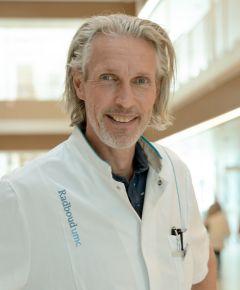
Professor Bas Bloem is a neurologist at the Radboud University Medical Centre, Nijmegen, The Netherlands. He received his medical degree, with honours, at Leiden University Medical Centre in 1993 and obtained his PhD degree in 1994. He trained as a neurologist between 1994 and 2000. He received additional training as specialist in movement disorders during fellowships at The Parkinson's Institute, Sunnyvale, California, and the Institute of Neurology, Queen Square, London. In September 2008, he was appointed professor of neurology, with movement disorders as special area of interest.
Professor Bloem is on the editorial board of leading national and international (scientific) journals and has over 800 publications to his credit. Since 2020 he serves as Co-Editor in Chief of the Journal of Parkinson's Disease. In 2002, Professor Bloem founded the Radboudumc Center of Expertise for Parkinson's & Movement Disorders and, together with Dr. Marten Munneke, developed ParkinsonNet, an innovative care concept for Parkinson's patients consisting of 70 professional regional networks. In 2018, he won the Tom Isaacs award in recognition of his long-standing achievements in the field of Parkinson's disease. In 2022 he received the Stevin Award, the highest recognition for a Dutch scientist who has had greatest impact on society.

Want more?
Don't forget to subscribe! There are many ways to listen: Apple Podcasts, TuneIn (Amazon Echo), Spotify or RSS Feed. (Need help subscribing? See our quick guide.)
For all of our Substantial Matters podcast episodes, visit Parkinson.org/Podcast.
Related Materials
Related Blog Posts

Painting with Parkinson’s: All About Art Therapy

Expert Care Experience: Dance/Movement Therapy
