Episode 182: Allied Health Spotlight: Partnering with an Occupational Therapist
-
Dan Keller 0:03
Welcome to this episode of Substantial Matters: Life and Science of Parkinson's. I'm your host, Dan Keller. At the Parkinson's Foundation, we want all people with Parkinson's and their families to get the care and support they need. Better care starts with better research and leads to better lives. In this podcast series, we highlight the fruits of that research, the treatments and techniques that can help you live a better life now, as well as research that can bring a better tomorrow.
Living a better life with Parkinson's is not just about managing the medical components of the disease, it also involves supporting every aspect of daily life, and that is where occupational therapists, or OTs, come in. Occupation, in this sense, doesn't refer to work, but means what you occupy yourself with in daily life. As part of a comprehensive Parkinson's team, OTs are allied health professionals with the training, expertise, and creativity to help people solve both the big and small physical or mental challenges of daily living, from taking a shower, getting dressed, or opening a can in the kitchen. I spoke with occupational therapist Karyssa Silva of Alders Bridge Communities in Rhode Island to better understand where OTs fit into the healthcare team and how they provide solutions to problems that people with PD may have in their daily lives. Why don't you tell me a little bit about yourself and what inspired you to become an occupational therapist, and especially a focus with Parkinson's disease?
Karyssa Silva 2:00
So I have been an occupational therapist now for about 15 years. I first went into the field strictly wanting to work with children. My brother was diagnosed with a sensory processing disorder, which is now a part of the autism spectrum, but when he was first diagnosed, it was not considered an autism-type diagnosis, I guess you could say. So, my plan was to strictly work with children, and I did quite a few placements of fieldwork that is required by my degree in the school system, and I loved it. And then I kind of faced my fears and had to go to a placement that worked with the geriatric population and ended up falling in love. I was provided the great opportunity to work even before I had graduated. I was offered a job from the rehab director at my placement before graduation and before passing my boards—which are standardized tests that need to be taken—and I have not left the geriatric or older adult population since. I haven't stepped foot back into a school unless it's for one of my children, and I'm just as happy as I was on day one, which is great.
Dan Keller 3:23
You've worked at both ends of the age spectrum. What is it that you particularly find rewarding or attractive with the geriatric population?
Karyssa Silva 3:34
It's OT in general, to be very honest, that I find the most rewarding, and with that being said, is the fact that you see the progress that people make in themselves. And it doesn't matter which age group you're really talking about, you know, you're working with the younger generation, and they're finally able to have great, legible handwriting that their teacher and their parents are so proud of, and you can see that gleam kind of just beaming off of them. And the same goes for the geriatric population, or the older adult population—it's being able to do the tasks that they were once doing on their own, or that they could remember doing, and being able to do it again, whether it's slightly modified or not. It's just that rewarding factor of, "I've got this, I can do this," and that self-confidence that just really comes off.
Dan Keller 4:33
When do you recommend that a person with Parkinson's see an OT, and how do they find OT services?
Karyssa Silva 4:42
So that's a really great question, because not everybody with Parkinson's knows to look for an OT, or occupational therapy. I call it the bridge between physical therapy and speech therapy. Everybody knows that physical therapy is going to help them get walking and relieve any type of pain that they have, and speech therapy will help people with their swallowing deficit, or any type of cognitive deficit. So, what is left for OT? And that's what's so great about OT.
OT plays a vital role in helping people manage symptoms, or whatever they're having a difficult time with, to stay independent within their daily lives. So, yep, you can walk to the bathroom, but are you able to have the balance to go to the bathroom, or get in the shower, or be able to do things independently? That's where it really helps people with Parkinson's. To answer your first question, anybody with Parkinson's should see an OT as soon as they are diagnosed, because they saw something or something was brought to their attention that made them go out to kind of look for a diagnosis or an answer to why things were happening.
A lot of people have told me that it's happened with handwriting; they saw a difference in their handwriting. It was getting smaller, it was getting illegible, and they couldn't figure it out. Or somebody who, you know, walked miles and had a walking partner, all of a sudden the walking partner said, "Why aren't you swinging your arms? That's not really common for you." It's things like that that people are being told or recognizing in themselves that are causing them to reach out to doctors for a diagnosis or just for an answer, and that's when you should see an OT, because OT can help with symptoms that are so minute but making a difference in your life.
Dan Keller 6:38
Would the doctor refer out to an OT? Is that a good way to find someone in the field?
Karyssa Silva 6:45
Certainly. I don't know, honestly, especially after speaking to a number of neurologists, if the neurologist would automatically think, like, "Let me get you into an OT to see." They certainly can, and typically with any outpatient or home health, you would need a doctor's referral, and that could come from your physician or your neurologist, or whoever you see is managing your Parkinson's diagnosis.
But I don't think that they would think right off the bat, "Let me get you into an OT, just to kind of fine-tune those little tasks that are getting more troublesome for you." I think it's kind of knowing and having that knowledge of what OT is, and seeking out that referral. I haven't had a doctor yet tell a patient, "I think you should wait to see an OT." They're usually very happy to sign that referral over, but it is more self-advocating, or a caregiver advocating for OT.
Dan Keller 7:44
You named getting into the shower as one challenge, or a person noticing they have smaller handwriting. What are some other common challenges people notice, or someone else brings to their attention?
Karyssa Silva 8:00
We know with Parkinson's that it's a motor disorder, so people have a harder time moving, and right off the bat, typically people know that. What they don't realize is how it can affect cognition, or how it can affect the internal depression and anxiety of not wanting to go out in public. So what we see most is that, "I'm walking fine, I can get dressed fine, I can get in and out of the shower. Yes, my handwriting is getting smaller, I'm not swinging my arms," but it's getting people to realize what that could cause.
So not swinging your arms, you're not walking as fast as you were, which is preventing some people from going on the walks with friends around the neighborhood like they were, causing more of a depression than what the disorder can already cause. We also see that if you're not swinging your arms, it could throw your balance off, and people are falling, causing them to have some type of knee injury or wrist injury, or, "Oh my goodness, I'm falling, I can't go out in public, because what happens if I fall?" So we see a lot of the internal issues that we're dealing with with people, as well as fine motor and gross motor problems that people are having.
Dan Keller 9:22
With those challenges, can occupational therapy make a difference? Can they be remediated? Maybe people aren't swinging their arms, and they're almost unaware of it, but with intention, say, can they learn to walk with a better gait?
Karyssa Silva 9:40
Absolutely, absolutely. And the earlier you find these difficulties, the easier it is to fix or correct or adapt to those difficulties. So, for people not swinging their arms, as I mentioned, I am LSVT certified, and that is one of the big, big things that we do with people. It's called "BIG walking," and it seems a little crazy. I've had people who have told me, "I am not walking in the grocery store like that," and you're right, you shouldn't walk in the grocery store with, you know, these great big arm swings and this gait length that is a little exaggerated.
However, what feels exaggerated to somebody with Parkinson's typically looks normal to somebody that doesn't have Parkinson's or that has no idea about any type of disorder out there. So it might feel really big to them, but it doesn't look as big as it feels. So things like that can be corrected, and that's why caregiver education is huge. If you go to the store with your loved one or a friend, having them in a session or two to be like, "Hey, make sure you get your BIG walking in," or, "Swing those arms"—sometimes we need those reminders, and everybody needs gentle reminders all the time to do things, so it certainly is correctable, or at least adaptable.
Dan Keller 11:11
What does a first meeting with an occupational therapist look like? What should someone expect, and what happens during an evaluation?
Karyssa Silva 11:22
So the initial OT evaluation is just a way for us to get to know the person, know what their routines are, what they're looking for, and what they want from us. It's a lot of explaining what OT is. We see how the person is moving; if it's home care, then we see how they're doing in their own environment. Typically, the home care evaluation will look like how you do getting in and out of bed, in and out of your shower, and in and out of your favorite chair. If you're a big gardener, making sure how you do getting in and out of the house to go to the garden.
We are focused on the person, and every therapist is, but we are really focused on what is most valuable to you and what we need to help you do in order to be as successful in life and do those things that you want to do. It's a lot of question-asking and seeing how somebody maneuvers, whether they get fatigued, and how quickly they get fatigued in their sequencing of tasks. So, if they are a gardener, what steps do you need so that you're not going back and forth to the garage to get the tools you need? It's mostly just observing and then going forward with, "How are we going to correct or adapt, or what is the best way for you to be able to get this task done that means the most to you?"
Dan Keller 12:56
People operate in a big sphere—at home, at work, social settings, things like that. To evaluate someone comprehensively, is a home visit recommended, or can you do it virtually, or do you just talk to the person and they tell you what they're having problems with?
Karyssa Silva 13:14
I know we live in 2025 and virtual has now, since COVID, become a big thing. I don't love virtual visits. I don't feel like it's as interactive as possible, or as I prefer it to be. And again, this is just my preference. It can certainly be done in a clinic, at an outpatient clinic, mostly because you're seeing obviously how the person moves—not within their own environment—but you have the resources as far as strengthening and the machines and the tools to help that person target the certain muscle groups that you need in order to do the tasks that they love. Of course, seeing somebody in their home, like you said, that's their environment, that's how they maneuver, so in-home is great, but an outpatient clinic would suffice just as well.
Dan Keller 14:09
Do you recommend to them any ways to modify their home environment for better function and things like that? I've noticed as the population ages, a lot of home improvement stores have seen a market there, and they've got a lot of assistive devices, and the big online retailers have them. So, are you a resource for ways that they can modify their environment for better function?
Karyssa Silva 14:36
Absolutely, absolutely. So, home evaluations are something that OTs are pretty well known for, and again, we could do a virtual home evaluation. I like to see the person in their home to see how they're doing, because sometimes they don't realize that it's that one rug that they're tripping over or that is moving under their feet that could not be as safe. But people have brought us in pictures of their home, or measured, you know, "This is the lip of my tub, and I'm having a hard time getting over this lip." So if it's—I'm making up inches—but if it's four inches, we make sure that if we're in an outpatient clinic, they're able to step over something that is four inches high.
And it's really a lot of caregiver education. It's a lot of finding that one person who is going to be your support person that you can really rely on, so that we can go back and say—I mean, we've all been to the doctor's office and walked out and said, "What did he say about that? What did they say?" So it's having that other person, or even asking the therapist to write down our total recommendations of what to do for the bathroom, what to do even in your bedroom, or how you can adapt the simplest chair or wicker chair that you love sitting out on your porch. Definitely, we could definitely help with home evaluations and just giving those ideas, little things that you wouldn't even think of.
Dan Keller 16:10
We've recently had a podcast that talks about preparing for a doctor's visit, being at the doctor's visit, and after the visit, so that might be something that people also wanted to refer back to on our site. What do you find yourself recommending most? Maybe in general, what kind of tips or tools?
Karyssa Silva 16:33
That's a good question, because it truly relies on the person and where they are in their Parkinson's journey; it really depends. One of the biggest things I think would be a support group. I've talked quite a bit about the intrinsic feelings of depression and anxiety, but it truly is knowing that you're not alone, and other people are very creative and have come up with ways that they've handled things or adapted things that have helped them that I've seen come out in support groups, and the same thing goes for the caregivers. Caregivers seem to put themselves on the back burner, and it can be more daunting than helping. So having a caregiver support group, or, you know, even if it's an online chat, or just somebody who can relate—that is one of, I think, the biggest things I've recommended.
Obviously, besides small things like Therapy Putty that you can get on Amazon, which helps with fine motor strength and grip strength, and sit-to-stand type exercises or machines that help with lifts. Those are probably not as much recommended, but the smaller stress balls and small things like that. Nothing expensive, it doesn't have to be fancy, it just has to all be about function. Truly.
Dan Keller 18:01
People have problems with various conditions—multiple sclerosis, Parkinson's—with clothing and dressing, and shoes, and things like that. Buttons and zippers are not easy to operate for small fine motor function, but now there's clothes with Velcro closures, magnets, so doesn't it get into that arena?
Karyssa Silva 18:27
That's our realm, that is us. If you had to describe OT in one sentence, what you just said describes us—that is us, that's what we do. We make things that you have to do to be a functioning human in society easier for you. So whether that's a sock aid, which is a mechanism that helps you put your sock on if you can't reach down or you don't have that fine motor strength to really get it over your feet, dressing sticks—which can be a little difficult for people, those are a little bit of the old-school type of OT—but absolutely Velcro, elastic shoelaces, magnets, like you were saying. People have come up with numerous ideas of how to just be able to get out into society and be who you were before your diagnosis.
Dan Keller 19:20
My father had had a hip replacement, and he had problems with it. It would disjoint, especially when he was trying to bend over to tie his shoes. A simple solution was to get loafers and get a long-handled shoehorn; that solved the problem.
Karyssa Silva 19:36
Exactly. I had a gentleman who could not—he lived alone—he could not open jars, could not for the life of him open jars. And he came up with this vice-type mechanism that stuck on his counter. I got him some Dycem, which is really like a cabinet liner; it allows for—it's an anti-slip type of fabric or mat. And with that, with his vice and my Dycem, he was opening every jar possible that he needed to open. So like I said, it isn't fancy, it's not about fancy equipment, it's really about function. And if it's functional to you, then let's do it, let's figure it out, and come up with a way for you to be able to do the things that you need to do.
Dan Keller 20:28
Sounds like there's some creativity in this, you know. Stand back, look at the problem, and find the solution, which doesn't have to be high-tech. What's the one thing you wish more people understood about occupational therapy and its role, especially in Parkinson's care, in this case?
Karyssa Silva 20:48
I wish people understood that we are just as valuable as the PT that you're seeing. I love my PTs, and I love my speech therapists, but we are just as valuable in your entire journey. We can help, like I said, from day one until the day that it's getting more difficult to even get out of bed. We can tailor any type of plan, exercise, task—we can tailor it, that is us. You know, in school, we learned about the "just right challenge," and that was drilled into us for years: making sure that that person is challenged just enough, but can still complete the task as needed.
Dan Keller 21:39
We had a podcast episode with a clinical social worker, and he described social workers as the Yellow Pages of services; they know where to direct everybody. It sounds like you're sort of the Yellow Pages of daily function.
Karyssa Silva 21:59
Absolutely, absolutely.
Dan Keller 22:04
Is there any nutshell message to people who might avail themselves of the services of occupational therapists, but are not yet doing it?
Karyssa Silva 22:12
Absolutely, give it a shot. It will not be a waste of your time. And if you don't feel stronger—I think that's really where people hold up for PT, you know, "My knee replacement is your dad's hip replacement," I'm sure his hip was sore after he was done with his PT, but he could feel it getting stronger. OT is the same way, but your muscles aren't really going to hurt. It's not that, you know, "I just worked out and I'm feeling stronger, and I'm running up these stairs like I was when I was 20." We aren't so much doing that, but we're going to make sure that your shoe is tied, so that you can run up those stairs without falling.
It's little things—we're not just adapting to your loss, it's about staying active, it's staying independent, it's staying engaged. We make things easier for you so that you can go on and go to PT, I guess you could say, and have your muscles sore. So some people walk out of OT and they're like, "I don't really feel any different." You won't, but you're going to notice the difference if you give us a shot.
Dan Keller 23:26
Great, I appreciate the information and all the time, and I'm sure you've kind of enlightened people to another service that maybe they just hadn't thought of before to solve some problems they already have. Thanks a lot. Take care.
Karyssa Silva 23:42
Absolutely. Thank you.
Dan Keller 23:52
To find an occupational therapist, you can ask your doctor's office, a local hospital, or a university occupational therapy program. Whomever you find, just make sure they have experience working with people with PD. You can also speak with our helpline specialists, as we mentioned in the interview. You can find many assistive devices online or locally to help improve your home environment. Home improvement stores are also another option; just search their websites for assistive devices.
Two of our past podcasts may also be helpful, as Karyssa said. People sometimes walk away from their OT appointment and wonder if they missed something that was said. One podcast called "Make Every Minute Count: Optimizing Your Parkinson's Doctor Visits" applies just as well to a visit to the OT. In the show notes, we include a link to a worksheet to help you organize your thoughts to make the most of your time with your doctor or OT. See a recent webinar on this topic; visit parkinson.org/pdlibrary and search for "Taking Charge." Finally, another past podcast called "Aging in Place" shares ways to modify your home to fit your needs and find a suitable area to live in, so you can stay in your own home as long as possible.
As always, our PD information specialists can answer questions and provide information in English or Spanish about this topic or anything else having to do with Parkinson's. You can reach them at 1-800-4PD-INFO. If you have questions or want to leave feedback on this podcast or any other subject, you can do it at parkinson.org/feedback. If you enjoyed this podcast, be sure to subscribe and rate and review the series on Apple Podcasts or wherever you get your podcasts. At the Parkinson's Foundation, our mission is to help every person diagnosed with Parkinson's live the best possible life today. To that end, we'll be bringing you a new episode in this podcast series every month. Till then, for more information and resources visit parkinson.org or call our toll-free helpline at 1-800-4PD-INFO, that's 1-800-473-4636. Thank you for listening.
Karyssa Silva 26:39
Thank you.
Allied health professionals are a group of healthcare providers whose role and expertise complement the work of physicians. They include specialists such as physical and occupational therapists, speech-language pathologists, nutritionists, and many more. They are just as important as your Movement Disorders Specialists and Neurologists and play a vital role in creating a comprehensive, well-rounded Parkinson’s care team that attends to your individual needs and addresses your overall well-being.
Many people are familiar with physical and speech therapists, but fewer recognize the valuable benefits of working with an occupational therapist (OT). An OT helps identify the activities that you enjoy and ensures strategies are in place so you can continue doing what matters most. They work with you to adapt your environment, tap into your strengths, and create realistic strategies so you can keep living life on your terms.
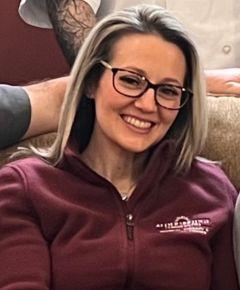
In this episode, Karyssa Silva, MS, OTR/L, CLT, an occupational therapist at Aldersbridge Physical Therapy & Wellness Outpatient Center in Rhode Island, shares how she helps people with Parkinson’s with daily tasks and activities that bring them joy. She works closely with people with PD and their loved ones to address physical and mental challenges, empowering them to stay engaged in the activities they value the most.
Steps to Prepare for a Parkinson’s Appointment: Worksheet
Released: August 19, 2025
-
Karyssa Silva is the Director of Rehabilitation at Aldersbridge Physical Therapy & Wellness Outpatient Center in East Providence, Rhode Island, where she leads a dedicated team of Occupational, Physical, and Speech Therapists. Licensed in both Rhode Island and Massachusetts, Karyssa brings over a decade of clinical and leadership experience to her role.
She began her career in 2010 as a Certified Occupational Therapy Assistant in a skilled nursing facility, quickly advancing to Director of Rehabilitation. In 2014, she earned her Master’s Degree in Occupational Therapy from the New England Institute of Technology. Her diverse background spans skilled nursing, home health, and outpatient care, with specialized expertise in LSVT BIG for Parkinson’s disease and certification as a Lymphedema Therapist. Karyssa is passionate about helping individuals with neurological and chronic conditions maintain their independence, function, and quality of life.

Want more?
Don't forget to subscribe! There are many ways to listen: Apple Podcasts, TuneIn (Amazon Echo), Spotify or RSS Feed. (Need help subscribing? See our quick guide.)
For all of our Substantial Matters podcast episodes, visit Parkinson.org/Podcast.
Related Materials
Occupational Therapy & Parkinson's
Steps to Prepare for a Parkinson’s Appointment
Related Blog Posts

