Episode 161: Atypical Parkinsonism Series: Unique Care Needs of PSP, CBD and MSA
-
Dan Keller 0:02
Welcome to this episode of Substantial Matters: Life and Science of Parkinson's. I'm your host, Dan Keller. At the Parkinson's Foundation, we want all people with Parkinson's and their families to get the care and support they need. Better care starts with better research and leads to better lives. In this podcast series, we highlight the fruits of that research—the treatments and techniques that can help you live a better life now, as well as research that can bring a better tomorrow.
Before kicking off today's episode, I would like to confirm that I have no relevant financial disclosures. This is the third of three podcast episodes within our atypical Parkinsonism podcast series, organized in collaboration with CurePSP and designed to increase awareness and improve the care of progressive supranuclear palsy (or PSP for short), corticobasal degeneration (or CBD), and multiple system atrophy (or MSA)—neurodegenerative diseases often considered atypical Parkinsonian syndromes.
Over half of people with PSP, CBD, and MSA are initially diagnosed with Parkinson's disease (or PD) due to common early Parkinsonian symptoms, including bradykinesia, rigidity, tremor, and gait changes. They are rare diseases affecting less than 60,000 people in the US, compared to over 1 million people in the US with PD. Due to the lack of understanding and experience among healthcare providers, it takes an average of two and a half years to arrive at a clinical diagnosis of PSP, CBD, or MSA, and it is thought that only 25% of people with PSP, CBD, and MSA are accurately diagnosed. Currently, there is little to no formal training available on atypical Parkinson's for clinicians, and most become familiar with their assessment, diagnosis, and treatment on the job.
To address this gap, we have produced this podcast series, which is part of a larger program we have developed in partnership with CurePSP to educate the medical community. If you are a healthcare professional and would like to receive credit for your time listening to this three-part podcast series, please visit the Parkinson's Foundation Learning Lab. You can learn more about this opportunity at the end of this episode.
Today's guests, Jessica Shurer, Director of Clinical Affairs and Advocacy at CurePSP, and Nancy Montgomery, who cared for her husband who was diagnosed with progressive supranuclear palsy, will discuss the unique challenges of people living with PSP, CBD, or MSA and name helpful resources that support the quality of life of patients and family care partners. Jessica Shurer and Nancy Montgomery have disclosed that they have no relevant financial disclosures.
Jessica, there's a long and confusing road to diagnosis among these conditions. Can you just flesh that out—the reasons, time delay, things like that?
Jessica Shurer 3:48
Sure. So we're talking about three related diagnoses: progressive supranuclear palsy, corticobasal degeneration, and multiple system atrophy. I know you've had two podcasts before this, so all three are atypical Parkinsonian syndromes. They tend to progress a lot faster, don't respond as well to medications, and have earlier, more significant, and kind of funkier symptoms. So, oftentimes, individuals are originally diagnosed with something else—very often Parkinson's disease, sometimes a different neurodegenerative disease, or they'll explore autoimmune diseases or genetic conditions.
But then, usually a few months or a few years in, these other symptoms come out and progress faster, and so it makes the doctors think, "Okay, something else is going on here." It still takes an average of two and a half years to arrive at the correct diagnosis of PSP, CBD, or MSA. During that time, for a lot of families—of course, this is different for every patient and family—many go through what I call a diagnostic odyssey of seeing multiple neurologists and other specialists, going through different tests, trying different medications, and often being given different diagnoses until they get to that correct one. That can be a very confusing and scary process for them when they're just wanting answers on what's going on, you know? I'm curious, Nancy, was that the case for you and your husband?
Nancy Montgomery 5:39
Absolutely, Jessica. My husband had a diagnosis of Parkinson's, and we went through that whole process with the medications, and even up to the deep brain stimulation surgery. Then we moved, changed neurologists, and during the first meeting with our new neurologist, he said, "I think you have this progressive supranuclear palsy." We were like, "We've never heard of it before," and that was what started our journey.
Specifically for me, I was doing research, found CurePSP, and also found that here in Columbus, Ohio, at that time, there was not a support group. We wanted to reach out and meet others who had the same condition, so that's how I ended up getting into facilitating. I found out that, indeed, one of the frustrations is trying to get that diagnosis. They might get one, two, or three different diagnoses depending upon who they're talking to, and it does become very confusing and very frustrating. Then once they have the diagnosis, it's like, "Well, okay, is it PSP? Is it CBD? Is it MSA?" As we talk about it in our groups, the symptoms, the reactions, and the handling of the journey are really very similar for those three illnesses, but very different from Parkinson's.
Dan Keller 7:13
Nancy, you said that it was a second neurologist who arrived at the diagnosis. Do you have to educate healthcare professionals about the diagnosis—not only neurologists, but anyone who is treating someone with one of these more rare conditions?
Nancy Montgomery 7:31
Absolutely. Education of the medical professionals is very, very important. These are such rare diseases that a lot of medical professionals—neurologists, primary care doctors, therapists—never see a patient with one of the atypical Parkinson's conditions. So we, as the care partners and the patients, are really providing them with a lot of information.
As a CurePSP volunteer, one of the things that I do is try to get information to the neurologists and the medical care people. With my husband's primary care doctor, the first time I saw him, I said, "I don't want to offend you, but here is information about PSP and the other related diseases." He was so thankful. Having the materials to be able to give out to medical professionals is really, really important.
Jessica Shurer 8:26
I just want to underline that point, if I may, because it's so incredibly important. This is at the core of why the Parkinson's Foundation and CurePSP are partnering for this multi-part educational program, because we need to better educate healthcare professionals so that we can get people to the right diagnosis and the right care faster.
A point that you made, Nancy, that I want to highlight too, is when you go from a diagnosis of Parkinson's disease—where at a minimum you're somewhat familiar with it, there are so many resources out there for it, there's such a large community of people, and there are healthcare providers that are very specialized in it or at least familiar with it—and you go from that kind of community and wealth of resources to something that you've never heard of before, and most healthcare professionals have never heard of, there's a huge vulnerability in that. That's why we're doing this program, so that we can help people in that diagnostic odyssey.
Dan Keller 9:39
The Parkinson's Foundation has what they call ambassadors. These are usually care partners or laypeople who do outreach to the medical community. Is there any such thing for these conditions, or are they so rare that it's hard to get enough people to be ambassadors?
Nancy Montgomery 9:58
I can jump in and speak to what we're doing here in Columbus. There's another CurePSP volunteer in the area, and she and I get materials from CurePSP and provide them to healthcare professionals. Particularly, we try to get them to the therapists, because there are oftentimes they're going to look at a patient and say, "I've seen a lot of Parkinson's patients, but this looks a little bit different." We also spend time at an annual neuroscience convention that is held here; we always have a table there and a presence so we can talk one-on-one to those individuals. So that's a very important part of the CurePSP program.
Jessica Shurer 10:44
Absolutely. We don't have something exactly called ambassadors, but we have peer supporters or other volunteers working in different capacities and roles. A big focus for so many of them is raising this awareness at different levels in their local communities, with local healthcare professionals, or even up to legislative advocacy and everywhere in between. Nancy made a great point earlier about having to educate their own healthcare professionals. On one hand, there's so much frustration in that. What an odd layer to this disease journey to have to be your own expert and educate your doctors. At the same time, there's so much empowerment in that for our community.
Dan Keller 11:32
How about on the other side of the coin—doctors bringing information to the families and the patients? How much do they have to tailor their language and terminology to meet the families and patients where they really are?
Jessica Shurer 11:51
I think it depends. I think that as healthcare professionals, we should always meet people where they are, and that means providing individualized care. We say in Parkinson's disease, "If you've met one person with Parkinson's, you've met one person with Parkinson's," because everyone has such a different journey, experience, and progression. It's the same for individuals with these diseases.
So, we need to understand how much information somebody is willing to hear at that moment, how they digest information, and what kind of support they need. Part of that is leading people to the right resources when they're ready for them. I think that communication between healthcare professionals and the individuals and families is really key to building rapport and trust, because they're often looking for someone who knows about these diseases to help guide and support them from the time of diagnosis through the end of life.
Dan Keller 12:58
The medical profession over the years, maybe not so much at this point, has always been looked at as paternalistic—sort of top-down. In these ongoing conversations after diagnosis, but during the course of the disease, how much should the patient be involved or not ignored? I mean, sort of talking only to the caregiver while the patient just sits there not being involved. How much effort should be made to bring them into the conversation and the decisions?
Nancy Montgomery 13:31
That's really a very interesting question, and it really ties to what Jessica was saying about speaking to the level of the patient and the care partner, as well as talking to them about issues as they're ready. So many people are just so totally overwhelmed—they've heard of Parkinson's, they haven't heard of these other illnesses, and they're just, shall we say, freaked out.
The medical professionals really need to take a cue from the patient, who typically understands what the medical provider is saying but sometimes has difficulty processing it, as well as processing their speech to be able to answer a question. In my experience, I did most of the talking, but it was based on what my husband was communicating to me in his own way, so I felt that we were both very much partners in that process.
Jessica Shurer 14:39
And to add to that too, because those are such great points, Nancy, and thank you for adding your personal experience. With all three of these diseases, there are a lot of speech and voice challenges, and for PSP and CBD particularly, there can be some cognitive challenges as well. Because of that, if it's a lot harder for someone to verbalize their wishes or answer questions, a lot of providers, to your point, Dan, kind of just talk around them, and that is not truly patient- or person-centered care.
We need to practice a lot of patience with that and take a family-centered care approach. We shouldn't pretend someone is not there and talk about them, but turn to the person with the diagnosis as much as possible to say, "We're talking about a lot right now. Do you have questions?" or "Do you agree with this?" and meet them at that level.
Another point I'd love to bring up with this too is when healthcare professionals communicate and educate about these diseases, I think a big difference between Parkinson's disease and these other diseases is the messaging. In Parkinson's, while we recognize it's still hard for many reasons—no one wants to live with a progressive neurological diagnosis—there's a message of, "You're going to live for a long time with it, there are many treatments available, exercise can help manage symptoms and slow the progression, and you've got this. You can live really well with this."
With these diseases, because they progress a lot faster—I once had a care partner tell me it's like being on a fast-moving train you can't get off of—sometimes healthcare professionals don't know how to sensitively offer hope when they're providing education. I've had so many people over the years come to me saying, "My doctor said I have MSA or CBD, and they told me there's really nothing that can be done, it's terminal, exercise doesn't slow it, and medications don't help." It leaves them feeling extremely helpless and extremely hopeless. So I think a really important part of building this relationship and supporting people is how we provide this information—offering hope while still being realistic about the diseases.
Nancy Montgomery 17:20
I'd like to tag on to what Jessica was just saying about the frustration of being on this journey when nobody is really sure exactly what that journey is going to be; that's a sense of frustration for everybody. My own personal bias is toward support groups. In many of the support groups that I facilitate, including a Parkinson's support group, we hear so much about the symptoms. A lot of it is, "I'm having this problem. Maybe urinary incontinence is a big one. How have you other people dealt with this? What are the tips and tricks that you have found?" A number of the people in the support group will say that they learn so much from that group about how to handle the practical day-to-day things to make their lives better.
Dan Keller 18:20
Speaking of day-to-day things, it seems like the logistics could be overwhelming. There are many different healthcare professionals involved, appointments, and everything else. Do you find this is all-consuming?
Nancy Montgomery 18:34
Absolutely, yes. It reaches a point where it's very difficult. The patients have very limited mobility, so being able to take them to an appointment—not just to their neurologist, but if they're in therapy, going to all the different therapists—becomes very, very difficult, overwhelming, and tiring.
One of the best things is home healthcare. A number of medical professionals will come into the home, and having that support in their own home provides two advantages: one, they're getting attention and medical care, but they're also getting it in their own environment. If somebody is having difficulty with transfers—moving from a chair or a bed to a wheelchair—having that professional in the home is so helpful because they're in the real situation, not in the clinic situation.
Dan Keller 19:36
What do you do to take care of yourself?
Nancy Montgomery 19:40
Oh, geez, that is the toughest question. I hear so often from people, "I feel so alone." Again, I think the support groups help. Getting friends and family, if you can, to come in just for an hour so that you can go out for a walk or go grocery shopping helps. Grocery shopping becomes a privilege, not a chore, when you get that hour away from that immediate circumstance.
Bring in home healthcare if you can—not just the medical professionals, but home aides. And one of the things is, it's never too late to start talking to hospice. Hospice is a wonderful resource, and I think a lot of people think, "Okay, well, this is the end," and that's not the case. Hospice is another layer of support and is so helpful. By talking to them, you're not making a commitment at that first conversation; however, you're making those contacts, and when you get to the point where it's like, "I absolutely can't do this myself, I need help," you know who to call.
Jessica Shurer 20:48
I think that's a really important role that healthcare professionals can play: educating patients and families about these kinds of resources earlier. These conversations—and especially the not-so-fun conversations—necessarily need to happen a lot earlier in these diseases. So, when to bring in respite care services like in-home care, thinking about end-of-life, and tapping into palliative care and hospice.
Also, brain donation is incredibly important for understanding these diseases, and that decision, if someone wants to pursue that, needs to happen earlier. I think that's part of the guidance and education that healthcare professionals can offer patients and families as they're navigating all of this.
Dan Keller 21:39
I take it brain donation is critical to advancing research.
Jessica Shurer 21:44
Absolutely. They're using brain tissue to understand where in the brain this starts, how the proteins are aggregating, and why this is even occurring. Right now, we don't have disease-modifying treatments for these conditions, let alone a cure. First understanding why they're happening and why the proteins are misfolding differently will lead us to creating better treatments, so that hopefully people can not only live longer but live with a better quality of life.
Dan Keller 22:19
There's advanced care planning, but what about other kinds of advanced planning, such as finances, wills, living wills, and directives?
Nancy Montgomery 22:31
It is extremely important to start on them yesterday—and not just for the patient, but also for the care partner. One of the things I think we tend to neglect as a care partner is our own health and our own well-being. Oh geez, what if something happens to me? In my situation, my husband would have been totally lost.
So, have all that preparation: make sure that you have that will, you have the medical directive, and you have a DNR if that's what you want. You decide ahead of time whether a feeding tube is what the patient wants or not, so that all of this is set. The finances, where everything is... and geez, just try to write down all of the different passwords that you have for all the different websites that you go on. It is so important to have that documented for both the patient and the care partner.
Dan Keller 23:31
What are some of the key takeaways? Is it possible to encapsulate some messages? Jessica?
Jessica Shurer 23:39
Sure, where to start with that. I think that it's critical to recognize the overlaps in care, needs, and treatment options for people with atypical Parkinsonian syndromes and other more common diseases like Parkinson's disease. This allows the two communities, as the Parkinson's Foundation and CurePSP are doing, to align and build a larger community through that.
At the same time, we must recognize the distinct, unique challenges of people living with these rare diseases. As Nancy said, they can create a sense of isolation, vulnerability, and anticipatory grief that happens a lot earlier. So I think realizing where we have those overlaps and commonalities, and where this community is different, is key to making sure that care is being individualized and specialized to meet those unique needs. Nancy, what would you add to that?
Nancy Montgomery 24:51
You're absolutely right on, Jessica. What I would add is that, as a healthcare professional, you need to understand that you are seeing that patient and that care partner in a snippet of time. You might see them one hour a month, one hour a week, or one hour a day; you're not seeing them 24/7. So please understand that when you are ending your session with that patient and care partner, those two people are going back to their reality, which could be very different than what you're seeing in that session. Please understand that you are only seeing that snippet in time, and the concerns that the patient and the care partner express, while you may not see them, are very real to them.
Dan Keller 25:47
Finally, it would be ideal if everybody were near a Center of Excellence that dealt with PSP, MSA, and CBD. Short of that, where can they turn to bring in information and knowledge, wherever they are geographically?
Jessica Shurer 26:08
Sure. I think a beauty of this partnership between our two organizations is that CurePSP has a network of what we call Centers of Care. It's 30 medical centers total—28 in the US and two in Canada—that offer specialized services for PSP, CBD, and MSA. The Parkinson's Foundation has a similar program called the Center of Excellence program, and something like two-thirds of our centers overlap. So there are these centers out there where the providers truly understand these diseases, but we also recognize that not everyone lives near them.
Telemedicine is available now, and that's helped with access to care in so many ways, though it hasn't fixed all the access issues. I would say first find out if you live in an area where one of these centers exists or if you're able to travel to one of them. If not, you can reach out to either the Parkinson's Foundation or, especially if you're living with one of these diseases, to CurePSP to see what resources are in your local community, such as support groups or trained healthcare providers.
CurePSP also has a wealth of resources on our website, both digital and ones that you can either print or we can mail to you specific to these diseases. You can use them not only to educate yourself, but you can bring them to your healthcare professionals. For example, we are updating what I call our Allied Health booklet right now to make it a lot more comprehensive, and it's specifically for physical, occupational, and speech therapists. We can mail that to someone, and you can bring it to your local physical therapist who may have never worked with someone with your diagnosis before. You can say, "Please read this, because I need to be treated a little bit differently from a Parkinson's disease patient. Here are these unique considerations." Tapping into those kinds of tools helps you build your team around that.
Dan Keller 28:24
Have we missed anything important from either of you?
Nancy Montgomery 28:28
I will just add to what Jessica just said from a day-to-day perspective of how to manage beyond the medical. Every county in the United States has access to an Area Agency on Aging office. They have wonderful resources to help patients find someone to do transportation, to sign up for Meals on Wheels, and that kind of resource.
There's also a lot of confusion with veterans. They go to the Veterans Administration and might be told, "Well, you don't qualify for this." We have found that the Disabled American Veterans organization tends to be very helpful too. So, those are some of the resources that anybody working with one of these patients or their care partner can suggest to help them handle the day-to-day type of thing.
Dan Keller 29:27
Very good, I appreciate it. A lot of information—a lot of useful information that I'm sure people can draw upon. So, thanks.
Jessica Shurer 29:34
It's such an important topic. I'm so glad we're having this conversation. I appreciate both the Parkinson's Foundation's support in it, as well as your time, Dan.
Nancy Montgomery 29:45
And Jessica, thank you for involving me. I appreciate it.
Jessica Shurer 29:49
Oh my gosh, thank you for telling your story and offering your personal insight. You're the true expert in this. Thank you.
Dan Keller 30:04
We hope you were also able to listen to the first two episodes of the Atypical Parkinsonism podcast series, which cover common early symptoms of PSP, CBD, and MSA, the overlaps and differences with Parkinson's disease, and the interprofessional approaches to symptom management for these syndromes.
You can also visit our PD library at parkinson.org/library to read our fact sheet on the topic titled Parkinson's Disease versus Parkinsonism, as well as visit CurePSP's website, www.curepsp.org, to learn more about PSP, CBD, and MSA and other resources available. And if you are a healthcare professional seeking accreditation for this podcast series, you can visit the Parkinson's Foundation Learning Lab at education.parkinson.org/atypical to log in and claim your continuing medical education credit.
If you want to leave feedback on this podcast or any other subject, you can do it at parkinson.org/feedback. If you enjoyed this podcast, be sure to subscribe and rate and review the series on Apple Podcasts, or wherever you get your podcasts. At the Parkinson's Foundation, our mission is to help every person diagnosed with Parkinson's live the best possible life today. To that end, we'll be bringing you a new episode in this podcast series every other week. Till next time, for more information and resources, visit parkinson.org or call our toll-free helpline at 1-800-4PD-INFO, that's 1-800-473-4636. Thank you for listening.
Considered “atypical Parkinsonian syndromes,” over half of people with progressive supranuclear palsy (PSP), corticobasal degeneration (CBD) and multiple system atrophy (MSA) are initially misdiagnosed with Parkinson’s disease (PD) due to similarities in early symptoms as well as lack of awareness of these rare, neurodegenerative diseases among many healthcare professionals and the general public.
This is the third of three podcast episodes within our atypical parkinsonism podcast series, organized in partnership with CurePSP and designed to address the unique care needs across the disease stages of PSP, CBD and MSA.
Jessica Shurer, Director of Clinical Affairs and Advocacy at CurePSP, and Nancy Montgomery, who cared for her husband who was diagnosed with progressive supranuclear palsy, cover common challenges experienced by people living with PSP, CBD or MSA and describe helpful resources and roles played by healthcare teams that support the quality of life of patients and family care partners.
Jessica Shurer, Nancy Montgomery, and podcast host, Dan Keller, have disclosed that they have no relevant financial disclosures.
Released: October 17, 2023
-
Jessica Shurer, MSW, LCSW, is the Director of Clinical Affairs and Advocacy of CurePSP. In this role she oversees CurePSP’s efforts aimed at increasing support, education, and awareness of progressive supranuclear palsy (PSP), corticobasal degeneration (CBD), and multiple system atrophy (MSA) as well as manages the CurePSP Center of Care program, a network of 33 medical centers dedicated to the comprehensive care of PSP, CBD, and MSA. She is also currently leading a partnership between CurePSP and the Parkinson’s Foundation focused on education for healthcare professionals on atypical Parkinsonian syndromes.
Prior to joining the team at CurePSP in October 2021, she served as the Center Coordinator and Clinical Social Worker of the Movement Disorders Center at the University of North Carolina at Chapel Hill, a Parkinson’s Foundation Center of Excellence and CurePSP Center of Care. She had been in her previous position since graduating from UNC Chapel Hill in 2012 with a Master of Social Work, Interdisciplinary Certificate in Aging, and Hartford Partnership Program for Aging Education Fellowship.
She has volunteered on the Board of Directors for CurePSP, Scientific Advisory Board of the Davis Phinney Foundation, and several national task forces and committees with the Parkinson’s Foundation. She is a member of the Movement Disorders Society, International Neuropalliative Care Society, and National Association of Social Workers. Her clinical and research interests include the psychosocial and unmet needs of navigating neurodegenerative disease, integrated healthcare delivery, and palliative and end-of-life care.

-
Nancy Montgomery is a graduate of Temple University with a degree in Communications. Her career includes being a Congressional Press Secretary, handling marketing for financial institutions, served as VP and Branch Administrator for a bank; and ended her career as a Project and Product Manager for financial services technology companies, specializing in anti-fraud and anti-money laundering software. Montgomery also served on local chapter boards of the United Way, American Red Cross, and Habitat for Humanity.
Ms. Montgomery started as a CurePSP volunteer in 2019, shortly after her husband’s diagnosis of PSP. Her husband, Jerry Kohl, was diagnosed with Parkinson’s Disease in 2010 at the age of 57 and lead to his early retirement in 2013. In 2017, Mr. Kohl had Deep Brain Stimulation surgery. In April 2018, after moving to the Columbus, OH area, his new neurologist and movement specialist updated the diagnosis to PSP.
Not knowing anything about PSP, they began researching the illness and wanted to meet others with similar patients. They attended a couple of CurePSP Family Conferences. Ms. Montgomery took it further and is founder and facilitator of the Central Ohio Support Group for patients and care partners for those with PSP/CBD/MSA. The group has been meeting for 4 years. In September 2020, Montgomery also took on the role of co-facilitator for a CurePSP Support Group for women care partners.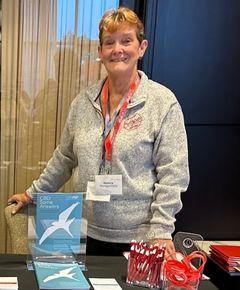


Want more?
Don't forget to subscribe! There are many ways to listen: Apple Podcasts, TuneIn (Amazon Echo), Spotify or RSS Feed. (Need help subscribing? See our quick guide.)
For all of our Substantial Matters podcast episodes, visit Parkinson.org/Podcast.
Related Materials
Related Blog Posts

Parkinson’s Foundation, with support from CVS Health Foundation, Launch New Courses to Educate Healthcare Professionals

Palliative Care and Hospice: 5 Tips for Advocating for Yourself and Your Loved One
