Episode 116: Caring for Loved Ones with Parkinson’s Disease
-
Dan Keller 0:02 Welcome to this episode of Substantial Matters: Life and Science of Parkinson's. I'm your host, Dan Keller, at the Parkinson's Foundation. We want all people with Parkinson's and their families to get the care and support they need. Better care starts with better research and leads to better lives. In this podcast series, we highlight the fruits of that research—the treatments and techniques that can help you live a better life now, as well as research that can bring a better tomorrow.
Care partners constantly adapt to new challenges when caring for a loved one with a chronic disease, especially as the disease progresses. As Parkinson's progresses, people with PD are less able to do things for themselves and often rely on care partners throughout their journey. They require more care, and caregiving requires more effort, time, and energy. Care partner emotional and physical health may suffer, and whatever impacts them and their ability to care for a loved one can be reflected in a decline in the well-being of the loved one, so addressing the needs of care partners is critical for both themselves and for the person with Parkinson's.
In honor of National Family Caregivers Month, I spoke with Dr. Jori Fleisher of Rush University Medical Center in Chicago, a Parkinson's Foundation Center of Excellence. She has been addressing the needs of people with PD and their care partners for some time. She and colleagues are in the process of developing a mentoring program to match care partner mentees with trained peer mentors. In this episode, she discusses some of the findings from a study of that program, how the program is being refined, and where the work goes from here.
I started our discussion by asking her what motivated her to first address care partner stress. Today's podcast is sponsored by Kyowa Kirin. Being a care partner can be a very taxing, tiring, and mentally and physically burdensome endeavor. So, what prompted you to conduct this research?
Dr. Jori Fleisher 2:35 So, I've been fortunate enough to be welcomed into the homes of so many people with Parkinson's and their families, as our team in New York and now in Chicago has been conducting several studies of interdisciplinary home visits. And it's one thing to see patients and families in the clinic and the office; it's really another thing to see how people live on a day-to-day basis and how their disease affects their day-to-day living and functioning.
And you really get such a sense of not only the relationship between, you know, the patient and their loved ones, their care partners, but sort of what the care partners are facing. It's one thing to say it's, you know, hard to help my loved one transfer from the bed to the bathroom, but to see the actual space in which that person is trying to lift their loved one, bend, you know, pivot, and stressing their own back, or you know, their bad knees, and trying to, you know, help someone along, it really puts so much in context, and that was really inspiring for us to want to do more.
Dan Keller 3:40 So in the research that you had presented at the neurology meeting and are following up on, what did the research entail and what were some of the highlights of the findings?
Dr. Jori Fleisher 3:52 So what we did was in the course of a study in which we identified 65 patient and caregiver partners—for each of these pairs or dyads, we visited them four times over the course of about 12 months. And we knew from our prior work that this was feasible, that this seemed to lead to pretty high patient and care partner satisfaction, that they were happy with getting care in their home, but we had found that caregiver strain was still getting worse, and so we wanted to do something more specifically for caregivers.
And so we identified and trained 34 experienced caregivers—so people whose loved ones had Parkinson's or related disorders, and really had been through it, had walked this journey with their loved one, and may still have been actively caregiving. And we kind of brought everyone up to speed, gave them a couple of lectures on Parkinson's, and taught them about how to be a mentor, how to listen to someone, how to engage someone who's really struggling, and we gave them a pretty straightforward handbook with kind of tips and some things to talk about.
And so for those 65 patient caregiver pairs, between the second and third home visit, we reminded the caregiver that, actually, you know, we've got some backup for you, and we connected them with one of these trained mentors. And so for 16 weeks between that second and third home visit, they had a call every week with their assigned mentor. And so, you know, this was a listening ear, a shoulder to cry on, someone to vent to, but someone who's been there.
And we looked to see whether this was feasible, for the most part—you know, is this something that people wanted, would they do it, would they stick with it, would they actually have these calls, were there people out there who wanted to be mentors—and then really sort of as an exploratory outcome to see, you know, could this make any dent in the caregivers' depression, anxiety, or caregiver strain?
Dan Keller 5:51 And what did you find?
Dr. Jori Fleisher 5:53 So we found very high satisfaction. So among mentors and mentees, satisfaction was about 91 out of a possible 100, that folks did actually do it. If we built it, they came, so they had an average of about 11 calls lasting about 30 minutes each over the course of the 16 weeks, and 85% of people said that this was useful. 98% said that they got along with their matched mentor or mentee.
We did not find any statistically significant changes in terms of depression or anxiety or caregiver strain, but we weren't really powered to do that, so we really thought of this as kind of a proof of concept of is this even wanted, would people be interested in it, and it turns out that they are.
Dan Keller 6:39 It sort of sounds like the formal measures may be less relevant than people's sort of open-ended reports and satisfaction.
Dr. Jori Fleisher 6:49 Absolutely. And so that's really what led us to take the next step, because the interesting thing was in this study that I just described, many caregivers signed on because this is a home visit study, and they really, they were in it for the home visits, which is great. That was, that was sort of the main focus of the study, but when it came time for the mentoring, you know, for some people, they were like, "Oh, yeah, absolutely, I remember, you know, I signed up for this, bring it on." For other caregivers, you know, they were sort of, "Sure, I'll talk to this person, I don't know who they are, but I'll give it a try." And other people really felt like, "No, I don't want to talk with someone about this. This is too personal. No one could possibly understand what I'm going through," you know. Some of the people opted out.
And so in the next step that we did, we said, you know what, let's look at this program on its own. So we just completed a new study with entirely new caregivers, where we trained new mentors, paired them up, and it was completely separate from clinical care. So, really, if you want caregiver mentoring, you know that what you're signing up for. And we are looking at those results now, but the qualitative feedback that we have gotten from both the mentors and the mentees has been just so overwhelmingly positive. "I wish I'd had someone like my mentee has now when I was going through this journey," or, "I didn't realize how alone I felt until I talked with someone who's validated everything that I'm going through." You know, and "I feel so much less lonely now," which, especially given the last year and a half that we've had, and how much social isolation has really affected our caregivers, this has really been kind of a lifeline for many people.
Dan Keller 8:31 Is there an advantage to having one-on-one mentor-mentee relationships as compared to say somebody just going to a support group?
Dr. Jori Fleisher 8:41 I think they're different and complementary. So we see all the time there are a lot of caregivers who might seem in clinic like they need more support, but they are adamant that they are not going to go to a support group. They don't want to go, they don't want to cry with a bunch of other people, even though that's not necessarily what a support group is. They don't feel comfortable being vulnerable or sharing personal details in a group setting, but a one-on-one where they can establish a relationship and establish trust and really have someone who is role modeling—you know, "Here's what I did in this situation," or giving them examples and really reinforcing, "You know, hey Bob, what you did there, you know, with your loved one, that was the right move. I went through that, and I wish I'd done what you did"—that one-on-one relationship really seems very powerful. So, I think there's some people that are going to want a support group, there's some people that are going to want just mentoring, there's some that will want both, and I think they bring different benefits.
Dan Keller 9:41 You had mentioned social isolation. So, is this research particularly novel or important now, especially since everybody has been experiencing social isolation with COVID? But I suppose if you are a full-time caregiver, it's even more acute.
Dr. Jori Fleisher 9:58 It is, and it isn't. And so one of the most heartbreaking things that I heard over and over again from so many of our care partners at the beginning of COVID was, "This is nothing new for us because we've been socially isolated because of my loved one's disease. This is our day-to-day." And so for some caregivers, particularly at the beginning, I think it was a little bit easier than it was for others, you know, to stay home and to stay away from people, because that was their life, as they, you know, they couldn't get out because their loved one needed 24-hour assistance.
Paralelly, I do think as time has gone on and the pandemic has really dragged on, and, you know, I think the level of social isolation really has affected everyone, and it's affected people living with the disease. You know, they can't get out to their exercise group, or they can't get out to physical therapy, or, you know, to their doctor's appointments as easily. And so everything really comes down to the care partner. You know, no one can go 24/7 every single day for the entire duration of this pandemic, so I think our caregivers are really facing just tremendous pressure that that we've never seen before, and anything we can do to support them is welcome and should be celebrated.
And there are a lot of different models, so caregiver mentoring has been looked at previously in Alzheimer's in the UK, and has been looked at in caregivers of individuals with cancer, and the programs have been structured differently, but I think you know in all of these different populations there's social isolation pre-COVID, and it's all been heightened since then.
Dan Keller 11:39 You'd also mentioned that a handbook went along with this program. Do you intend to make that widely available, or the program in general, if it all pans out?
Dr. Jori Fleisher 11:51 We do. So we took that very first handbook, which was maybe 40 pages, and when we moved into the second study that we just completed, we brought in new caregivers who'd never seen this before. We brought in some of our mentors and some of our mentees, did focus groups and said, "What is missing, what is helpful here, what is not helpful here, what do we need to cover more, you know, what resources do you want in here?" if we were to make some comprehensive guide, and we went from a 40-page book to an over 300-page book. We probably overshot the target. It is sort of a phone book, but we're working on that now, and hoping in the next iteration...
So the study that we're hoping to do will be a national randomized controlled trial of this, and depending on the results of that, you know, making sure that this handbook is helpful. Absolutely, we intend to make it public and shareable, because we've spent so much time, and our caregivers have given us so many of these resources, that it needs to be shared.
Dan Keller 12:53 Do you have a time frame in mind when this may reach maturity and be ready for a widespread rollout?
Dr. Jori Fleisher 13:01 We're analyzing now the second study, and so we're hoping to get some publications out within this next year, but also applying for larger NIH funding this fall. Depending on if it gets funded and when, that much, much larger study would hopefully be launched in probably late 2022, 2023. And so, you know, research frustratingly takes so long to do it right, but we hope that we are doing it right, considering things and really engaging our caregivers and our stakeholders every step along the way to make sure that what we turn out is going to be useful.
So in this bigger national study that we're proposing, number one, everything is doable remotely. So hopefully we will be long past COVID when any of this happens, but if you are a caregiver to a loved one and you are in, you know, remote Alaska, you can be part of this program. If you are, you know, urban, awesome, you can be part of this program. If you don't have a movement disorder specialist near you, that's okay. We will connect you. That's the goal of this next big study, and to be able to share those results, get people these resources, and really provide connection.
Dan Keller 14:16 Aside from people joining into this study, wherever they are, and waiting for the full results in a few years, do you have any practical advice now for care partners in terms of stress reduction, emotional fatigue, burnout?
Dr. Jori Fleisher 14:32 I think number one, recognizing that this is hard. Caregiving is hard, and if you feel like, you know, at the end of the day, you are worn out, and this has been hard work, you are right. And to do it day in and day out—give yourself some grace, and acknowledge that this is not meant to be a one-person thing, and that Parkinson's is hard for the person living with it, but also for everyone who's affected.
I always tell my patients, you know, Parkinson's doesn't affect just the person with the diagnosis; it has ripple effects out into the entire family and social circles. So, knowing that, build your team, reach out for help, and sometimes it can be really hard to ask for help, it can be hard to even know what kind of help to ask for, so you know, specific things. If your loved one has a doctor's appointment coming up on Tuesday, and you know you might get stuck in traffic, and you're going to be late home, and there's a neighbor who says, you know, "Hey, I'm here, you know, let me know how I can help," Monday night call and ask them, "Do you mind just ordering us dinner, or can you just, you know, can you send us a pizza Tuesday night? I know we're going to get home late. It'll be a long day, you know." Really tangible, simple things.
So many times people in the family, people in the extended community want to help, and they just don't know how. So finding really small, simple ways, you know—take something off of your list, take something off of your plate, and give it to someone who's waiting to help.
Dan Keller 16:03 Does Medicare or any other insurance cover some respite care, just so the caregiver can get a full day or a part of a day off, or something like that?
Dr. Jori Fleisher 16:15 It's such a great question, and it's such a needed support, and unfortunately, most of the time, no. If someone is receiving hospice services, then sometimes there is the ability to get very short-term respite care, but for the most part, for most families, you know, caregiving falls on an unpaid family member, which means that, you know, you're sort of losing... If that caregiver could be part of the workforce, you know, they're sort of giving up the wages that they could be bringing in, benefits, you know, and all that, to take that hit and to be there for their loved one.
And we don't have great caregiver systems in place in this country, so hiring someone, you know, is often out of pocket. Sometimes Medicare and insurance will cover some small portion of hours, but for most people that's an out-of-pocket expense. It's expensive. There are a lot of shortages right now in healthcare across the board, and that extends to home caregivers. So, it can be a really, really tough journey to, you know, know that you need help, and then try to identify sources of help, and to find, you know, folks who will be reliable and that you can count on.
Dan Keller 17:24 Have we missed anything important or interesting to add?
Dr. Jori Fleisher 17:28 I mean, I would say from an advocacy standpoint, there is work going on at the national level to try to support, to try to put in place better support networks for people living with chronic diseases and people needing caregiver support. So you know, call your congressperson, call your senator, and say we need to fix the system.
As more people get diagnosed with Parkinson's—we just passed the 1.2 million people with Parkinson's mark yesterday, just in the United States alone. As more people are diagnosed with Parkinson's, as people are getting older, the burden on caregivers is only going to grow. We need to do better. We need to do better for our loved ones with PD. We need to do better for our care partners.
As the flight attendants say, "Put your oxygen mask on yourself first before you help your neighbor," right? We need to make sure that we are resuscitating and revitalizing our care partners, so that they can wake up and do it, you know, the next day. So, take care of yourself, ask for help, and advocate to make this better.
Dan Keller 18:32 Great, thank you. Besides asking for help and taking up friends' and neighbors' offers to help, care partners can find resources and professionals for advice on managing well while caring for a loved one. A good place to start is right on our own website at parkinson.org. Search for caregiver resources, and you'll find helpful tips from other care partners, care partner courses, and expert briefings. There's also a support group guide, a playlist of YouTube videos, as well as videos from our Care Partner Summit.
In our library, you can find our free Caring and Coping book, which you can order online or download immediately. If you want to hear more about Jori's development of a home care program for advanced PD, we have a podcast called exactly that. There's also one discussing the Care Partner Summit, in which a care partner describes her emotional journey caring for her husband, and how resources helped her deal with changing situations.
And, of course, our helpline information specialists can provide more resources. As always, they are available to answer questions in English or Spanish about today's topic, or anything else having to do with Parkinson's. You can reach them at 1-800-4PD-INFO. News and updates about future events and resources are available by joining our email list at the bottom of our website's homepage.
If you want to leave feedback on this podcast or any other subject, you can do it at parkinson.org/feedback. If you enjoyed this podcast, be sure to subscribe and rate and review the series on Apple Podcasts or wherever you get your podcasts. At the Parkinson's Foundation, our mission is to help every person diagnosed with Parkinson's live the best possible life today. To that end, we'll be bringing you a new episode in this podcast series every other week. Till next time, for more information and resources, visit parkinson.org or call our toll-free helpline at 1-800-4PD-INFO, that's 1-800-473-4636. And thanks again to Kyowa Kirin for sponsoring today's podcast. Thank you for listening.
For many years, Western medicine focused on disease and on keeping people healthy. Then it evolved to view the “whole person,” including the physical, mental, emotional, social, and environmental aspects of one’s functioning. Today’s medicine goes even beyond that model and encompasses the family, especially care partners, who take on so much when caring for a loved one with a chronic disease.
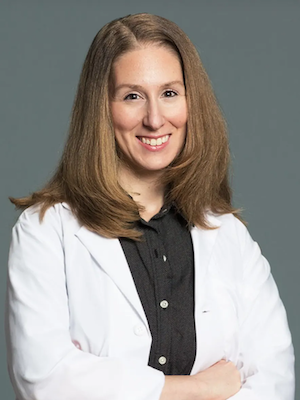
A leading voice in this area is Jori Fleisher, MD, MSCE of Rush University Medical Center in Chicago, who has been developing a peer mentoring program in Parkinson’s and related diseases. In a study she conducted using regularly scheduled home visits for people with advanced neurodegenerative diseases, the researchers found that caregivers’ strain increased from mild to moderate or even to severe over the course of one year. So now she is addressing caregiver needs through a peer mentoring program built into a home visit program, with a research component to it. After a period of training, peer mentors were matched with a mentee and eventually a second mentee over the course of a year. In this episode, Jori reviews what she and her colleagues have learned so far, how they are refining the program, and where they will go from here, including a large, national, randomized trial of the program.
Released: November 2, 2021
-
Jori Fleisher, MD MSCE is the Leslie Nan Burridge Endowed Faculty Scholar in Parkinson’s Disease Research and an Associate Professor of Neurological Sciences at Rush University Medical Center. She is a movement disorders neurologist who directs the Rush Lewy Body Dementia Association Research Center of Excellence, CurePSP Center of Care, and the Rush Advanced Interdisciplinary Movement Disorders Supportive Care Clinic. Dr. Fleisher received her Master’s of Science in Clinical Epidemiology from the University of Pennsylvania, where she completed neurology and global health equities residencies and movement disorders fellowship. Dr. Fleisher has additional training in health services research, palliative care, and implementation science. Supported by the National Institutes of Health, Parkinson’s Foundation, other foundations, and philanthropy, Dr. Fleisher has research underway focused on interdisciplinary home visits, telemedicine, interprofessional education, and peer mentoring to improve the lives of patients and families living with advanced movement disorders. Additionally, her team studies the physical, emotional, and social benefits of karate in people with Parkinson’s Disease. Dr. Fleisher is a graduate of the American Academy of Neurology Emerging Leaders Forum and Palatucci Advocacy and Leadership Forum, a member of the Lewy Body Dementia Association Scientific Advisory Committee, and a frequent speaker for local and national patient and healthcare professional educational events.

Want more?
Don't forget to subscribe! There are many ways to listen: Apple Podcasts, TuneIn (Amazon Echo), Spotify or RSS Feed. (Need help subscribing? See our quick guide.)
For all of our Substantial Matters podcast episodes, visit Parkinson.org/Podcast.
Related Materials
Related Blog Posts

3 Essential Resources for 3 Different Kinds of Care Partners

Advanced Parkinson’s Care: Practical Ways to Help Your Loved One
