Episode 52: Parkinson's Education Through Community Outreach
-
Dan Keller 0:08
Welcome to this episode of Substantial Matters: Life and Science of Parkinson's. I'm your host, Dan Keller. At the Parkinson's Foundation, we want all people with Parkinson's and their families to get the care and support they need. Better care starts with better research and leads to better lives. In this podcast series, we highlight the fruits of that research, the treatments and techniques that can help you live a better life now, as well as research that can bring a better tomorrow. Parkinson's disease affects people around the world. How to best provide care for and enhance the lives of people with Parkinson's is a particular challenge for countries with an aging population. Singapore, an island city-state at the southern tip of Indonesia, is one of them. Workers at the National Neuroscience Institute recognized that hospitals and nursing homes there could not handle the burden of Parkinson's care alone, nor would they be the best place for everyone with the disease. So they implemented three community outreach programs to directly serve people with PD and educate the healthcare community about the disease so they could provide the best care. When I was in Singapore, I had a chance to speak with Dr. Louis Tan of the Department of Neurology at the Neuroscience Institute. He told me about the three programs, how they work, and how the positive response to them has led them to expand the programs.Dr. Louis Tan 1:45
The first is what we call the Community Care Partners Program. The second is an Integrated Community Care Program, and the third is the Community Parkinson's Exercise Class that we have in the community.Dan Keller 1:59
Why don't we take them in order? The Community Care Partners Program—how does that work? What do you do?Dr. Louis Tan 2:05
So this program has been instituted for the last 10 years. It was actually initially started with some seed funding from what is now known as the Parkinson's Foundation, where we actually wanted to train people in the community. These are nonprofit organizations that provide care to patients in the community, mainly in, for example, daycare facilities or senior care facilities, where they look after the patient for half a day or one day, do therapy with them, do activities and exercises with them. And also community hospitals, like convalescent hospitals and nursing homes, where patients go there to recover from acute illness. So we felt that there was a need not just for hospital-based care, but for people or volunteers or even staff in these facilities to understand Parkinson's, to know more about how to better manage these patients, to know the unique features of these conditions that these patients face, the medications, the side effects, the complications, and the specific unique needs that these patients have. So the whole program was to educate. We conduct workshops. We have it at least two or three times a year. We have symposiums where we invite them to join us at a very low cost. We bring them for half a day or one day, or up to two-day programs where they get educated with hands-on, interactive workshops for them to just know how to better manage our Parkinson's patients in the community.Dan Keller 3:37
Do you have an estimate of how many people usually participate that you're training, and also how many sites participate?Dr. Louis Tan 3:44
So over the years, we have got almost more than 20 Community Care Partners already. And each time we have an attendance of about 30 to 40 staff from these centers who come for training. And these staff may be from nurses to therapists to therapy assistants or nursing aides, where they just come to be equipped on how to manage our patients.Dan Keller 4:47
What kind of reaction do you get from them?Dr. Louis Tan 4:47
Well, it's generally been very positive, because I think whatever we train them, they may be unique to Parkinson's, but often it's also relevant for a lot of the other patients that they see. So I think they appreciate it. They appreciate the need for them to be able to better manage these patients, especially since Singapore has a rapidly aging population. The numbers of patients with Parkinson's will just increase in the years to come, and we cannot really manage all of them in a hospital. So we are trying to move from a hospital-centric approach to a more community-centric approach to treating Parkinson's patients.Dan Keller 4:47
Another initiative you have is the Integrated Community Care Program. Who does this serve mostly?Dr. Louis Tan 4:54
So this is a program where we actually have community nurses that go into the homes of our patients to assess them and to integrate the care within the community. So we find that while the patients come to us and see us in the clinic, sometimes we don't have a full picture of their needs and how they're managing and functioning at home. Sometimes they may have problems. They may be staying alone. They may be staying alone with an elderly spouse, or sometimes in Singapore they are staying alone with a domestic helper. So we want to be able to go into the homes, and we are targeting those with a higher risk—so more advanced Parkinson's, those who are older, staying alone, risk of falls, more advanced stage—so that we can go into the homes to look at their needs and see what they need. And then from there do an assessment, and then bring in the relevant community carers to come in to help them. So this could be people who come in to befriend them, come in to provide meals, come in to help with daily needs of washing and bathing, or just tidying or just companionship. So these are the different things that we are looking at when we actually go into a person's home and when we do the assessment. But together with that also, we have also started to train the other community home care nurses specifically about how to manage Parkinson's patients. So as we know, Parkinson's patients are a unique population. They have specific needs. Their medications are quite specific. The carers or the nurses need to understand about wearing off, about dyskinesia, about the emotional needs, about blood pressure issues, the constipation issues. So these are specific complications that we train the nurses so that eventually when they visit a Parkinson's patient in the home, they can look out for this and hopefully prevent complications or pre-empt the complications before they even occur.Dan Keller 6:54
What about these exercise classes that you do in the community? How well are they attended, accepted, and do you see results?Dr. Louis Tan 7:02
Yeah, so this is a third initiative where we felt that we needed to have exercise classes that are closer to the people living with Parkinson's, closer to their homes. And we have programs working closely with our Parkinson's Society in Singapore, where they actually have many multiple classes through the week for people with Parkinson's to come and attend. And they do a one-hour exercise class once a week. And they are, of course, encouraged at home to do daily exercise as well, as we all know exercise is very important, and many of these individuals will need the support, and they find it good to be able to do it in a class situation where there is mutual support, motivation, and encouragement. And each of these people living with Parkinson's actually are stratified according to ability level, so that the more advanced ones come together, those who are more mobile also come together, and they are able to do things in accordance with their functional ability and do the exercises which are tailored for them. So this program has been so successful that we actually have moved it beyond our one center with the society to four other centers in partnership with another organization that is called the St. Luke’s ElderCare. And so we have satellite centers around the islands, and there are people who come once a week. Some are even requesting two times a week to come for the Parkinson's exercise classes. So I think this really has been a very successful initiative because it really helps the people with Parkinson's to get into active lifestyle, to do their best to remain active, and to hopefully keep functional even as they live with Parkinson's.Dan Keller 8:47
Are these mostly land-based? Or do you have any aquatic exercises?Dr. Louis Tan 8:51
Well, unfortunately, no. At the moment, it's mainly land-based, so it's a lot of walking. Even those who are not able to walk so well, we do it chair-based. But we also have equipment. So these are centers with full equipment, where they have machines, either treadmills or cycles and other strength equipment that they use as part of the exercise regimen.Dan Keller 9:15
So overall, in terms of community outreach, what's your advice or recommendation to other centers that do what you do, at least medically? But is there ways they can serve the community better?Dr. Louis Tan 9:30
Yeah, so I think we really believe that a person with Parkinson's, other than the medical aspects, there's many dimensions to it as well. So as I said, physical exercise and activity is important, and we can't do it just in the hospitals. It's best done in a facility that is closest to their home. We need to be able to provide constant support even in the community so that they have places to go to, and the places and facilities that they visit, the staff there need to know Parkinson's well enough to manage them so that the people with Parkinson's can have the confidence that when they go to a care facility, the staff there understand Parkinson's, they understand what they're going through, and are able to support them and help them and be able to manage them in the best way possible.Dan Keller 10:21
Very good. Thank you.Just as the Parkinson's Foundation Center of Excellence in Singapore provides community outreach and services, so do the ones based in the U.S. You can find a list of them on our website at parkinson.org/coe. You can also call our toll-free helpline to find them or to find other community outreach resources near you. And to see how specific ethnic or other communities are being served through outreach, you can listen to some of our other podcasts in this series, such as numbers 11, 12, 39, and 45. The Parkinson's Foundation has recently launched a similar educational model through its first Aware in Care Ambassador pilot program. This volunteer group is organized to help distribute Aware in Care kits, a tool designed to improve outcomes of people with Parkinson's disease in the hospital. The group distributes the kits to both the Parkinson's community and healthcare providers, and works with hospitals to change the policies that put their Parkinson's patients at a high risk of serious complications that could be avoided. To learn more about this program and how you can help educate others on Parkinson's disease, visit parkinson.org/awareincare. As always, PD information specialists are available on our helpline. They can answer questions and provide information about this topic or anything else having to do with Parkinson's. You can reach them at 1-800-4PD-INFO. If you have any questions about the topics discussed today, or if you want to leave feedback on this podcast or any other subject, you can do it at parkinson.org/feedback. At the Parkinson's Foundation, our mission is to help every person diagnosed with Parkinson's live the best possible life today. To that end, we'll be bringing you a new episode in this podcast series every other week. Till then, for more information and resources, visit parkinson.org or call our toll-free helpline at 1-800-4PD-INFO, that's 1-800-473-4636. Thank you for listening.
Parkinson’s disease affects people around the world, so societies in different countries manage it according to their own circumstances. Singapore, a modern, prosperous southeast Asian country, has a rapidly aging population, and thus, an increasing need to provide services to people with Parkinson’s, which occurs mainly in older individuals. Workers at the National Neuroscience Institute in Singapore, a Parkinson’s Foundation Center of Excellence, recognized that hospitals and nursing homes cannot handle the impending health care burden themselves and have therefore designed and implemented three community outreach programs to serve people with PD and to educate health care workers how best to serve this population. Dr. Louis Tan of the Department of Neurology describes these programs, how people respond to them, and alliances they have made with other organizations.
Released: April 9, 2019
-
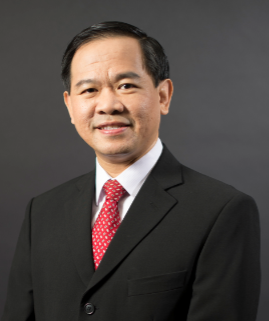
Dr. Louis Tan is a Senior Consultant Neurologist and Deputy Director, Research at the Singapore National Neuroscience Institute, a Parkinson’s Foundation Center of Excellence. He is also Co-Director of its Parkinson’s Disease and Movement Disorders Centre (TTSH campus) and an Adjunct Associate Professor of Duke-NUS Graduate Medical School, Singapore.
He is Treasurer-elect of the International Parkinson and Movement Disorder Society and previously served as Chair of the Education committee and Asian-Oceanian Section of the Society.
Upon graduating from the National University of Singapore and completing his neurology training at Tan Tock Seng Hospital, he underwent a movement disorders fellowship at the Parkinson’s Institute in Sunnyvale, California. His areas of specialty and research interests are Parkinson’s disease and movement disorders. He is also interested in the interested in the epidemiology, clinical studies and clinical trials in Parkinson’s disease and other movement disorders.

Want more?
Don't forget to subscribe! There are many ways to listen: Apple Podcasts, TuneIn (Amazon Echo), Spotify or RSS Feed. (Need help subscribing? See our quick guide.)
For all of our Substantial Matters podcast episodes, visit Parkinson.org/Podcast.