Episode 29: Home Care Program for Advanced PD
-
Dan Keller 00:00
Welcome to this episode of Substantial Matters: Life and Science of Parkinson's. I'm your host, Dan Keller. At the Parkinson's Foundation, we want all people with Parkinson's and their families to get the care and support they need. Better care starts with better research and leads to better lives. In this podcast series, we highlight the fruits of that research, the treatments and techniques that can help you live a better life now, as well as research that can bring a better tomorrow. People experiencing the early and middle stages of Parkinson's disease can see their movement disorders neurologists and care team on a regular basis in office or clinic settings, but once they have advanced PD, it can be difficult for them to get out. At a conference last year, we spoke with Dr. Jori Fleisher, now at Rush University in Chicago, who helped develop the Edmund J. Safra interdisciplinary home visit program when she was at New York University. She explains the impetus for the program, how it works, and what it can accomplish.Dr. Jori Fleisher 01:20
As the disease progresses, the number of symptoms increases, the severity of those symptoms increases, and you reach this terrible paradox where just when our patients need us the most and our caregivers need us the most, it becomes really difficult, if not impossible, to actually get to the clinic. So if you've been lucky enough to access care and get connected to the care that you need, you then lose it when you need it the most. And so we developed this program, and it really was the brainchild of my boss in our center before I arrived there, to really take this care where we wrap our arms around our patients and families and go to them. If they can't come to us, why should they be estranged from care? We will go to you, and we will wrap our arms around you and provide you with what you need. What we do is we have a team of movement disorders neurologists, which is either myself or one of our fellows, and our social worker who runs our program and a nurse, and we go together as a team to the homes of our patients across all five boroughs of New York. So if they've been seen in our center and they meet Medicare criteria for being homebound, which is actually fairly loose—it just means you have to have trouble getting out of your house. Getting out of your house needs to require a considerable, taxing effort, and you need the assistance of either a device or another person to help you—and you have Parkinson's or something like it. So we see people with Parkinson's-related conditions. We go to your home, if you'll have us, on a quarterly basis and do everything that we would normally do in a visit. So we ask all of the usual questions. We do all of the physical exam. We make you do the tapping and the standing and the pulling backwards and the walking back and forth. But we also ask, you know, what does your support network look like? We don't just ask how your medicines are working and whether protein is interacting with your meals, but we actually ask you, are you eating? How are you getting food? Is there food in your refrigerator? Can we help you with that? And if there's not, we'll connect you to Meals on Wheels. You know, if someone can't get out of the home to do physical therapy, we know how important exercise is, we will refer you to in-home physical therapy or occupational therapy. If you're falling out of bed and you need bed rails, we've got support groups that we can connect our patients to, but especially our caregivers, because really, the care partners—they're sort of the lever in this—is if you can get that care partner supported, you know, it doesn't matter in some cases how bad the person's symptoms are. If that caregiver feels like they can handle it and they're doing well, that patient's going to do well, and they're going to age in place, at home, safely, where they want to be for as long as possible. So we really sort of bring everything to bear medically that we can from the nursing perspective, from social work. We really tap into a ton of community resources to support our patients 100%.Dan Keller 03:53
I guess the question is always, is it reimbursed? Or how do you do this economically?Dr. Jori Fleisher 03:58
So that's a great question. And right now, it's through grant funding from the Edmund J. Safra Foundation, from support from the Parkinson's Foundation and Parkinson's Alliance. So currently, we're not billing for any of this. It is entirely complimentary to our patients. Clearly, there needs to be a business model and a way to support this. And one of the things that we've looked into is if we cost out how much this all is—and we don't look at any outcomes—but we just say, okay, this is a costly thing to do. The neurologist time is probably the most costly portion of this. So one thing we've looked into incorporating, and have been successful at so far, is bringing in telemedicine. So lately, since February, from a grant through the Parkinson's Alliance, we've been able to send our nurse and our social worker out into the field. So they go to the home with an iPad that's equipped and is HIPAA-compliant, so it's safe, it's not hackable, and they phone in to me, and I'm in my office. And so while we're having the visit, I'm seeing and interacting with the patient and the caregiver directly. I'm also documenting into the electronic medical record, writing their note, writing their orders for whatever medications they might need, drafting a letter that then goes out to their referring neurologist, their primary care doctor, their PT, their OT, whoever is on their team, to keep everyone in the loop. And so we're trying to use our time as efficiently as possible. I think as things evolve and as the state of telemedicine gets better, and as more programs are showing efficacy, we really need to advocate at the national level for telemedicine to be reimbursed in these kinds of situations. Right now, it's reimbursed in certain limited situations, but this is absolutely an area where we need it. There's great work that's been going on in telemedicine and Parkinson's disease, but no one has really looked at populations this elderly and this sick. So we see almost 100 patients. We've done nearly 300 visits, and we have a small study just of a subset of those. And what we found is this is probably the oldest and the sickest group of Parkinson's patients that will have ever been reported, and they're very different from the patients that have been seen in other telemedicine projects. It's a sicker group. And so you have to really keep that in mind when you're coming up with a telemedicine approach. It's really difficult for these patients to log on to a computer the way that someone who's maybe 10 or 15 years younger or doesn't have dementia or doesn't have hallucinations would. Sending a lot of equipment to them is a burden. So we've thought about a lot of different strategies, and we had a really cool sort of iPad stand that I could manipulate and turn, and if someone had dyskinesias and moved out of view from the camera, I could wirelessly change it so that it followed them. And we learned, after a very few visits, that that really was not okay with our patients, and it really freaked them out. And so there's a lot of great technology out there that doesn't all apply, so coming up with a really sensitive and strategic way to do this, and then figuring out ways that insurance companies will allow for billing of it and recognize that this is not as good as regular outpatient care, you know, and potentially better—that this is actually cost-saving. So we're looking right now at utilization of preventative healthcare measures.Dan Keller 07:36
If other communities wanted to emulate this sort of thing, what's the best way to begin, ignoring, I guess, the lack of reimbursement at this point?Dr. Jori Fleisher 07:47
I think building your team is the most important thing first. You need to have a really strong team that has exceptional Parkinson's expertise across all these different disciplines. As the physician, I think I have the very least to offer out of the three of us. It's our nurse and our social worker who do the bulk of this, and I think that's why our patients are doing as well as they are. It's because of the community resources that our social worker knows about and is able to connect people to. It's the supportive counseling that she's able to offer them, and it's a lot of what our nurse does. So we look at medications, we actually sit there and we comb through the medicines and say, this is a duplicate, this is expired, you're not supposed to be on this. And we walk through the home and figure out, you know, what's unsafe. So finding a team of people that have that knowledge and really getting the team to work together—figuring out how you are going to do this, who is going to talk first, what step you are doing next—building that team and that expertise, and knowing what's available in your community, I think is huge. And then I can promise that if you build it, they will come. We opened up this program and said, okay, refer people that you think might need help, and we are at capacity. It's really skyrocketed, and we've had people whose families have reached out to us where they're seeing someone else—they're not within the NYU system—but they've found out about us online and reached out and just said, we need you. Can you please come to our home? And so I think it's definitely needed. It's the care that any of us would want for ourselves or our parents or our families if they were struggling at home.Dan Keller 09:19
Are these patients and families finding you by word of mouth, other people who are in the program like it enough to be passing the word?Dr. Jori Fleisher 09:27
Some are. The majority comes from referrals from our providers. So at NYU, our movement disorder center is the Marlene and Paolo Fresco Institute for Parkinson's and Movement Disorders. So there are five neurologists, and we draw our patients from them. So they identify patients that they think are at risk of hospitalizations or having frequent falls or missing appointments. There's a concern that we're not getting the full picture, and we're really concerned about these patients, and so that's how most patients get to us. But certainly there have been some that have come externally, that have found out about us online and reached out that way. But also all of the patients that we've seen—we thought, okay, maybe some people will want to graduate out of the program—but the vast majority of people have wanted to continue receiving visits. I think that argues that satisfaction is pretty high.Dr. Jori Fleisher 10:55
Where do you go next? That's a great question. We're doing several different things. So we're just wrapping up our initial study. So even though we've seen almost 100 patients, when we launched, we did a small sub-study looking at just those individuals who had idiopathic Parkinson's disease—so garden-variety Parkinson's disease—and did not have cognitive impairment at the time that we were seeing them, which is a small subset of our patients. But the hypothesis was maybe with a year in this program, we can stabilize or somehow mitigate how quickly quality of life declines in this very sick population. And what we found, to our surprise, was yes, this is a very old population, this is a very disabled population, and their Parkinson's does worsen over the course of that year. But despite that, their quality of life improved or stabilized in seven out of eight domains that we looked at, which was shocking to us and gives us a tremendous amount of cautious optimism.Dan Keller 13:20
Anything important to add?Dr. Jori Fleisher 13:23
We're looking at resource utilization. We're hoping to quantify what exactly this costs, how we can make this scalable, and whether there are other ways to add in telemedicine. We think this could be a model that other centers of excellence and other places around the country and perhaps around the world could use when the model is tweaked. We know that there's tremendous disparity in accessing care early on in the disease, but especially maintaining care and preserving access for those who need it the most—that's where we really need to focus.Dan Keller 13:58
Great. Thank you.Dan Keller 14:09
To find out the best ways to access care at all stages of PD, you can call our toll-free helpline to speak with our PD Information Specialists. They can answer questions and provide information about this topic or anything else having to do with Parkinson's. You can reach them at 1-800-4PD-INFO. If you have any questions about the topics discussed today, or if you want to leave feedback on this podcast or any other subject, you can do it at parkinson.org/feedback. At the Parkinson's Foundation, our mission is to help every person diagnosed with Parkinson's live the best possible life today. To that end, we'll be bringing you a new episode in this podcast series every other week. Until then, for more information and resources, visit parkinson.org or call our toll-free helpline at 1-800-4PD-INFO—that's 1-800-473-4636. Thank you for listening.
Medical professionals have a lot to offer people in the early and middle stages of Parkinson’s disease. People with PD can visit their teams of doctors, nurses, social workers, and other health professionals on a regular basis in an office or clinic setting. A problem can arise, however, when determining how to best help people in the more advanced stages of the disease, when they develop more symptoms of greater severity and have limited mobility. Dr. Jori Fleisher of the Rush University Medical Center Movement Disorders Program in Chicago, a Parkinson’s Foundation Center of Excellence, helped develop a home visit program to address this issue when she was at New York University Medical Center. The Edmond J. Safra Interdisciplinary Home Visit Program brings a multidisciplinary team of health professionals to the homes of people with PD when they need care the most.
Released: May 22, 2018
-
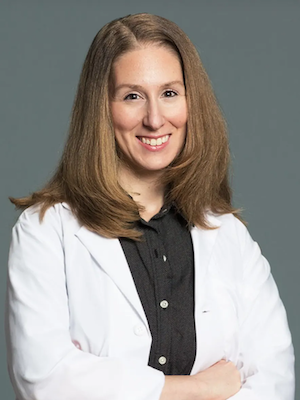
Dr. Jori Fleisher is a movement disorders fellowship-trained neurologist and health services researcher with a special interest in understanding the needs of individuals and families living with advanced Parkinson’s Disease and related disorders, and designing new models of care to better serve this population. After three years on the faculty at New York University, Dr. Fleisher joined the Rush University Medical Center Parkinson’s Disease and Movement Disorders Program in 2017, where she sees patients and conducts research. Supported by the National Institutes of Health and CurePSP, Dr. Fleisher has several new research studies focused on interdisciplinary home visits and caregiver peer mentoring to improve the lives of patients and families living with these conditions. Dr. Fleisher has been recognized as an Emerging Leader and outstanding patient advocate by the American Academy of Neurology.

Want more?
Don't forget to subscribe! There are many ways to listen: Apple Podcasts, TuneIn (Amazon Echo), Spotify or RSS Feed. (Need help subscribing? See our quick guide.)
For all of our Substantial Matters podcast episodes, visit Parkinson.org/Podcast.