Episode 25: Meet the High School Student Who Is Changing Parkinson's Disease Diagnosis
-
Dan Keller 00:00
Welcome to this episode of Substantial Matters: Life and Science of Parkinson's. I'm your host, Dan Keller. At the Parkinson's Foundation, we want all people with Parkinson's and their families to get the care and support they need. Better care starts with better research and leads to better lives. In this podcast series, we highlight the fruits of that research, the treatments and techniques that can help you live a better life now, as well as research that can bring a better tomorrow. There is no single test or scan that can confirm a Parkinson's diagnosis, but high school student Erin Smith is working on a program that could make early detection easier. Her technology, called FacePrint, is a non-invasive, inexpensive system that can help diagnose the disease. Based on analysis of facial expressions, a camera captures the muscle movements underlying the expressions, digitizes these movements, and analyzes them using software she is developing. Erin describes how she came up with the idea.Erin Smith 01:19
So about two years ago, when I was a sophomore in high school, I was watching a video by the Michael J. Fox Foundation, and I noticed that whenever Michael J. Fox or another Parkinson's patient would smile or laugh with one another, it came off as very emotionally distant. And as I started interacting with other Parkinson's patients and talking to local caretakers and clinicians, they reported similar observations in their loved ones, even years before diagnosis. Then, as I started looking through past medical papers, I found that essentially the parts of the brain that experience some of the earliest changes in Parkinson's patients are really glanced over in terms of current clinical criteria. They are the same parts of the brain responsible for spontaneous and posed facial expressions. I was very curious to see if I could quantify and capture these changes to provide an external manifestation of early internal neurological pathology.Dan Keller 02:12
What does the system consist of? How does it look at them? How does it interpret what's going on?Erin Smith 02:17
How the system currently works is, there's two different types of tests that I have Parkinson's and then non-Parkinson's patients go through. And so essentially, the first test is where they watch a series of commercials or really engaging videos that are designed to elicit certain spontaneous facial reactions. And then the second tests are where patients are deliberately making a certain type of facial expression. So they're shown an emoji, and then they replicate the expression that the emoji displays. And so from there, I take the footage and I break it down frame by frame using readily available facial recognition software, and then from there I take that data, and I've been able to mine through the data and identify a series of biomarkers that differentiate the Parkinson's and non-Parkinson's patients. And then from there, I run the responses through a series of machine learning algorithms that essentially mine through the data and then determine, based off of facial responses, whether or not somebody is showing early signs of Parkinson's.Dan Keller 03:22
So the biomarkers that you're looking at are just muscle movements as expressed on the face.Erin Smith 03:28
Yeah. So the biomarkers are really behavioral biomarkers, meaning they are differences in certain facial muscle contractions or the way that facial muscles move. So it's not so much the expression, but it's more so the different movements that make up the expression.Dan Keller 03:46
Is it only the muscles that control these expressions that are affected, or is there actually an underlying difference in the emotion? Do you know?Erin Smith 03:57
So that's something that's really fascinating—the question of whether or not there's a difference in the emotions, or whether or not it's solely based off of the facial muscle movements that are used to convey these emotions. And so that's something that's largely unknown currently with past research. So that's something that I've been looking at, and I'm really interested moving forward to do more research that specifically looks at exactly what is different. Is it the emotional responses, or is it merely how the emotions are conveyed? Or is it even separate from that and more of the actual muscles and movements themselves? But that's largely unknown currently.Dan Keller 04:33
How many people have you validated this on, both healthy people as controls and also people in various stages with Parkinson's?Erin Smith 04:42
So far, I've been able to work with 265 patients composed of Parkinson's patients and then healthy control counterparts. And so from this, we've been able to see really robust findings already, with an accuracy of almost 88%. But essentially what I'm working on doing right now is scaling up data collection. So as we continue to collect data from Parkinson's and healthy control patients, and other patients with diseases that are commonly misclassified as Parkinson's disease, we can really scale up the amount of data we have available and use that to develop more robust algorithms and then also validate the algorithms I've already developed.Dan Keller 05:19
So it sounds like one aim would be able to differentiate between Parkinson's disease itself and parkinsonism, which is caused by various things—drugs and other conditions—and even maybe essential tremor.Erin Smith 05:34
Yes, absolutely. So I've been looking at right now specifically Parkinson's disease and essential tremor, but really the potential application would grow, and there's a lot of other potential applications as well.Dan Keller 05:47
Have you tried to see if it works with various races or various ethnic groups?Erin Smith 05:53
Yeah, absolutely. So that's something that's been really huge, is making sure that the data that I collect is representative of the entire spectrum of people with Parkinson's disease. So one thing that I've really had to specifically work on is making sure that we have women and people of all different races included in the data collection process, really because males have a higher incidence of Parkinson's disease. So we just want to make sure that people who still do have Parkinson's disease but who just aren't as well represented in terms of the number of cases are still present in the training data, so we can still capture their responses. So that's like a really big focus of this research, actually.Dan Keller 06:33
Do you have enough data to be able to calculate sensitivity and specificity? Sensitivity being the ability to detect it when it is there, and specificity being the ability not to detect it if someone doesn't have Parkinson's.Erin Smith 06:49
Yes. So currently, the sensitivity and specificity for the algorithms are about 87% and 91%. So those numbers—I'm really focused on improving them more, and that will be possible as we collect more responses and really fine-tune the algorithms and also develop other algorithms that can capture responses.Dan Keller 07:09
How early in the disease do you think it may be able to pick up some of these cues?Erin Smith 07:15
Yeah, so that's something that's really interesting, because if you talk to different clinicians or different caretakers, or if you even start looking through photos of people even years before they have the onset of resting tremor or other symptoms that we typically associate with Parkinson's disease, you can start to subjectively see some of these differences. So for example, Michael J. Fox is a really interesting case, just because you have different movies that he was in years before his diagnosis as well. And so if the algorithms are able to capture at these early stages, then that will be a really powerful application and hopefully open up options to test and develop novel therapeutics. So another really big priority of this research is to find people who are at risk of Parkinson's disease and then continuously monitor them, so then we can see, before diagnosis, were we able to capture these changes and just quantify and validate the subjective observations.Dan Keller 08:12
I suppose longitudinal studies like you just described would take quite a while to maybe look at high-risk people, because they may actually develop Parkinson's more than the general population, but if you're looking in the general population, where a lot of Parkinson's does occur, then you might have to follow people for a long time to see which ones do develop it.Erin Smith 08:34
No, absolutely. So that's something that it's definitely a really exciting opportunity, but then there's also so many different factors that go along with it and complicate it, for sure.Dan Keller 08:46
And I suppose the ultimate goal would be to have drugs that you could actually intervene and slow down the progression or prevent it if you found it very early. But at this point, it doesn't seem to be on the horizon or immediate horizon, let's say.Erin Smith 08:59
Yeah, absolutely, but essentially just doing everything that we can right now to start creating the path to test and develop therapeutics, and also everything we can do now to start identifying objective indicators of disease onset, which will ultimately hopefully lead to a cure.Dan Keller 09:16
Do what you find change with treatment, or is it always apparent the treatment doesn't affect these expressions?Erin Smith 09:24
So that's actually a very interesting question that I'm starting a few studies this upcoming year that will specifically look more into that, because essentially something that may be different is the medications people are taking, and also if different facial movements can indicate on and off times of medication. So that's something that as I'm rolling out more studies and scaling up data collection, I'm also collecting responses about medication and about their in-patient on and off periods, and then how that relates to the facial biomarkers as well.Dan Keller 09:58
Do you see this having applications in other conditions, maybe multiple sclerosis, depression, autism, PTSD, or traumatic brain injury or concussion? It seems like the field is wide open for these kinds of things.Erin Smith 10:15
Yeah. So something that is really fascinating is essentially there are certain parts of the brain that are really involved in the formation of certain facial expressions. So essentially, any disease that has changes in these certain parts of the brain could be manifested by certain facial expressions. Certain diseases such as PTSD or depression—you can see certain subjective observations that people make about the way their emotions come off or the way that they make certain facial expressions. And so essentially, if we can capture those changes, it will help us not only detect and monitor these diseases, but will also provide really powerful insights into early-stage changes that are occurring in the brain. So the door is really wide open in terms of other neurological or neurodegenerative diseases that may have similar facial biomarkers.Dan Keller 11:06
Is it ready for clinical use now, or if not, when do you foresee that it may actually be put into practice?Erin Smith 11:14
I want to continue to collect patient responses, just to really ensure that the algorithms that I currently have are able to provide a robust way to capture disease onset. And so after I complete my next study, which will essentially be increasing the scope of patients that are involved in the data collection process, then it will be ready to be rolled out to clinics. But along the way, I've really maintained a relationship with certain clinicians and caretakers to ensure that, as this technology is being developed, it's being developed into something that will be useful in a clinical setting.Dan Keller 11:52
Could it be used remotely? Could you actually just have people in their homes going through something and then analyzing the data in a central location?Erin Smith 12:02
Yeah, yeah. So something that's really interesting about this is that currently, the entire data collection process is actually entirely remote. So it's just a website that you go to, and it walks you through the questionnaire and then the data collection process. And so similarly, this tool could be used remotely. So one potential application would be as a monitoring tool, where people who are at risk of Parkinson's disease, or who have Parkinson's disease, could continuously go through these tests periodically, and then their data and responses could be remotely shared back with a clinician. So basically, a really powerful feedback loop between the patient and the clinicians that would enable personalized treatments or provide more invaluable data to the clinician on a day-to-day or weekly basis, which is currently a big limitation in healthcare.Dan Keller 12:55
Have you patented the system, or do you intend to, or can you?Erin Smith 12:59
It actually has a patent. So I filed my provisional not last summer, but the summer before, and then this past school year, I was able to file my full utility patent.Dan Keller 13:12
What do you want to do next?Erin Smith 13:14
I'm a senior in high school this year, so I am still midway through my college application process. I recently got an acceptance to Stanford, so I'm really interested in going there and then continuing my research and developing the interests that I've developed here in high school, and really combining my interest in healthcare and entrepreneurship and creating technology that bridges the gap between developing healthcare solutions in a laboratory setting and then commercializing those. So I'm really interested in the intersection of computer science and neuroscience, and personalized medicine.Dan Keller 13:55
I really appreciate it. Thanks a lot.Dan Keller 14:06
Erin's work has already been recognized by a variety of media and has won her several science prizes, including ones from the National Center for Women and Technology, the International BioGENEius Challenge, and Google. As she continues to refine her facial recognition system for Parkinson's, Erin is looking for more people to analyze, with the hope of leading to even greater accuracy. If you would like to participate, visit parkinson.org/faceprint for more information. If you have any questions about the topics discussed today, or if you want to leave feedback on this podcast or any other subject, you can do it at parkinson.org/feedback. At the Parkinson's Foundation, our mission is to help every person diagnosed with Parkinson's live the best possible life today. To that end, we'll be bringing you a new episode in this podcast series every other week. Until then, for more information and resources, visit parkinson.org or call our toll-free helpline at 1-800-4PD-INFO—that's 1-800-473-4636. Thank you for listening.
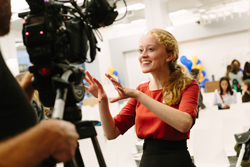
There is no single, definitive test for Parkinson’s disease (PD). The diagnosis is made by an expert clinician who asks questions about a person’s health and medical history and observes their movement. But an enterprising high school student is working on a system that analyzes movements of facial muscles to make an early diagnosis and track Parkinson’s progression. Erin Smith of Shawnee Mission West High School in the Kansas City, Kansas area adapted a real-time facial expression recognition system to detect “facial masking,” a common Parkinson’s symptom caused by stiff facial muscles. Her system, called FacePrint, uses a web camera or smartphone to analyze facial movements and compare them to a database of people with and without Parkinson’s.
Released: March 27, 2018
-
Ms. Smith is the founder of FacePrint, a novel, telemedicine diagnostic tool for Parkinson’s disease. FacePrint uses facial recognition software and machine learning algorithms to detect early-stage differences in facial muscle movements. FacePrint has won numerous awards, including first prize in the Twitter #BUILTBYGIRLS Challenge. Her work has been featured in Forbes, Fortune and Seventeen Magazine. Ms. Smith has won top awards for her research at several international science competitions, including the Intel International Science and Engineering Fair and the International BioGENEius Challenge. She loves participating in hackathons and is the co-founder of KC STEMinists, which teaches middle and high school students how to use computer science to address societal issues. Ms. Smith is a senior at Shawnee Mission High School near Kansas City, Kansas. As she pursues higher education and beyond, she wants to continue to develop innovative healthcare technologies by combining her interests in neuroscience and computer science, transforming the way diseases are diagnosed and treated.

Want more?
Don't forget to subscribe! There are many ways to listen: Apple Podcasts, TuneIn (Amazon Echo), Spotify or RSS Feed. (Need help subscribing? See our quick guide.)
For all of our Substantial Matters podcast episodes, visit Parkinson.org/Podcast.