## Breadcrumb
- [Home](/)
- [Resources & Support](/resources-support)
- [For Professionals](/resources-support/professionals)
- [Our Care Strategy](/resources-support/professionals/our-care-strategy)
## Breadcrumb
- [Home](/)
- [Resources & Support](/resources-support)
- [For Professionals](/resources-support/professionals)
- [Our Care Strategy](/resources-support/professionals/our-care-strategy)
# Hospital Care Initiative
## 💡 Quick Summary
- The Parkinson’s Foundation is committed to [leading the national effort](/resources-support/professionals/our-care-strategy/hospital-care-initiative#publications "Hospital Care Initiative") to improve hospital care for people with Parkinson’s through systemic changes in policy, technology, culture and education.
- Critical tools and resources, created by the Parkinson’s Foundation, are available to improve safety for hospitalized patients with Parkinson’s.
- Health systems can partner with the Parkinson’s Foundation to start, expand or study the impact of quality improvement projects focused on improving hospital safety for people with PD through the [Learning Collaborative](/resources-support/professionals/our-care-strategy/hospital-care-initiative#learningcollab "Hospital Care Initiative").
- The Parkinson’s Foundation [Hospital Care Standards](/resources-support/professionals/our-care-strategy/hospital-care-initiative#standards "Hospital Care Initiative") are aligned with the CMS Age-Friendly Hospital Measure for ease of implementation.
 The Parkinson’s Foundation Hospital Care Initiative aims to eliminate preventable harm and promote higher reliability in care for people with Parkinson’s disease (PD) in the hospital.
When people with Parkinson’s receive quality Parkinson’s care, they can better manage their PD symptoms —and maximize quality of life. The Parkinson’s Foundation provides best-practice care training, the latest PD information and access to educational tools for doctors, nurses and every member of the health care team.
## Hospital Care Initiative
### The Problem
Each year more than **[300,000 people with Parkinson’s disease](/library/fact-sheets/hospital-care "Parkinson's Hospital Care Infographic")** receive hospital care in the U.S. Whether unexpected or planned, a hospital visit puts a person with PD at significant risk of avoidable complications that can lead to longer hospital stays, more severe PD symptoms, and increased costs. We estimate that every year, **1 in 6 people with Parkinson’s will experience avoidable complications in the hospital**, often related to issues with medication management, mobility and dysphagia.
### How We Are Addressing It
The Parkinson’s Foundation is committed to leading the national effort to improve hospital care through systemic changes in policy, technology, culture and education. **Our Hospital Care Initiative aims to eliminate preventable harm and promote higher reliability in care for people with Parkinson’s in the hospital.** Through this initiative, we develop critical tools and resources for patients and providers.
### Parkinson’s Foundation Hospital Care Recommendations
Building on our **[Making Hospitals Safer for People with Parkinson’s](/sites/default/files/documents/hospital-care-report-2022.pdf "hospital-care-report-2022.pdf")** report, the **Parkinson’s Foundation Hospital Care Recommendations** outline five standards of care to improve hospital safety and tools to facilitate their implementation. The standards were created in partnership with Hackensack Meridian Health, Henry Ford Health, and the University of Florida Health Norman Fixel Institute for Neurological Diseases, with support from Dr. Peter Pronovost and Manatt Health.
[**DOWNLOAD HOSPITAL CARE RECOMMENDATIONS**](/sites/default/files/documents/hospital-care-recommendations-april2023.pdf "hospital-care-recommendations-april2023")
### Care Standards
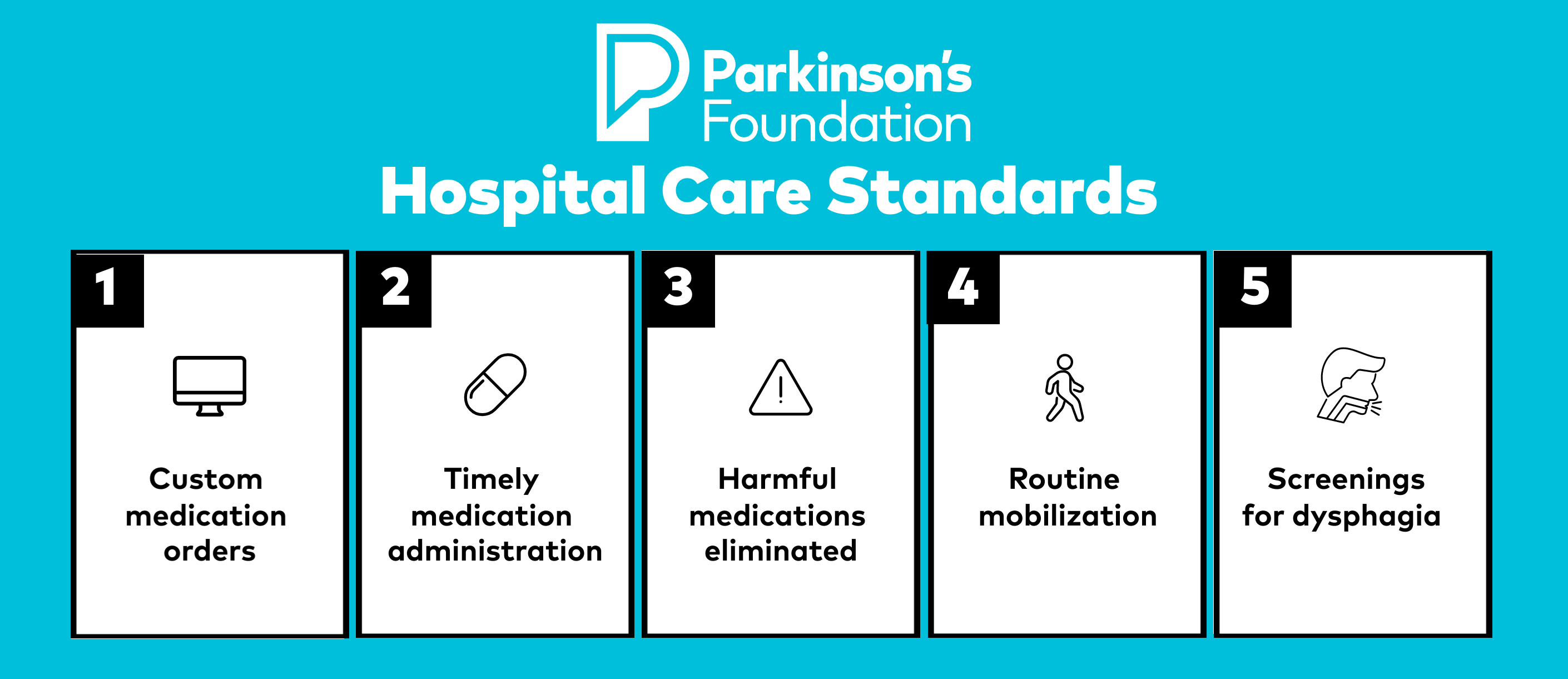 - ### 1. Custom medication orders
All Parkinson’s medications are ordered in a custom fashion, according to patients’ at-home regimen.
**Why it matters:** Ordering medications in a custom fashion allows clinicians to provide exact timing on the order that reflects the at-home schedule of people with Parkinson’s. This is essential given the short half-lives of many dopaminergic medications and the potentially severe complications caused by deviations in schedules and doses.
- ### 2. Timely medication administration
All Parkinson’s medications are administered within 15 minutes of patients’ at home regimen, 100% of the time.
**Why it matters:** Delivering medication on time every time is essential to preventing harm to people with Parkinson’s, whose symptoms are tightly managed via prescribed patient schedules. There is no defined medication administration window to prevent worse outcomes, but they can appear when medications are delivered early or late by 30–60 minutes, so a more rigorous 15-minute standard for medication administration timeliness must be established to prevent clinical harm.
- ### 3. Harmful medications eliminated
Potentially harmful medication events are eliminated, particularly in dopamine-blocking medications, agents for pain, and sedatives.
**Why it matters:** Certain routine and normally benign medications can worsen Parkinson’s symptoms due to their interaction with Parkinson’s medications and the Parkinson’s disease process. Haloperidol, metoclopramide, and prochlorperazine are among the most important contraindicated medications to avoid in the care of people with Parkinson’s to prevent harm. [View our list of contraindicated medications.](/sites/default/files/documents/hospital-care-fact-sheet.pdf "hospital-care-fact-sheet.pdf")
- ### 4. Routine mobilization
All people with Parkinson’s should mobilize three times a day if clinically appropriate and under professional supervision if necessary.
**Why it matters:** Limited movement in people with Parkinson’s can make motor symptoms like festination, freezing, and rigidity more pronounced, which increases fall risk. Early mobilization and effective rehabilitation strategies can reduce movement limitations, decrease fall risk, and prevent secondary complications associated with hospitalization.
- ### 5. Screenings for dysphagia
All people with Parkinson’s should undergo screening for dysphagia within 24 hours of admittance, with measures taken to minimize the risk of aspiration pneumonia, as needed.
**Why it matters:** Oropharyngeal dysphagia is common among people with Parkinson’s (80%), yet many people with Parkinson’s are not aware they have it (33%). Screening can ensure providers and people with Parkinson’s are aware of risks related to swallowing. It is equally imperative that providers recognize the role that medication management plays in aspiration prevention, even when dysphagia is identified. Careful consideration of alternative medication delivery must be part of standard Parkinson’s hospital care.
## Promoting the Hospital Care Standards
There is growing consensus on effective and sustainable solutions that hospitals can implement to prevent harm among Parkinson’s disease patients. The Parkinson’s Foundation continues to prioritize disseminating Hospital Care Standards through publications, partnerships and awareness initiatives.
We also aim to align our work with the *[Age-Friendly 4Ms Framework](https://www.johnahartford.org/grants-strategy/current-strategies/age-friendly/age-friendly-health-systems-initiative)* and [the ](https://www.johnahartford.org/resources/view/cms-guidance-on-the-age-friendly-hospital-measure)*[CMS Age-Friendly Hospital Measure](https://www.johnahartford.org/resources/view/cms-guidance-on-the-age-friendly-hospital-measure).* Implementing the Parkinson’s Foundation Hospital Care Standards can help you meet your Age-Friendly goals.
### Age-Friendly Hospital Care for people with Parkinson’s
Hospitals participating in Medicare’s Hospital Inpatient Quality Reporting Program must now attest to having processes that comply with the 4Ms Framework Age-Friendly Care or risk a 29% reduction of their Medicare payment update.
Since nearly 75% of people with Parkinson’s are 65 or older, and the root causes of harm for Parkinson’s patients align with the 4Ms Framework, health systems can address the 4Ms - what Matters to patients, Medication, Mobility, and Mentation – while implementing the Parkinson’s Foundation Hospital Care Standards.
- [Read the Article](https://doi.org/10.1016/j.jcjq.2025.09.005)
- [Listen to the Podcast](/library/podcast/188 "Episode 188: Improving Safety and Parkinson’s Care in the Hospital")
- [Use the Toolkit](/sites/default/files/documents/PD-Emergency-Department-Toolkit-0326.pdf "PD-Emergency-Department-Toolkit-0326.pdf")
## Parkinson’s Foundation Hospital Care Learning Collaborative
Through the Hospital Care Learning Collaborative, the Parkinson’s Foundation took a significant step toward its vision to eliminate preventable harm and promote more reliable care for people with Parkinson’s in the hospital.
This peer-learning group brings together clinicians and leaders from hospitals, emergency departments and health systems who are working in their institutions to implement quality improvement projects focused on improving hospital safety for people with PD.
The Learning Collaborative welcomes a wide range of disciplines and roles, including physicians, nurses, administrators, quality leaders, pharmacists, researchers, physical/occupational therapists, speech language pathologists, informaticists and more. We encourage hospital-wide and system-wide participation to optimize learning and impact.
More than 50 healthcare systems are now part of the Hospital Care Learning Collaborative, up from 20 systems since our 2023 launch.
To learn more about starting a quality improvement project focused on improving hospital safety for people with PD at your institution and joining a future cohort, email [**Hospitalcare@Parkinson.org**](mailto:Hospitalcare@Parkinson.org).
- [**Learn More About Hospitalizations**](/living-with-parkinsons/care-programs/hospitalization "Hospitalization")
- [**View Hospital Care Resources for Patients**](/resources-support/hospital-safety-guide "Hospital Safety Guide")
### Parkinson's Disease in the Emergency Department Toolkit
This toolkit is a digital resource for Emergency Department (ED) clinicians. Developed by the Parkinson's Foundation in partnership with the Geriatric Emergency Department Collaborative, it highlights three Parkinson's Foundation Hospital Care Standards, providing tools, case studies and how-to guides to help streamline implementation of three interventions shown to improve care for people with PD in the ED.
[Download now](https://www.parkinson.org/sites/default/files/documents/PD-Emergency-Department-Toolkit-0326.pdf)
## Projects That Are Generating Evidence
The Foundation’s Hospital Care Initiative is evidence based and evidence generating. We are driving research that clearly demonstrates the impact of inadequate care in the hospital and builds expert consensus around best practices in harm prevention.
### Demonstrating the Harm
These projects help us better define where and how frequently hospital care is falling short of our recommended standards and how it negatively impacts outcomes for people with Parkinson’s. Examples include:
- In partnership with Cleveland Clinic, we analyzed outcomes of hospitalized patients with Parkinson’s before a specific care intervention was implemented.
- **Key Finding:** Approximately 60% of Parkinson’s patients received less than their prescribed daily dose of PD medications during at least one day of a hospital stay. This was associated with increased poor 30-day outcomes and increased risk of death within 90 days.
- **Key Finding:** Approximately 12% of Parkinson’s patients received at least one dose of a medication contraindicated with PD during a hospital stay. This was associated with twice the average length of stay and twice the risk of death within 90 days.
- In partnership with University of Florida, we analyzed more than 321,000 hospitalizations of people with Parkinson’s to understand frequent challenges faced in hospitals across the country.
- **Key Finding:** UTI significantly prolonged length of stay (LOS) for people with PD and was independently associated with delirium for people with PD.
### Creating Solutions
These projects bring together experts to define ways to address systemic failures in how hospital care is provided to people with Parkinson’s. When defined well, these solutions can be replicated in other hospitals and health systems. For example:
- The [Parkinson’s Foundation Hospital Care Benchmarking Toolkit](/sites/default/files/documents/Hospital-Care-Benchmarking-Toolkit-2026.pdf "Hospital-Care-Benchmarking-Toolkit-2026.pdf") supports benchmarking, quality improvement, research, and shared learning aimed at improving hospital care for people with Parkinson's disease.
- Get started by downloading the [Parkinson’s Foundation Hospital Care Benchmarking Toolkit Quick Start Guide](/sites/default/files/documents/Hospital-Care-Benchmarking-Toolkit-QuickStart.pdf "Hospital-Care-Benchmarking-Toolkit-QuickStart.pdf").
- When you are ready to assess Parkinson’s care in your health system, download the [Parkinson’s Foundation Hospital Care Benchmarking Toolkit](/sites/default/files/documents/Hospital-Care-Benchmarking-Toolkit-2026.pdf "Hospital-Care-Benchmarking-Toolkit-2026.pdf").
- For Epic sites, a version of the toolkit with instructions on using the Epic SlicerDicer self-service tool available on the [Epic Userweb](https://userweb.epic.com/Thread/150327/Now-Available-Parkinsons-Foundation-Hospital-Care-Benchmarki/).
- In partnership with clinicians’ subject matter experts, including members of the Parkinson’s community, the Parkinson’s Foundation defined expert recommendations for how to identify and manage acute dysphagia in the inpatient setting.
### Measuring the Impact of Interventions
These projects compare the health outcomes of people with Parkinson’s in the hospital before and after solutions are implemented to measure the impact and effectiveness of the interventions. For example:
- In partnership with Cleveland Clinic, the Parkinson’s Foundation assessed the impact of an intervention designed to minimize medication errors and improve outcomes for hospitalized people with Parkinson’s.
- In partnership with University Hospitals Health Systems in Northeast Ohio, the Parkinson's Foundation found that people with PD who were mobilized in the hospital at least three times daily had a shorter length of stay and were more likely to be discharged home.
- ### Parkinson’s Foundation Hospital Care Publications
The list below includes Parkinson’s Foundation led or supported research publications, completed in collaboration with our hospital care partner:
- [Frequency and outcome of PEG tube implantations in hospitalized Parkinson's disease patients](https://doi.org/10.1016/j.parkreldis.2026.108921) (2026)
- [Morbidity, mortality, facility placement and cost of deep brain stimulation for Parkinson’s disease](https://doi.org/10.1038/s41531-026-01445-1) (2026)
- [Machine learning prediction of discharge destination in patients with Parkinson’s disease; a nationwide cohort study](https://doi.org/10.1038/s41531-026-01309-8) (2026)
- [Urinary Tract Infections in Hospitalized Patients with Parkinson's Disease: Risk Factors and Outcomes](https://movementdisorders.onlinelibrary.wiley.com/doi/10.1002/mdc3.70556) (2026)
- [Advancing Parkinson’s Care and Patient Safety Through CMS’s Age-Friendly Hospital Measure](https://doi.org/10.1016/j.jcjq.2025.09.005) (2025)
- [Consensus expert recommendations for management of dysphagia during hospital admission in Parkinson’s disease](https://doi.org/10.1177/1877718x251410503) (2025)
- [A Systematic Review of the Parkinson's Foundation Hospital Care Recommendations](https://movementdisorders.onlinelibrary.wiley.com/doi/10.1002/mdc3.70247) (2025)
- [Impact of an Inpatient Mobility Program on Outcomes in Parkinson’s Disease](https://linkinghub.elsevier.com/retrieve/pii/S1353802025005759) (2025)
- [A Partnership to Improve Hospital Care for Patients with Parkinson’s Disease](https://www.epicshare.org/share-and-learn/parkinsons-guidance-in-epic) (2025)
- [From Queasy to Rigid - an Amendment on the Administration of Contraindicated Antiemetics in Hospitalized People with Parkinson’s Disease](https://www.sciencedirect.com/science/article/abs/pii/S1353802025005231) (2025)
- [Improving recognition and management of inpatient delirium in Parkinson’s disease: evidence review and implications for clinical care](https://doi.org/10.3389/fnagi.2025.1693827) (2025)
- [Protecting Parkinson’s Patients: Hospital Care Standards to Avoid Preventable Harm](https://www.sciencedirect.com/science/article/abs/pii/S1553725024002587?via%3Dihub) (2024)
- [Need to Systematically Identify and Mitigate Risks Upon Hospitalization for Patients with Chronic Health Conditions](https://qualitysafety.bmj.com/content/33/11/755.info) (2024)
- [Standardizing Default Electronic Health Record Tools to Improve Safety for Hospitalized Patients with Parkinson’s Disease](https://www.frontiersin.org/journals/aging-neuroscience/articles/10.3389/fnagi.2023.1278322/full) (2024)
- [Establishing a Framework for Quality of Inpatient Care for Parkinson’s Disease: A Study on Inpatient Medication Administration](https://doi.org/10.1016/j.parkreldis.2023.105491) (2023)
### Find Local Support
Find your nearest Parkinson's Foundation chapter for local events, support groups, care facilities and more.
10 Miles 25 Miles 50 Miles 100 Miles 250 Miles
### Order a Parkinson’s Hospital Safety Guide
The Hospital Safety Guide is a resource for people with Parkinson's and their care partners filled with useful tools and information to prepare for and navigate a hospital stay.
[ORDER NOW](/resources-support/pd-library/order-publications)
[LEARN MORE](/resources-support/hospital-safety-guide)
- Share on Facebook
- Share on X
- Share on LinkedIn